A Responsive Persona
Everyday Willingness
A person who is open to their community, attuned to their environment and has a positive trusting attitude finds themselves always, consciously and unconsciously, in a state of willingness.
Situations or expectations may develop that call for a response on polite or humane grounds at any time. If you provide a response promptly and appropriately, you will be described as «».
Responsiveness may lead you into genuine and often serious involvements: the proposed vehicle for willingness.
If is consistently generated, it comes to be part of a your social self or «». This is a specialized version of the public persona (PH'6Q4sHK) described as part of .
The two key features of a are:
- efforts that are generated with full willingness;
- constancy of fully willing attention to the person and/or group.
The is the field within which a is the operating vehicle.
 Responsiveness in the Taxonomy
Generating the Tree
The to be developed and examined in this section is the third and final element in a structural hierarchy triplet.
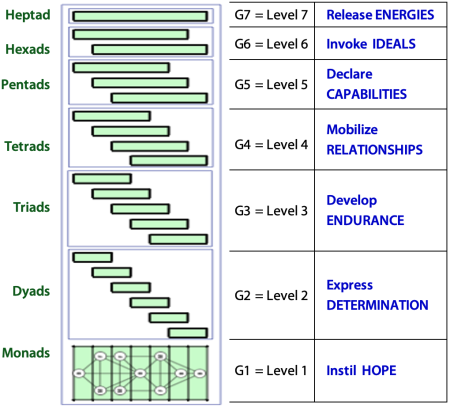
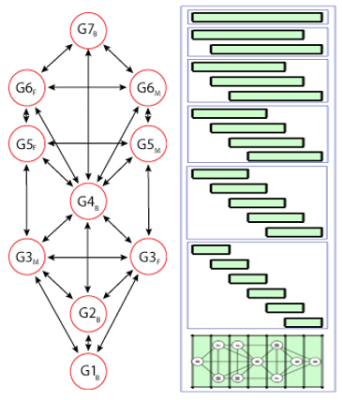
The top row of Requirements in any structural hierarchy creates this final Tree, which means that, diagrammatically, the structural hierarchy is turned on its side. The requirements for attempting the impossible (PsH7) are shown in the diagram below.
|
|
Because each Level contains groups and has its own dynamic, labelling of the G-based Centres may need slight adjustments.
Determining the Internal Duality
In the triplet, the originating Tree that captured determinants of had an internal duality as follows:
courageous involvement v genuine commitment .
The lower part of the internal duality of the would therefore be expected to be: genuine commitment—if it follows the pattern discovered for Domain Fundamentals and subsequently found to be appropriate elsewhere.
In studying the Tree according to this pattern, the upper part has been provisionally labeled: .
Organising the Inquiry
Dynamic Duality
Trees reflect dynamic functioning in the world-as-it-is, and therefore need to incorporate both personal pressures from preferences and self-interest and also practical pressures and social constraints. These are modeled by a dynamic duality.
Application of the dynamic duality to each hierarchical level converts it into one or two Centres depending on how the two pressures interact. When there are two polarized centres in a level, one will be more dominant.
Determining the Channels
Having clarified the Centres at each of the levels, there are several ways to analyse Channels of influence between them. The method chosen here is similar to that used for creating a better communual existence, bringing goodness to life, and elsewhere.
The analysis to follow will therefore proceed via the following steps:
Step-1: Responsiveness requires a base in a local group or network:
which requires a channel crossing 3 levels.
Step-2: Responsiveness must stabilize oneself and efforts:
which is provided by channels crossing 2 levels.
Step-3: Responsiveness can then be integrated into the group:
which uses channels crossing 1 level.
Step-4: Responsiveness must finally become dependable:
which results from channels linking personally and socially controlled Centres in the 3 bipolar levels.
Although the Tree pattern is now well-established in THEE, it is necessary to carefully check and confirm the expected channels, and be confident that other potential channels cannot or should not be activated.
Psychosocial Pressures
As Levels in this Tree are derived from Groupings in the Structural Hierarchy, they will likely have the 1° and/or 2° psychosocial pressures that were allocated in the previous section. However, this feature requires further investigation.
Trees are also posited to have the pressures in standard order i.e. G1 or KL1 = RL1, G2 or KL2 = RL2 etc as explained here.
The Tree pattern can now be investigated step by step starting with:
Originally posted: 5-July-2026