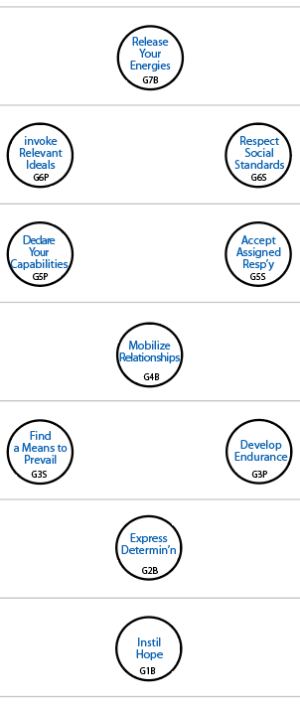
Generation of Centres

The Tension

The goal here is to appreciate the dynamics of responsiveness in the world-as-it-is. That means recognizing the tension that immediately arises in situations where we must choose whether or not to respond.

As well as personal intentions and interests, it is essential to deal with practical pressures and social constraints that are likely to affect responding. These are modeled using a dynamic duality, which states that functioning of any grouping/level may be governed in three distinct ways: 

  • personal or individual perspectives and forces, essentially self-based, labeled P.
  • social or milieu perspectives and forces, essentially impersonal,
    labeled S.
  • a synthesis or fusion of personal and social that cannot be disentangled—leading to a balance and labeled B.

Application of a dynamic duality to any Level converts it either into one balanced Centre or two polarized Centres. When there are two centres, as a matter of convention, the more dominant one in practice is placed on the right side of the Tree.

Applying the Duality

G1/L1: Hope
Instil Hope is a single balanced CentreG1B
ClosedWhy?

Your hope cannot be controlled by another or a group regardless of your view. Nor is it possible to instil hope in others if you yourself do not possess hope. If you just created a hope that others wanted to hear, you would lack conviction. If that hope were solely your own position and not potentially within others, then it would be rejected as unreal or unreasonable. The two perspectives are unavoidably entangled and fused.

G2/L2Determination
Express Determination is a single balanced CentreG2B
ClosedWhy?

Determination is something that will be controlled by you, but what you express determination about is a function of the social milieu. Circumstances can call for determination, for example in the form of commitment or perseverance, but on their own they cannot force this response. Handling depends on you. So the two perspectives are entangled.

G3/L3Endurance
Endurance is polarized with two different Centres named:

Develop Endurance-G3P
Find a Means to Prevail-G3S

ClosedWhy?

Endurance is a personal state, an attitudinal adjustment towards the world, that is fully under your control. It is about a readiness to withstand whatever may occur. This is a general disposition. However, the milieu controls what has to be overcome and forces you to respond in some way with the aim of prevailing, which may or may not succeed. This is a specific focused activity.

Dominance: The two Centres naturally affect each other, but endurance (G3P) must persist and continue whether or not efforts to prevail (G3S) succeed. So developing endurance is dominant and placed on the right in the Tree.

G4/L4: Relationships
Mobilize Relationships is a single balanced CentreG4B
ClosedWhy

You must play a major role in developing and activating relationships, but this cannot occur without the social milieu providing opportunities to relate. While others must actively desire to be in a relationship with you, their presence does not require or force a relation. So each perspective needs the other: the two are entangled.

G5/L5: Capabilities
Capabilities is polarized with two different Centres named:

Accept Assigned Responsibility-G5S
Declare Your Capabilities-G5P

ClosedWhy?

Becoming fully aware of the varied capabilities that you can bring to bear and stating them is purely a matter for you and not determined by the milieu. However, social bodies in the milieu can create a role and assign responsibilities that it expects you to handle given your known abilities. If it does align with some of your capabilities, all you can do is accept that responsibility. If you refuse, that would not be responsive!.

Dominance: The social situation is one where any assigned responsibility (G5S) is public and generates expectations. Acceptance must take preference over declaring capabilities (G5P) that you might prefer to use but which others may have less interest in. So G5S is dominant and placed on the right in the Tree.

G6/L6: Ideals
Ideals is polarized with two different Centres named:

Invoke Relevant Ideals-G6P
Respect Social Standards-G6S

ClosedWhy?

Values are applied in any activity and different situations will activate different ideals. Identifying and upholding relevant ideals is fully under your control. However, in all social situations there will also be standards relating to how to behave and the quality of contributions. These are governed by conventions and other ethical rules and applied independently of your personally preferred ideals and views. Breach of such standards brings a person into disrepute, so they must be recognized and respected.

Dominance: The communal verdict governs whether invoked ideals (G6P) are appropriate and count in regard to social acceptability and excellence. So respecting standards (G6S) is dominant and placed on the right in the Tree.

G7/L7: Energies
Release Energies is a single balanced CentreG7B
ClosedWhy?

Your release of energies is something that you can and must control. However, such release has no meaning apart from a specific challenging situation. That situation is a milieu factor that cannot independently force you to release energies. So the two perspectives are entangled.