Fundamental Structural Hierarchies
PsH6: Realizing Values
Background
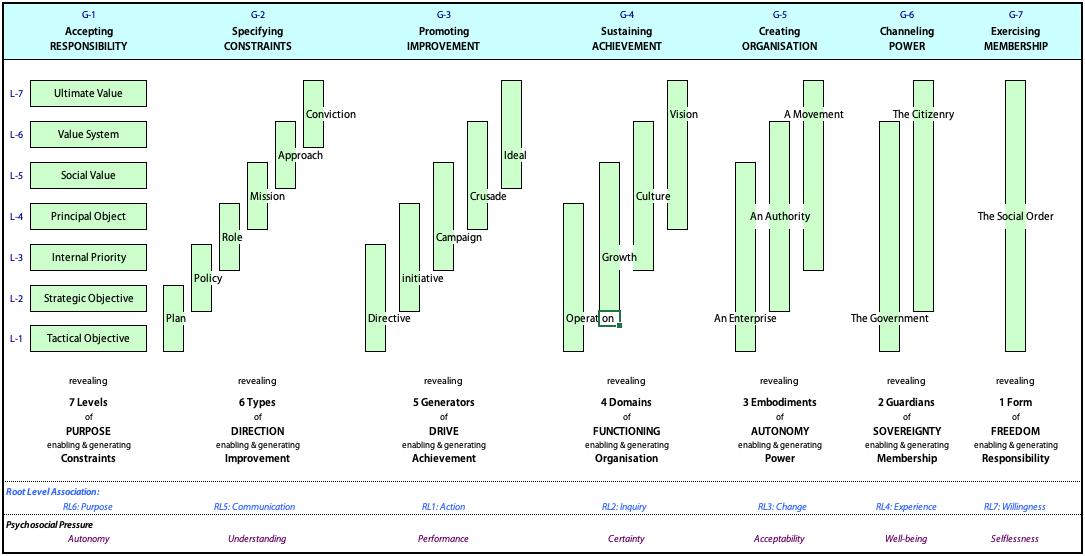
The Purpose Domain is where the structural hierarchy form was first discovered and developed in the 1980s. Its details are to be found in Ch. 10 and Ch.12 of Working with Values (1995).
The thumbnail at right can be used as a constant reminder of the framework.
Note: 
The requirement groupings are:
There is also an oscillating duality that has not been formally developed:
Odd-numbered groupings: individually-dominated and differentiating.
Even-numbered groupings: socially-dominated and integrating.
As each grouping is considered in the section below, the goal is to focus down on a possible sharp alteration in the focus, not to collect all evidence or summarize all findings. In each case, a relevant Master-Table from Working with Values is provided. For full details, download Ch. 10 and Ch.12.
Check Each Grouping
The Duality
From this review-based investigation, it appears that requirements in are either individually activated or socially demonstrated. «Individually» is used rather than «personally» to accommodate artificial bodies with a social identity, like formal organisations.
The A BB AA BB pattern discovered in is therefore confirmed in , but the phrases that suited , private and public, while not wholly inappropriate, do not adequately capture the phenomena.
This analysis means that the pattern, whose taxonomic significance and function remain to be determined, extends beyond the spiral-derived class of structural hierarchies.
PsH7: Attempting the Impossible
Background
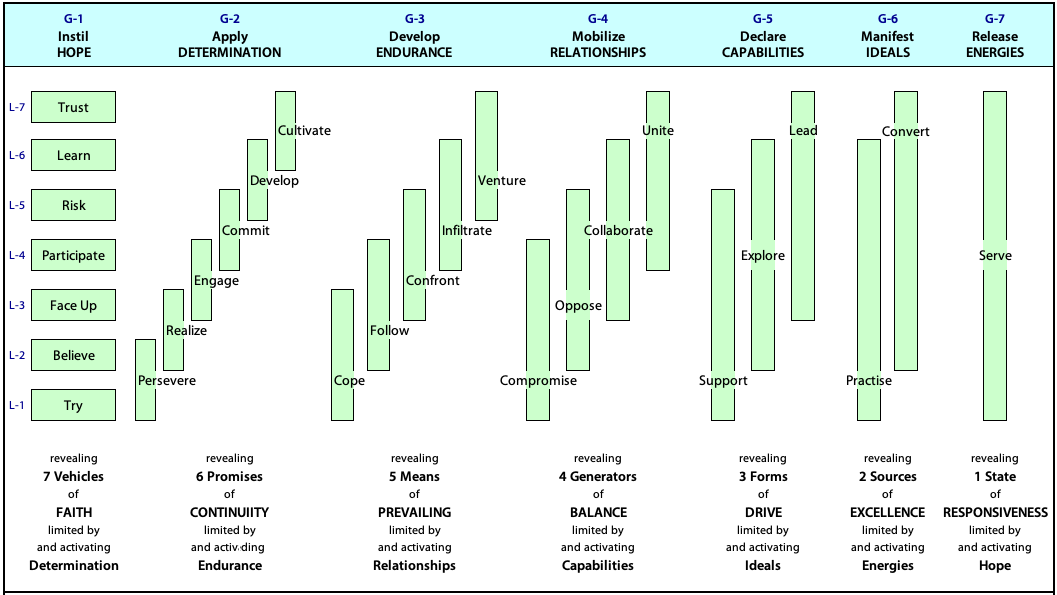
The fundamental structural hierarchy in the Willingness Domain is the most recently developed.
The thumbnail at right can be used as a constant reminder of the framework.
The requirement groupings are:
The oscillating duality is:
Odd-numbered groupings: assertion directed outwards and operating independently
Even-numbered groupings: assertion directed inwards and requiring social confirmation.
As each grouping is considered in the section, the goal is to focus down on a possible sharp alteration in the focus, not to collect all evidence or summarize all findings. In each case, links are provided to the relevant topics to enable a check on the conclusion reached.
Check Each Grouping
The Duality
From the above, it appears that requirements in are either personally activated or socially demonstrated.
The A BB AA BB pattern—discovered in , confirmed in other Spiral-derived structural hierarchies and in —is here further confirmed in . The phrases that suited , private and public, while not wholly inappropriate, do not adequately capture the phenomena.
The presence of the pattern in a second fundamental structural hierarchy suggests that it will apply in all Primary Domains. A further check below in the Root Domain is likely to be positive ... but let us see.
RsH: Creativity in Endeavours
Background
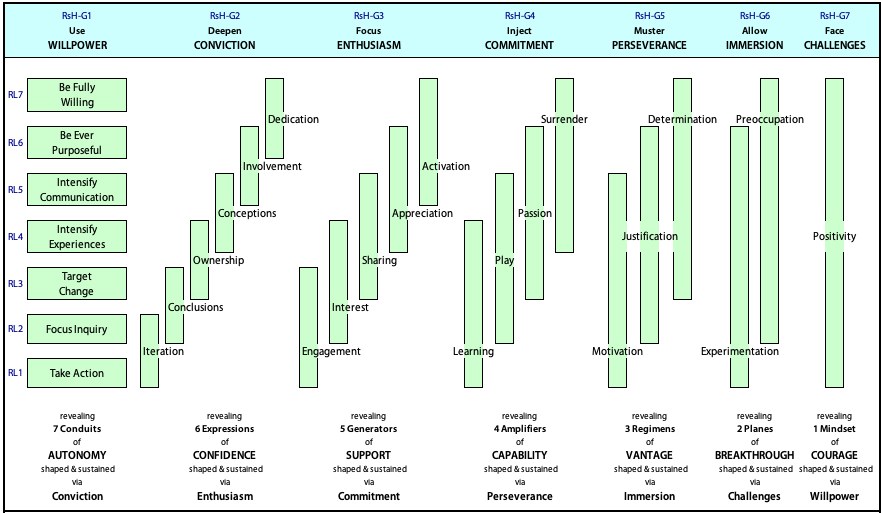
The Root Domain of generates a , and that leads to the .
The thumbnail at right can be used as a reminder of the framework.
The requirement groupings are:
The oscillating duality is complex:
Odd-numbered groupings use an inner-focus for experiences with an outer-focus for products.
Even-numbered groupings use an outer-focus for experiences with an inner-focus for products.
As each grouping is considered in the section, the goal is to focus down on a possible sharp alteration in the focus, not to collect all evidence or summarize all findings. In each case, links are provided to the relevant topics to enable a check on the conclusion reached.
Check Each Grouping
The pattern has now been shown to extend to the fundamental structural hierarchies in the Primary and Root Domains.
-
Continue by investigating Tertiary Structural Hierarchies.
Originally posted: 6-Nov-2026.