Q-complex Frameworks

PH'5Q2CsH-Organising Management

Background
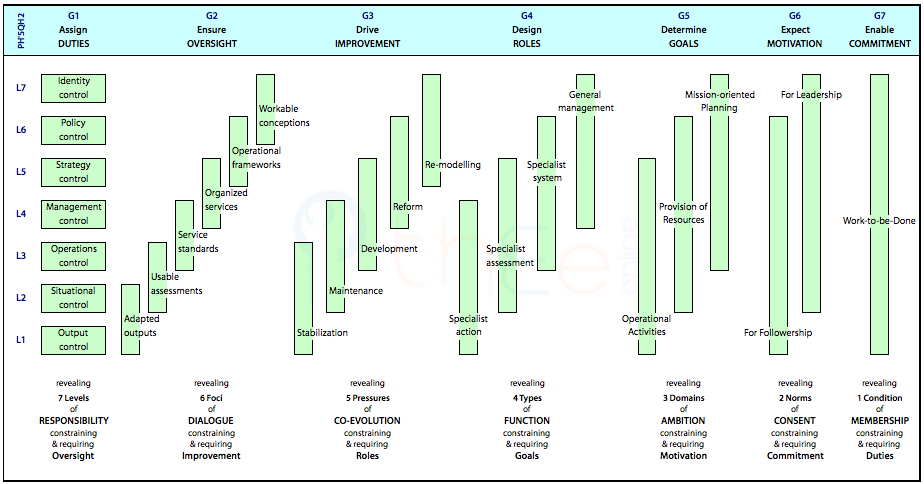
This organising management framework emerged from the very earliest studies of levels of work in organisations based on the discoveries of Elliot Jaques.

The thumbnail at right can be used as a constant reminder of the framework.

The requirement groupings are:

QG1:  Assign Duties
QG2:  Ensure Oversight
QG3:  Drive Improvement
QG4:  Design Roles
QG5: Determine Goals
QG6: Expect Motivation
QG7: Enable Commitment

The oscillating duality here has been identified as:

Odd-numbered groupings primarily involve management initiation.
Even-numbered groupings primarily involve management accommodation.

As each grouping is considered in turn below, the goal is to focus down on a possible sharp alteration in the focus, not to collect all evidence or summarize all findings. In each case, links are provided to the relevant topics to enable a check on the conclusion reached.

ClosedCheck Each Grouping

QG1:  Assign Duties

This requirement must be personally vested because while duties are assigned by management, they are only realized when a person owns the responsibility.

Details.

QG2:  Ensure Oversight

This requirement must be relationally enabled because it cannot exist without dialogue based on both top-down authority and guidance and bottom-up information and feedback.

Details.

QG3:  Drive Improvement

This requirement must be relationally enabled because it involves a top level driving the change, a middle level designing a feasible program and a bottom level implementing within the operational reality.

Details.

QG4:  Design Roles

This requirement must be personally vested because functions only become effective when particular roles are occupied by people with the relevant competence who can carry responsibility for that type of function.

Details.

QG5: Determine Goals

This requirement must be personally vested because goals get determined by individuals in particular roles. Consensus is then developed around these goals.

Details.

QG6: Expect Motivation

This requirement must be relationally enabled because while motivation is a personal matter, the expectations are developed within the organization by both superiors and subordinates, and motivation manifests through interactions.

Details.

QG7: Enable Commitment

This requirement must be relationally enabled because the organization must create the social conditions through which personal commitment becomes possible and sustainable.

Details.

The Duality

From this review-based investigation, it appears that requirements in organising management are either personally vested or relationally enabled.

The A BB AA BB pattern as discovered in PH'3CsH and confirmed in structural hierarchies found with fundamental and control complexes, also appears in this Q-complex.

The phrases that suited clarifying compatibility, private and public, while not wholly inappropriate, do not adequately capture the phenomena.


PH'5Q4CsH-Shaping Institutional Evolution

Background
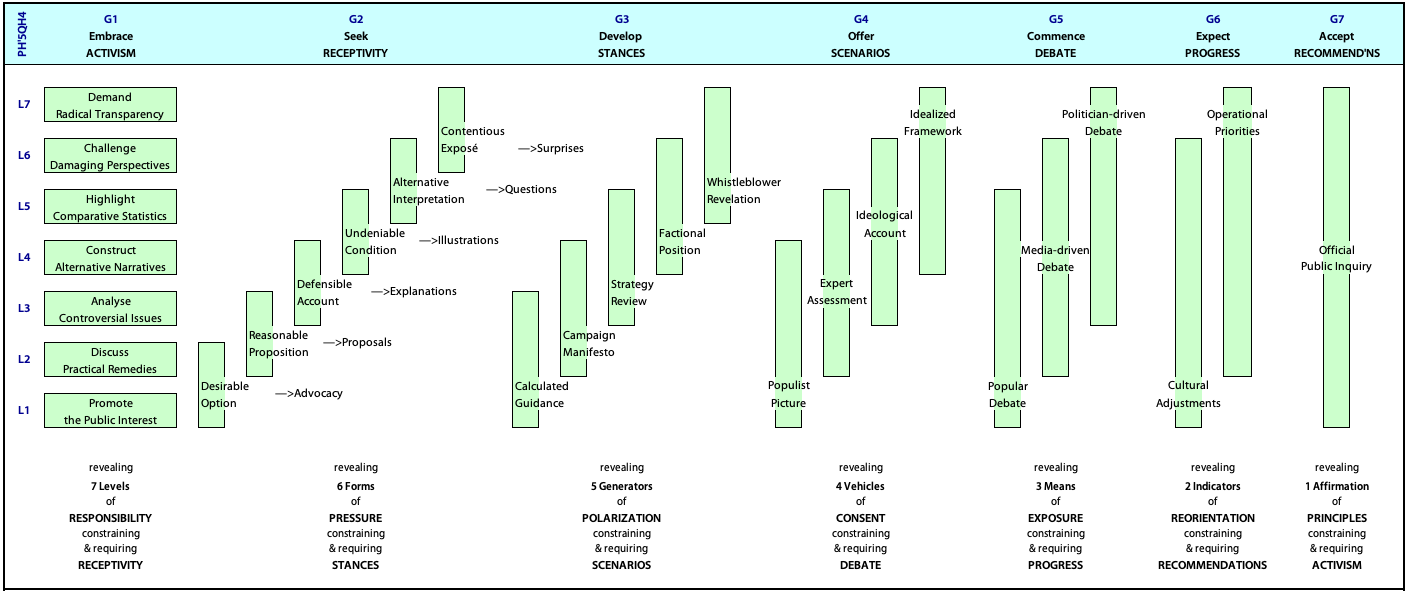
Societal Institutions (Q4)is a recently developed framework developed together with Philosophy Schools (Q5). As it seemed likely to pose more difficulties, it has been selected for investigation. Superficial examination of Q5 confirms the pattern.

The thumbnail at right can be used as a constant reminder of the framework.

The requirement groupings are:

QG1:  Embrace Activism
QG2:  Seek Receptivity
QG3:  Develop Stances
QG4:  Offer Scenarios
QG5: Commence Debate
QG6: Expect Progress
QG7: Accept Recommendations

The oscillating duality has been suggested as:

Odd-numbered groupings: affect but do not depend on the public
Even-numbered groupings: seek or require involvement of the public

As each grouping is considered in turn below, the goal is to focus down on a possible sharp alteration in the focus, not to collect all evidence or summarize all findings. In each case, links are provided to the relevant topics to enable a check on the conclusion reached.

ClosedCheck Each Grouping

QG1:  Embrace Activism

This requirement must be directed to each person because it requires individuals to take on a responsibility for changing values and beliefs or at least accepting that others need to do so.

Details.

QG2:  Seek Receptivity

This requirement must be disseminated within society because issues need to strike a chord in wider society. Without that resonance, the various forms of pressure have no impact and will be ignored.

Details.

QG3:  Develop Stances

This requirement must be disseminated within society because unless the stance is popularized, there will be no support, division or polarization.

Details.

QG4:  Offer Scenarios

This requirement must be directed to each person because, unlike pressure-G2 and polarization-G3, consent to an offered scenario is an individual matter. Even widespread consent is an aggregation of individual consents.

Details.

QG5: Commence Debate

This requirement must be directed to each person because the onlookers in a debate are the ones exposed to the issues, and without that exposure the debate is pointless. Each person listens and possibly contributes independently of others.

Details.

QG6: Expect Progress

This requirement must be disseminated within society because progress in an institution is a societal matter and impacts on everyone. Expectations spread leading to multiple modest adjustments and distributed innovations.

Details.

QG7: Accept Recommendations

This requirement must be disseminated within society because an official inquiry is a public process using principles already valued in society. It is set up so that everyone may witness it and hear about it through the press.

Details.

The Duality

From this review-based investigation, it appears that requirements in shaping institutional evolution are either directed to each person or disseminated within society.

The A BB AA BB pattern discovered in PH'3CsH and confirmed in both fundamental and control classes, also applies in this second Association Arena (PH'5Q).

The phrases that suited clarifying compatibility, private and public, while not wholly inappropriate, do not adequately capture the phenomena.


PH'6Q4CsH-Looking Out for Yourself

Background
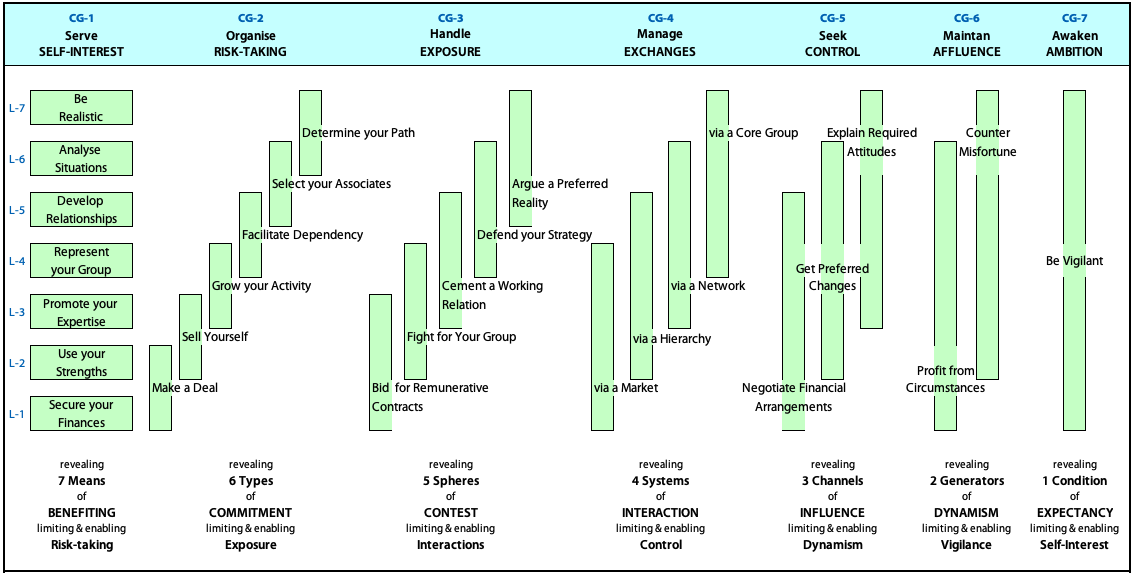
This framework is the most recent Q-complex structural hierarchy to be developed.

The thumbnail at right can be used as a constant reminder of the framework.

The requirement groupings are:

QG1:  Serve Self-interest
QG2:  Organise Risk-taking
QG3:  Handle Exposure
QG4:  Manage Exchanges
QG5: Exert Influence
QG6: Maintain Affluence
QG7: Release Aspirations

The oscillating duality is rather complex and shows up in:

mode and time of application, and orientation to appraisal and effort.

As each grouping is considered in turn below, the goal is to focus down on a possible sharp alteration in the focus, not to collect all evidence or summarize all findings. In each case, links are provided to the relevant topics to enable a check on the conclusion reached.

ClosedCheck Each Grouping

QG1:  Serve Self-interest

This requirement must be personally determined because each person alone knows what their self-interest is. Others are limited in helping or are indifferent or in competition.

Details.

QG2:  Organise Risk-taking

This requirement must be context-sensitive because risks are a function of attempts to make gains in the social milieu whose conditions cannot be controlled.

Details.

QG3:  Handle Exposure

This requirement must be context-sensitive because everything depends on how others see, assess and respond to your exposure in contests.

Details.

QG4:  Manage Exchanges

This requirement must be personally determined because this is about having your wishes and needs satisfied and no one can handle that on your behalf. The social milieu can only provide opportunities for necessary interactions.

Details.

QG5: Exert Influence

This requirement must be personally determined because it involves understanding your weight in social situations and using that on others in line with your interests, preferences and views.

Details.

QG6: Maintain Affluence

This requirement must be context-sensitive because it is a function of responding to external phenomena like opportunities, social regulation, crises, misfortune and disasters over which you have no control.

Details.

QG7: Release Aspirations

This requirement must be context-sensitive because the realization of inner ambitions depends on evolving future events which are not under a person's control.

Details.

The Duality

From this review-based investigation, it appears that requirements in looking out for yourself are either personally determined or context-sensitive.

The A BB AA BB pattern discovered in PH'3CsH and confirmed in both fundamental and control classes, also applies in a second Q-complex.

The phrases that suited clarifying compatibility, private and public, while not wholly inappropriate, do not adequately capture the phenomena.


The newly discovered A BB AA BB pattern has now been shown to apply to all classes of structural hierarchy, and more than one case in each.

Originally posted: 6-Nov-2026