Conclusion: A New Duality
Investigation Findings
The investigative challenge has three elements:
a) Determine whether the observation of an A BB AA BB pattern in the groupings of the framework can be generalized to other and possibly all structural hierarchies.
b) If general, determine how best to characterize A and B so they apply across the board.
c) Conjecture what this pattern means in practice and create a taxonomic label.
In this section, 11 structural hierarchies from the main taxonomic classes, at least 2 from each, have been checked.
It is reasonable to state that this pattern is a general property of all structural hierarchies within THEE.
Having determined that, the next step is to compare characterizations of A and B in the various structural hierarchies, and look to abstract common labels. The findings are listed in the Table below.
Table of Findings
| Structural Hierarchy | Class of sH | A | B | Confidence |
|---|---|---|---|---|
| PH'3CsH |
Spiral-derived | Private |
Public |
High |
| PH'1CsH |
Spiral-derived | Created personally | Developed organizationally | High |
| PH'6CsH |
Spiral-derived | Personally embodied | Societally organized | High |
| PsH6 |
Fundamental | Individually activated | Socially demonstrated | High |
| PsH7 |
Fundamental | Individually activated | Socially demonstrated | High |
| RsH |
Fundamental | Individually activated | Socially demonstrated | High |
| PsH"6 |
Tertiary | Individually acknowledged | Socially authorized | High |
| RsH" |
Tertiary | Personally activated | Contextually stimulated | High |
| PH'5Q2CsH |
Q-complex | Personally vested | Relationally enabled | High |
| PH'5Q4CsH |
Q-complex | Directed to each person | Disseminated within society | Medium |
|
PH'6Q4CsH
|
Q-complex | Personally determined | Context-sensitive | High |
A New Duality
Confirmation of the Pattern
There appears to be no doubt that a pattern, not previously identified, exists in all structural hierarchies.
Moving from Monads/Grouping-1 to Heptad/Grouping 7, this pattern is represented as: A-B-B-A-A-B-B
This appears to be another individual-milieu duality akin to the dynamic duality (kD). However, like the internal duality (iD) and the executing duality (eD), there is no polarization.
This new duality can now be clarified and named.
Description of the Pattern
This duality describes the way that each grouping Requirement is realized or manifested through its groups, whose functioning generates an identifiable State.
Drawing on previously developed generalizations in the Architecture Room:
All structural hierarchies are held to be about generating effects (i.e. realizations) in the psychosocial world; and those effects depend on a vehicle (the originating Tree) and a field within which that vehicle functions (the final Tree).
A-labeled groupings require individual-centric realization
i.e. the realization is completed separately in each individual, which may be a person, organization or social body.
This individual-centric realization takes diverse forms according to the particular framework: e.g. privacy (in the original discovery) and activation, acknowledgement, embodiment, determination, vesting and more depending on the particular framework.
B-labeled groupings require context-mediated realization
i.e. the realization depends on the entity's embeddedness in a socio-physical milieu, such as a family, organization, social body or society as a whole.
This context-mediated realization still depends on each individual but the context becomes critical in some fashion: e.g. for a public manifestation (in the original discovery) and through relationships, conditioning, authorization, stimulation, sensitivity, development and more depending on the particular framework.
Proposed Name: Realization Duality with the formula: rD.
Origin of the Pattern
This A-B-B-A-A-B-B pattern appears to be generated by the psychosocial pressures emanating from levels in the , as explained here and here. Their presence within structural hierarchies is developed here.
It is proposed that pressure combinations are the basis of the pattern:
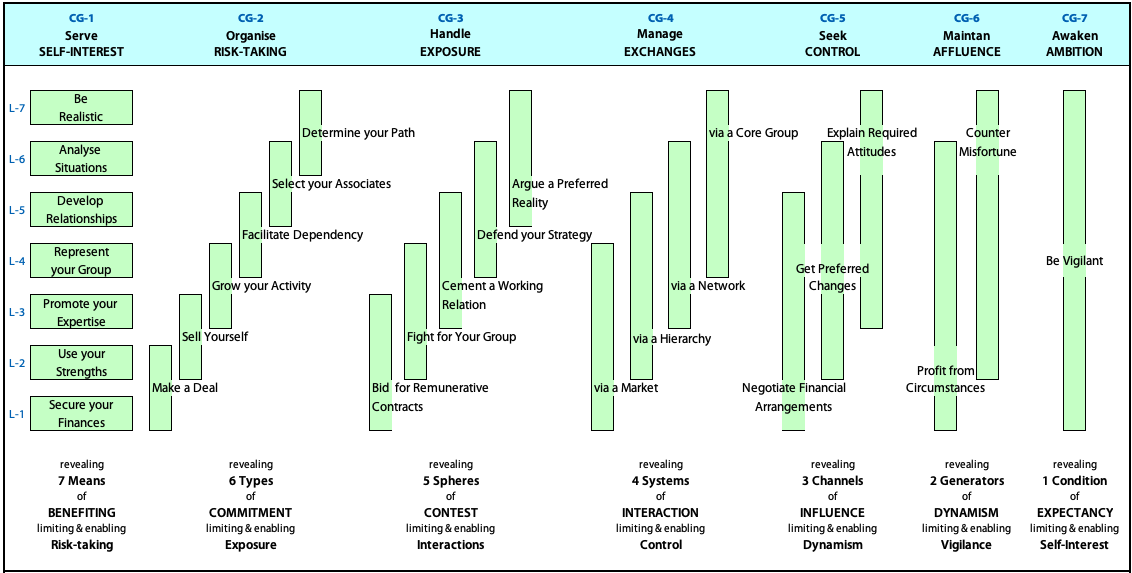
 Reminder: psychosocial pressures and Root Levels.
Click thumbnail to see the framework with pressures.
See relations of groupings, Root Levels and duality poles.
Note that:
The moves from transcendence to actualization.
is the lower terminal of the Root Hierarchy where psychosocial functioning makes contact with the infinite complexities of empirical reality for actualization; while is the upper terminal where psychosocial functioning opens into unbounded transcendence with infinite possibilities. Pressures at these terminals mean that functioning must take account of something beyond the boundary of the individual.
The intermediate levels, provide pressures that can operate wholly within an individual, even though functioning to mediate between possibilities and actualities will involve or affect the context as well.
It then follows in a structural hierarchy's realization duality that:
A: Individual-centric realization occurs when both pressures come from intermediate Root Levels: .
B: Context-mediated realization occurs when one pressure comes from a terminal Root Level: or .
To elaborate in detail:
contains neither terminal pressure → A
Autonomy requires realization within and for each individual, and understanding assists this process. The existence of such pressures within the context is not relevant. So is individual-centric.
RL1 enters at and remains in : → B in both
Performance forces an engagement with the socio-physical context. Understanding or certainty pressures are operative but do not remove the requirement for and to be context-mediated.
and only contain intermediate pressures: → A
Acceptability is not a matter for the context, and it pushes issues like acceptance, consent, identification and ownership to the fore. Certainty and well-being pressures are operative but do not modify this. So and are individual-centric.
RL7 enters at and remains in : → B in both
Selflessness forces attention and responsiveness in relation to others and a wider whole in a way that cannot be removed by well-being or autonomy pressures. So is context-mediated.
The well-established pressure structure is further validated in that it appears to explain where the realization duality pattern comes from. The functional impact of the pressures explains why that pattern is psychosocially meaningful.
This concludes the present investigation...
... and it is not possible for a similar pattern to exist in other structures because they have different patterns of pressure.
However, realization is an issue throughout the taxonomy and it would seem that the realization duality can be relevant to every structure through its link to psychosocial pressures i.e. it may be illuminating to work backwards from pressure to realization pole.
-
Apply the realization duality to the other taxonomic structures.
Originally posted: 6-Nov-2026.
