PH'6CsH: Political Life in Society
Background
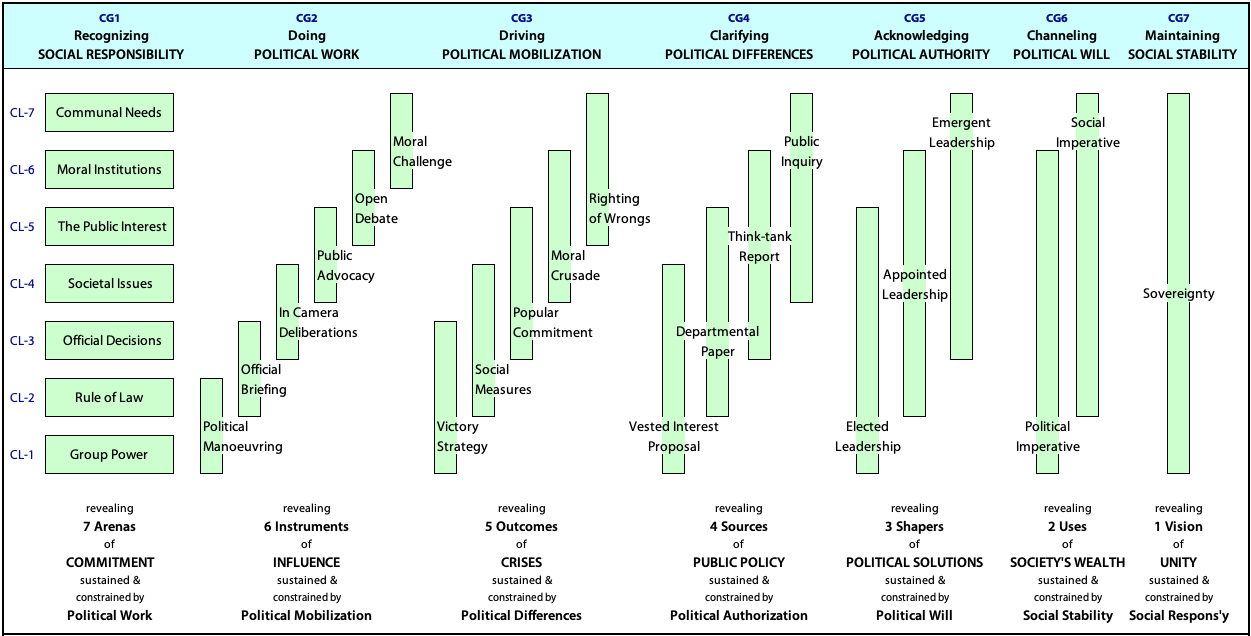
This politics framework developed over 20 years ago is slightly unusual in being the first spiral-derived structural hierarchy to be formulated.
The thumbnail at right can be used as a constant reminder of the framework.
The requirement groupings are:
The oscillating duality here has only recently been identified:
Odd-numbered groupings: constitution of political agency
Even-numbered groupings: exercise of political agency
As each grouping is considered in turn below, the goal is to focus down on a possible sharp alteration in the focus, not to collect all evidence or summarize all findings. In each case, links are provided to the relevant topics to enable a check on the conclusion reached.
The Groupings
CG1: Recognizing Social Responsibility
Political life must be recognized by everyone as a social reality, and one for which each person must accept responsibility. However, people are free to acknowledge their participation or to ignore politics. Social responsibility may be assumed in a variety of arenas, according to what feels natural and appropriate.
This requirement must be personally embodied, leading to a societal orientation associated with a variable degree of social pressure to be responsible.
CG2: Doing Political Work
Political work is about a political player using their power to alter what someone else does or gets. Power is expressed in communications that present and promote a particular version of reality, but the work does not occur within the player. The instruments used to focus political battles on social outcomes are publicly visible and seek the consent of the various players.
This requirement must be societally organized by political players who are seeking to participate, influence others and affect ultimate outcomes.
CG3: Driving Political Mobilization
Crises can be used for political gains by enabling mobilization. In this process, people are rallied, resources are assembled, activities are coordinated and a common result is pursued. The various drivers do depend on how people feel and tap into the self-interest and convictions of those involved. But mobilization is about a collectivity, not single individuals.
This requirement must be societally organized by political organizers like certain top executives, campaigners and popular leaders.
CG4: Clarifying Political Differences
Political differences get clarified through analyses and inform public policy, but the key issue here is who produces the reports and policy proposals. The sources of policy are four distinct systems, each of which develops its position on its own terms and using its preferred methods. The evidence may be mostly in the public domain, but interpretation, deliberation and report-writing occur internally. Mindsets in the various policy-inquiry systems are very different.
This requirement must be personally embodied by members of the distinctive bodies that perform needed inquiries in the way each thinks best.
Political authority comes from different authorization mechanisms that operate independently via elections, appointment or emergence of a following. As a result, different types of political leader are established by electors, appointing bodies and spontaneous followers.
This requirement must be personally embodied insofar as anyone involved in establishing leaders must psychologically acknowledge them as such, and the leaders themselves must acknowledge the authority they carry.
CG6: Channeling Political Will
Political will is an expression of societal power. Though emerging from the experiences of individuals, it only exists when it coalesces as societal imperatives. Imperatives are about driving changes affecting society as a whole.
This requirement must be societally organized, because no individual, not even a leader, can determine or control the general will.
CG7: Maintaining Social Stability
Social stability exists when the diversity within society is sufficiently integrated to produce a stable social order. In such a society, law is respected and peaceful coexistence is the norm. A stable social order allows for a greater or lesser degree of individuality, but its characteristic is mass action.
This requirement must be societally organized and will be publicly recognized.
The Duality
From the above, it appears that requirements in are either personally embodied or societally organized.
The A BB AA BB pattern discovered in is therefore confirmed in , but the phrases that suited , private and public, while not wholly inappropriate, do not adequately capture the phenomena.
This is now the third structural hierarchy in the Spiral-derived class that has shown the pattern. It can therefore be presumed to be generally applicable to this class at least.
-
Continue by investigating Domain Fundamental frameworks.
Originally posted: 6-Nov-2026