PH'1CsH: Expectations of Employment
Background
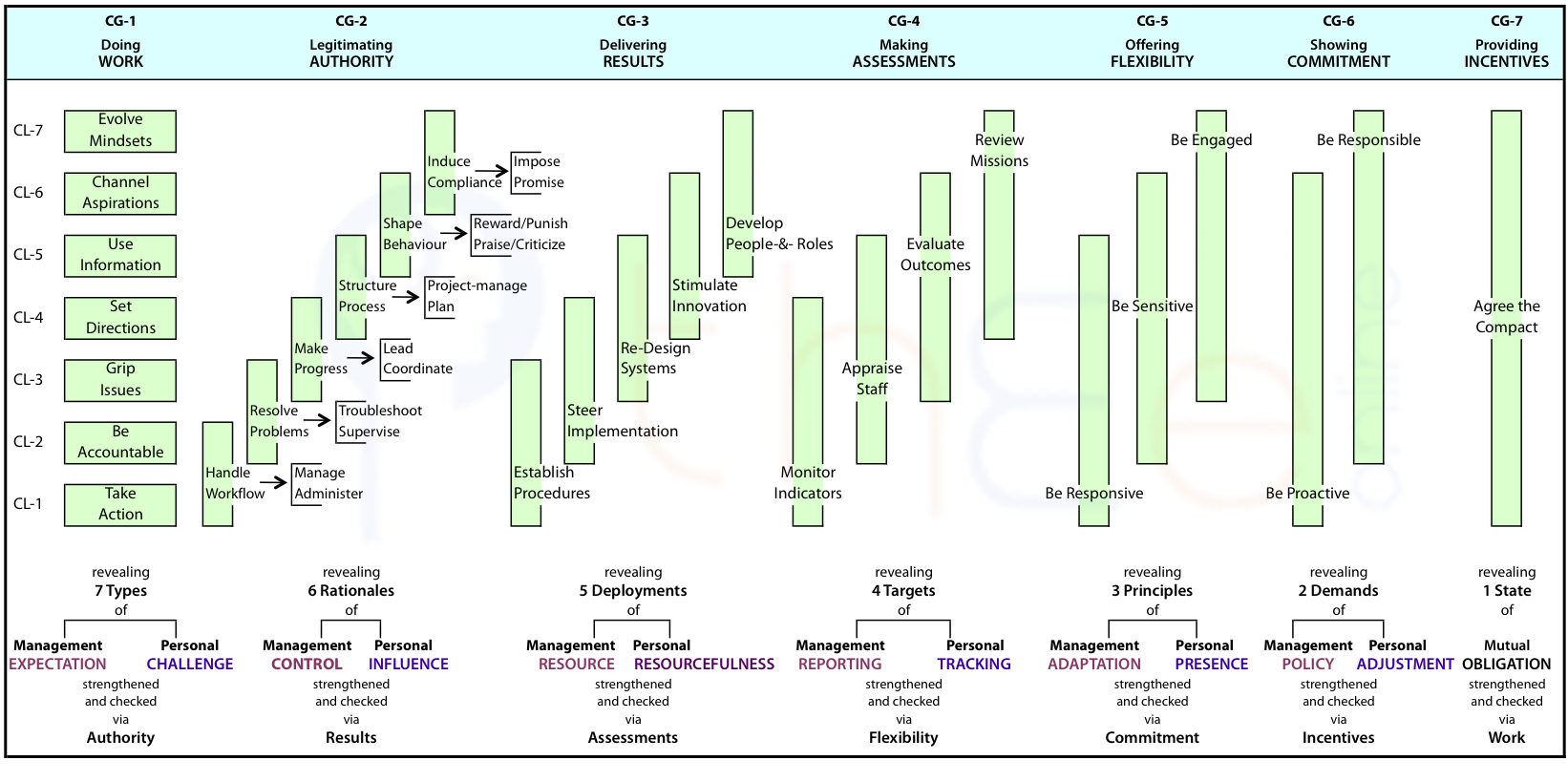
This framework is slightly unusual because each grouping has a dual perspective: employee/personal and management/organizational.
There is also an oscillating duality:
Odd-numbered groupings: personal affirmation.
Even-numbered groupings: management specification.
The thumbnail at right can be used as a constant reminder of the framework.
The requirement groupings are:
As each grouping is considered in turn below, the goal is to focus down on a possible sharp alteration in the focus, not to collect all evidence or summarize all findings. In each case, links are provided to the relevant topics to enable a check on the conclusion reached.
The Groupings
CG1: Doing Work
Work requires deliberation, judgement and determination, and the challenge in working must be seen by the person. An organization depends on mental activity that is at the employee's discretion.
This requirement must be created personally and because working is socially manifested, others expect this inner creation to occur.
CG2: Legitimating Authority
Authority must be openly allocated and recognized by employees. The necessary structures and relationships do not exist unless they are public knowledge.
This requirement must be developed organizationally and is only personally understood and used because of its explicit formalization.
CG3: Delivering Results
Results are delivered through a variety of management resources (goals, systems, procedures, personnel &c). While the use of these resources depends on the resourcefulness of employees, the delivery is itself a social phenomenon.
This requirement must be developed organizationally because it is the prime concern and function of the organization.
CG4: Making Assessments
Assessments end up being public. However the making of an assessment is mostly private involving as it does discernment, contextualizing, application of values, judgements and developing a sense of certainty. Inquiry calls for managers to grasp reality for themselves, and employees must privately track assessments.
This requirement must be created personally knowing that many relevant procedures and reports are or become public knowledge.
CG5: Offering Flexibility
Flexibility must be willingly offered by both management and employee, even as each desires it from the other. No organization can force responsiveness, sensitivity or engagement. The desired culture depends on personal presence by employees and personal adaptability by managers.
The requirement must be created personally and is expected to make a major organizational impact.
CG6: Showing Commitment
Commitments are made by organizations and by their employees. But what is required here is that commitments become overt and publicized so that each can have confidence in the other. Both responsibility and proactivity that result from such commitment depend on personal perceptions that remain private.
The requirement must be developed organizationally even if it depends on the perceptions and willingness of individuals.
CG7: Providing Incentives
Incentives must mesh the organization and the employee to have the desired effect, and only the organization can develop these. Incentives form part of the compact that develops and binds employees more powerfully than the formal contract.
The requirement must be developed organizationally so as to attract and retain employees.
The Duality
From the above, it appears that requirements in are either created personally or developed organizationally.
The A BB AA BB pattern discovered in is therefore confirmed in , but the phrases that suited , private and public, while not wholly inappropriate, do not adequately capture the phenomena.
Originally posted: 6-Nov-2026