Tertiary Structural Hierarchies
PsH"6: Accommodating Ethical Authorities
Background
The Purpose Domain is where the structural hierarchy form was first discovered and developed in the 1980s, initially in the fundamentals: PsH6. Subsequently a tertiary typology was identified and then a structural hierarchy was discovered, whose details are to be found in Ch. 9. Working with Values (1995).
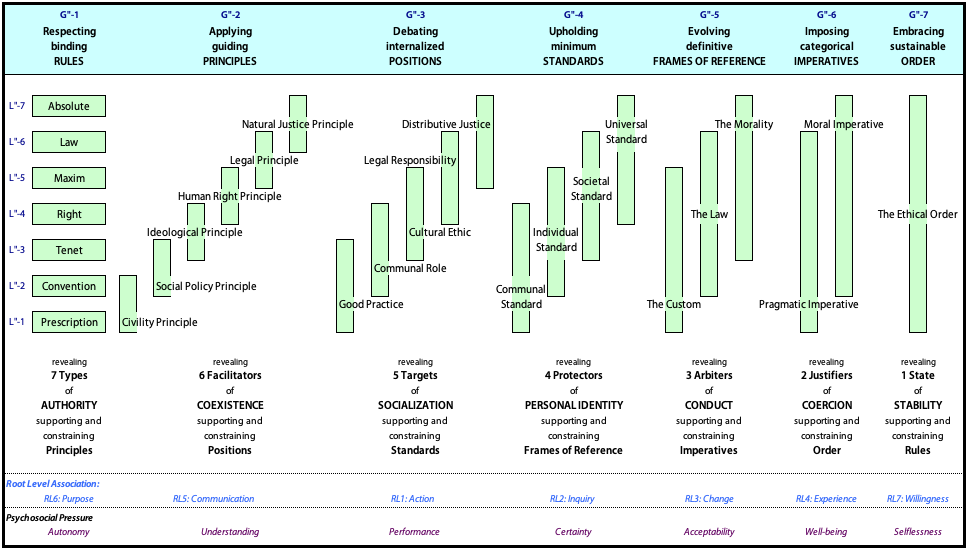
The thumbnail at right can be used as a constant reminder of the framework.
The requirement groupings are:
G"1: Recognizing Authority
G"2: Maintaining Community
G"3: Socializing Individuals
G"4: Protecting Identity
G"5: Judging Conduct
G"6: Regulating Obedience
G"7: Engendering Will
As each grouping is considered in the Check section below, the goal is to focus down on a possible sharp alteration in the focus, not to collect all evidence or summarize all findings. In each case, a relevant Master-Table from Working with Values is provided. For full details, download Ch. 9.
G"1: Recognizing Authority (Binding Rules)
Master-Table 21
This requirement must be individually acknowledged because social actors, persons and organizations, must recognize their obligations and realize that they are bound by rules and will be judged accordingly.
G"2: Maintaining Community (Guiding Principles)
Master-Table 22
This requirement must be socially authorized because principles must be determined by the community mainstream and their application must be socially acceptable. Responsibility for selection and use of principles is assigned to communally recognized entities.
G"3: Socializing Individuals (Internalized Positions)
Master-Table 23
This requirement must be socially authorized because no individual can establish a position alone. Positions emerge through public argument, campaigning, teaching, imitation and social pressure. Socialization involves affirmations and shaping by numerous diverse people and institutions.
G"4: Protecting Identity (Minimum Standards)
Master-Table 24
This requirement must be individually acknowledged because an identity has to be protected by the entity—person, social body, society—that espouses a particular standard. Even universal standards must be adopted by the entities whose identity they are expected to govern.
G"5: Judging Conduct (Frames of Reference)
Master-Table 25
This requirement must be individually acknowledged because judgements must resolve disagreement definitively and this will only occur if everyone, individually, regards the frame as authoritative and accepts its use by those entitled to make judgements.
G"6: Regulating Obedience (Categorical Imperatives)
Master-Table 26
This requirement must be socially authorized because neither imperative is a personal choice or preference. The imperatives either emerge from a transpersonal authority recognized by the group as binding on all individuals, or from laws handled by rulers who recognize their necessity.
G"7: Engendering Will (Sustainable Order)
This requirement must be socially authorized because it depends on the community and its government. While individuals are expected to embrace the order, that is not what its reality depends upon and no individual can change the order.
The Duality
From this review-based investigation, it appears that requirements in accommodating ethical authorities are either individually acknowledged or socially authorized. «Individually» is used rather than «personally» to accommodate artificial bodies with a social identity, like organisations or societies.
The A BB AA BB pattern discovered in PH'3CsH is therefore confirmed in PsH"6, but the phrases that suited clarifying compatibility, private and public, while not wholly inappropriate, do not adequately capture the phenomena.
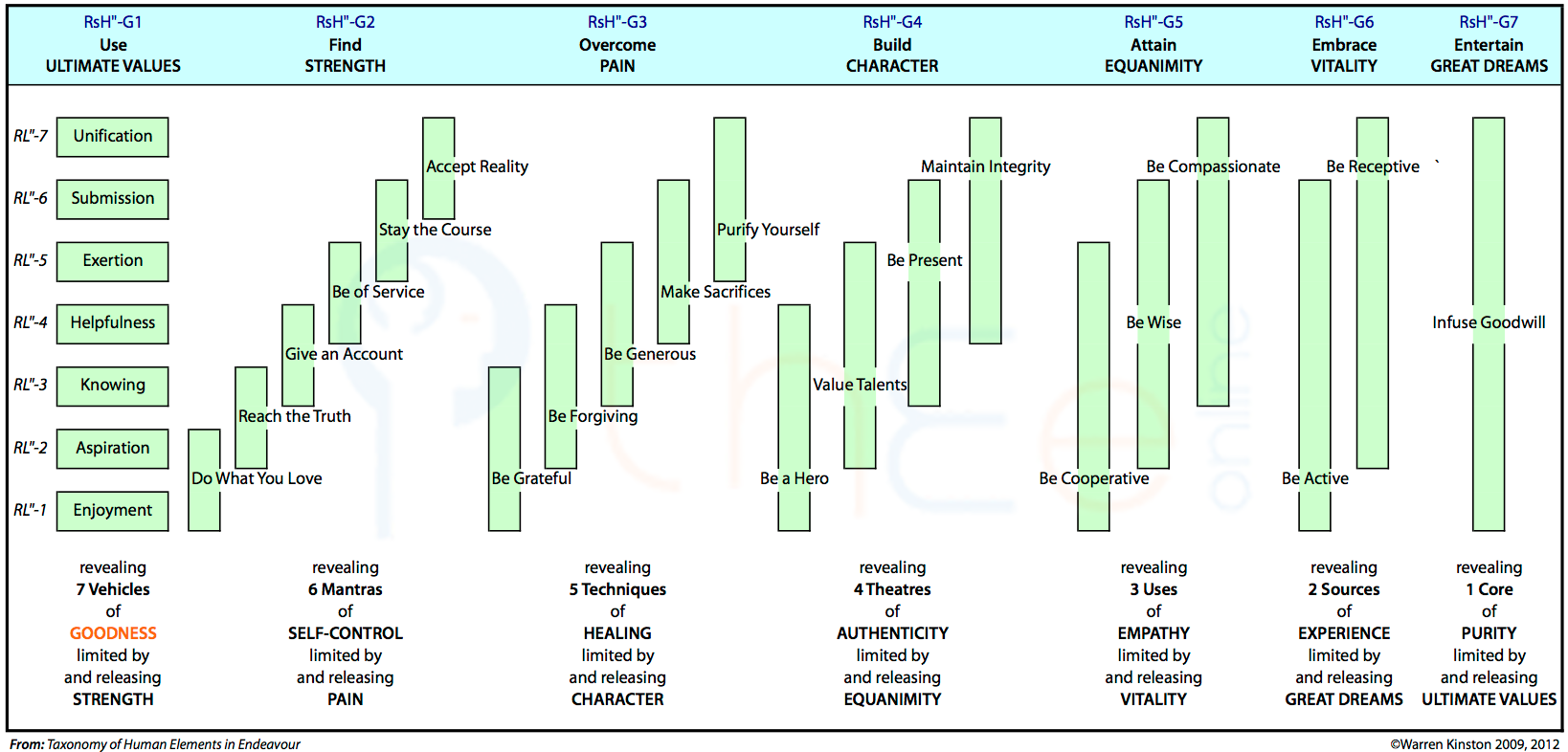
RsH": Producing Goodness
Background
The Root Domain generates a tertiary hierarchical framework of Primal Injunctions, and these lead to a structural hierarchy dealing with Producing Goodness.
The thumbnail at right can be used as a constant reminder of this framework.
The requirement groupings are:
G"1: Use Ultimate Values
G"2: Find Strength
G"3: Overcome Pain
G"4: Build Character
G"5: Attain Equanimity
G"6: Embrace Vitality
G"7: Entertain Great Dreams
The oscillating duality here is:
Odd-numbered groupings: affirming goodness
Even-numbered groupings: affirming self
As each grouping is considered in the Check section, the goal is to focus down on a possible sharp alteration in the focus, not to collect all evidence or summarize all findings. In each case, links are provided to the relevant topics to enable a check on the conclusion reached.
Notes:
- The phrasing for each requirement is changed from "must be" to "is" because there is no compulsion in regard to producing goodness.
- Contextually is used below to cover the socio-physical milieu including: other people, social demands, wider society, physical adversity, illness and egotistic states, internal distress, the condition of humanity.
G"1: Use Ultimate Values
This requirement is personally activated because an ultimate value is an inner experiential state that generates goodness using primal injunctions as the vehicles of goodness. No social body or institution can generate or sustain goodness other than through the individual people within them. Following activation of ultimate values, it is conjectured that spiritual energies are released.
G"2: Find Strength
This requirement is contextually stimulated because without the presence of demands and stresses in the social milieu that activate temptations to egocentricity, the strengths do not emerge. Inner strength and self-control are developed to produce goodness in the world-as-it-is.
G"3: Overcome Pain
This requirement is contextually stimulated because pain and suffering are part of the human condition. The techniques of healing to overcome pain must therefore be developed as a response to wounds that disrupt goodness.
G"4: Build Character
This requirement is personally activated because it entails a deliberate and enduring attention to one's self and its moral development. A person seeks authenticity in developing, owning and sustaining heroism, talents, presence, and integrity.
G"5: Attain Equanimity
This requirement is personally activated because it is a self-controlled individualized response to turmoil associated with dysfunction or destructiveness in the social milieu. Empathy can be used to enable compassion, wisdom or cooperativeness.
G"6: Embrace Vitality
This requirement is contextually stimulated because vitality is a response to immersion in the flow of events, and about positively and energetically engaging with people and situations.
G"7: Entertain Great Dreams
This requirement is contextually stimulated because, although the great dream is personally entertained, it only emerges due to the contrast between the imperfect world around and the possibility of everyone living together in a good world. The goal here is to impersonally sustain a vision for all humanity.
The Duality
From this review-based investigation, it appears that requirements in producing goodness are either personally activated or contextually stimulated.
The A BB AA BB pattern discovered in PH'3CsH and confirmed above in a Primary Domain tertiary framework is now also confirmed in the Root Domain tertiary framework. The phrases that suited clarifying compatibility, private and public, while not wholly inappropriate, do not adequately capture the phenomena.
Originally posted: 6-Nov-2026.
 Check Each Grouping