Organisation of Management
THEE Historical Note: This was the first ever Structural Hierarchy to be discovered. It was developed in the early 1980s at Brunel University, based on experiences in consulting to the UK's National Health Service (NHS). This section updates the model published in 1990 in the Journal of Applied Systems Analysis. More details here.
Differentiation and Integration
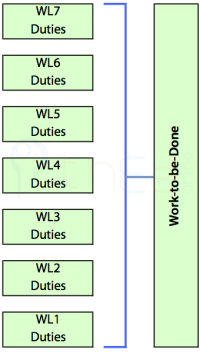
You will recall that work is hard to describe. It is now evident that the is never as simple as it first appears. Rather, the «same-sounding work» needs to be done at 7 different levels of progressively greater scope. This work-responsibility is expressed as as shown in the diagram at right.
 Reminder of the 7 Levels
This differentiation of the to enable effective management immediately poses issues of how work (including management work i.e. meta-work or 'work on work') can be integrated. «» has as its over-riding goal the integration of the «» within any organization.
The Structural Hierarchy
The taxonomic form that provides for the necessary integration is a Structural Hierarchy. Each Level in such a hierarchy is a Grouping and contains all Levels of the originating hierarchy. This section will investigate the Groupings and offer formulations which have been well tested in practice.
Structural Hierarchies are developed by progressively grouping adjacent Levels of THEE’s 7-Level holistic hierarchies in all possible ways. «Holistic» means that Levels in the hierarchy broadly imply or include each other, and this applies here.
The first «Level» in a Structural Hierarchy is a Grouping of 1 Level i.e. Grouping-1 () contains 7 Groups that are Monads i.e. made up of 1 original Level. The next «Level» will contain all Groups of 2 adjacent Levels i.e. contains 6 Dyads…and so on until we reach , the Heptad Grouping where there is just one Group consisting of all 7 original Levels.
As a result, every G-Level contains all the Levels of the originating hierarchy i.e. the original differentiation of an entity into Levels has been replaced by a re-unification applicable at each G-Level. There are 28 Groups (components) in a Structural Hierarchy.
However, definition of this THEE form is far more complex. Internal Levels i.e. the Levels within any Group, have distinctive qualifiers, which give the function of that level an essential characteristic. The qualifier applicable to a particular level finds its nature originating in the Level (or Monad) where it first appears e.g. the Monadic qualifier is created by Level-1 (or G11); the Dyadic qualifier is created by Level-2 (or G12), and so on. Internal levels that carry the qualifier are labelled with a lower case 'g' e.g. g4 refers to the 4th Level in each of the Tetrads, Pentads, Hexads and the Heptad and always has the same qualifier. Note that g4 does not exist in the Monads, Dyads or Triads which have fewer than 4 internal Levels.
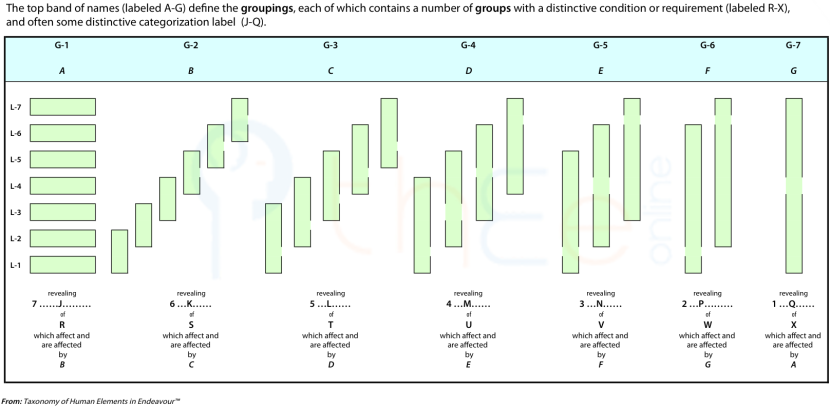
The Groupings and their Groups are ways to integrate work and overcome the differentiation and discontinuity demanded by the hierarchical stratification of . They have unique functions and properties and explain phenomena regularly highlighted by management consultants.
Unlike the framework of accountability, where personal factors are virtually irrelevant, the requirements of handling accountability within organizations must now be integrated with a variety of personal and social factors. The result is to provide for management that can not only get the work done and generate achievement, but can also deliver on the varied expectations and obligations intrinsic to employment.
Get Started
- For an advance account of the analysis, read this orientation.
-
See the full picture and summary tables in the review section.
-
Check out the historical background of the discovery.
OR
- Start with Duties-G1 Monads.
Originally posted: 19-Mar-2014