Means of Prevailing: G3-Triads
"Say not the struggle naught availeth."
Arthur Hugh Clough, 1849
Developing Endurance
Once is established, the next requirement in is to maintain intentions intrinsic to the challenge through thick and thin. In comparison to ordinary projects, progress when attempting the impossible is usually disorderly and the time-scale is uncertain.
Showing yourself indefatigable and unstoppable sustains hope and belief in your determination. Sustaining the effort through frustrations, diversions, disappointments and blind alleys leads to the development of endurance. This is a mindset that includes a readiness to suffer for the cause.
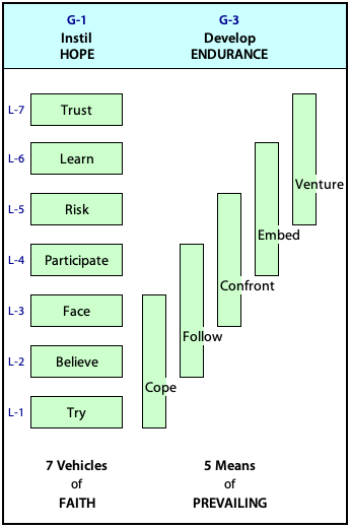
appears to be enabled by adding an additional level to the groups leading to the formation of 5 triads. Each triad has a qualifier that fits with . This is provisionally proposed to be «explicitly» in the sense of being open, clear and aware about essentials of the situation.
Each triad as a whole must be explicit, and the highest level specifically requires the g3-explicit quality. The middle level must be g2-unequivocal, and the lowest level must be g1-confident.
As part of endurance, there is a desire to prevail over whatever difficulty presents—even though prevailing may not always be possible. The grouping generates 5 distinct which are proposed as follows:
The function of developing endurance is proposed as: to deal unfalteringly with a flow of obstacles while maintaining direction and determination.
The triads reveal a progression upwards from the mundane, immediate and unavoidable means through to the more imaginative, occasional and optional means.
Requirements: All the means involve actively entangling yourself in problematic situations that you might otherwise prefer to avoid. So there must be patience and a tolerance for hardship, whether physical, psychological or social.
Dysfunction shows up as a loss of focus with activities drifting away from relevant goals.
Destructiveness shows up as sabotage of the attempt by substituting undesired or inappropriate goals.
Oscillating Pattern?
The potential for a pattern emerges from the contrast previously noted between -monads and -dyads.
requires assertion directed outwards to others and operating independently. While requires assertion directed inwards to oneself but dependent on confirmation from others.
This contrast suggests that might resemble . On examination: do appear to require assertions directed outwards and operating independently.
This strongly suggests an oscillating duality.
 Schema for Exposition
Function—which is the basis for taxonomic identification.
Internal structure of the triad to reveal that prevailing collapses if any single level fails.
Prevalence and necessity for use.
Time Horizon in proceeding.
Failure of a means of prevailing.
Means of Prevailing
Cope-G31
Function: To deal effectively with a situation without ceasing despite its many demands.
Attempting the impossible means that the situation will be difficult to handle. Typically there are intrusions, distractions, obstacles and resistances which cannot be ignored and must be managed. Coping is the reactive and defensive handling that seeks to protect the main effort.
Situations evolve in unpredictable ways with interventions often triggering reactions and difficulties. Those likely to benefit may create additional difficulties through seemingly unreasonable entreaties. Whatever happens, the relentless demands and intrusions must be managed in a positive dogged way as the attempt proceeds.
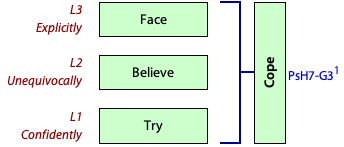
is constituted by:
L1: because coping entails doing what is sufficient. Confidence enables calm and unflagging attempts of various sorts, one of which is likely to be effective.
L2: that the flow of demands can be handled, because otherwise it is easy to feel overwhelmed and collapse in despair.
L3: the actual and ever-changing reality of the situation. Specific problems and disruptions must be clearly identified to have any chance of prevailing or at least remaining in the scene.
Follow-G32
Function: To align with given directions despite personal reservations.
does not get attention like leadership, but is essential by definition. Following that is willing requires a receptive attitude and yet it should be inherently strong.
Directions, whether given by a leader or emerging from a group consensus, require respect even if they seem incoherent, inconsistent, debatable, misguided or contrary to your own judgement. Following is hard when the group as a whole is uncertain, wavering or divided in its endorsement of a direction.
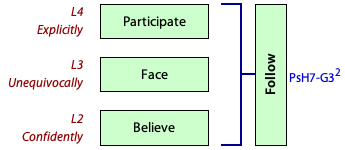
is constituted by:
L2: in the value of the directions that will assist you to prevail. This may mean believing the leadership too. In all cases, reservations will undermine your participation
L3: specific facts in the situation, because the direction deals with a particular reality and it is not possible to follow without being properly aware of that reality.
L4: which is why the directions that are given by the group or a recognized leader cannot be ignored. Following directions is a way of demonstrating belonging. Defiance would be viewed as rejecting participation and, depending on the seriousness, could result in disciplinary action or even exclusion from the group.
Confront-G33
Function: To highlight uncomfortable realities despite social resistance and potential hostility.
Confrontation is a direct clash of opposing ideas, which is often socially awkward or uncomfortable. Confronting may be unconventional in the group, affect vested interests, embarrass members or leaders, present as a threat, appear as arrogance, and ruffle feathers in the hierarchy. Conflict is commonly avoided and so there is a high possibility of being ignored, rejected or discredited during a confrontation.
As a result, it is necessary to be prudent. When weighing up the danger for the group against the risks for oneself, the group comes first with the expectation that common-sense will win out.
is constituted by:
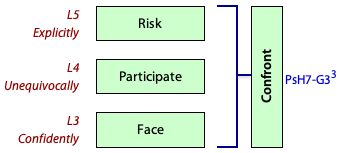
L3: a reality which a key person or many in the group are ignoring and over which it is necessary to prevail. The source of confrontation is awareness, and its power comes from a penetrating clarity. The ignored reality is typically something crucial like a danger, a failure, a mistake, a loss, or a transient opportunity.
L4: in the group and its future through dialogue. If the group was not so important and belonging to it did not matter, confronting would not occur.
L5: your position and reputation in the group for the benefit that is likely if what has been ignored or avoided is taken seriously and addressed.
Embed-G34
Function: To become an insider to forward the effort despite costs, possible exposure and uncertain success.
There can be a block to progress by an entity that resists conventional comprehension or influence from the outside. In order to proceed, a person can then get themselves embedded within the entity to allow direct knowledge, influence and sometimes effective action. Embedding may be personally organised (e.g. enrolling or signing up), be facilitated and open (e.g. embedding of journalists in front-line military activities) or be secretive (e.g. covert infiltration of an enemy headquarters).
Embedding calls for self-possession and functioning independently without the usual social support. The necessary immersion may take attention, time and energy away from the obvious needs and immediate practicalities seen by others. In some cases, it may be difficult to assess in advance whether embedding will be worthwhile.
is constituted by:
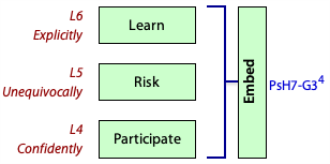
L4: in the problematic entity associated with the block with aims to prevail in the situation.
L5: your time, your energies, your balance, the support and perhaps even the respect of others if the effort turns out to be fruitless. If your motives are disliked and viewed as secretive, then exposure can be painful.
L6: what you need to know to overcome the specific block that precipitated this strategy.
Venture-G35
Function: To embark on an unfamiliar effort despite its unknown requirements and consequences.
Venturing implies being daring and knowingly hazarding yourself and your assets. Entering the unknown in this way calls for learning from experience while facing dangers that cannot be wholly predicted or mitigated in advance.
This is the most complex and risky means of prevailing. Ideally, it will produce something new and possibly enable a creative approach to prevailing.
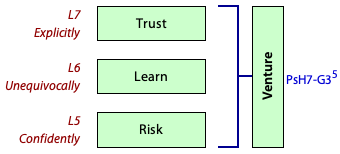
is constituted by:
L5: because it is obvious that any unfamiliar activity will expose you to both predictable and unforeseeable hazards. Confidence is essential or venturing will be half-hearted or entirely avoided.
L6: both prior to the venture to mitigate risk and as you reflect on your progress along new paths and into new arenas. You will also be forced to develop new knowledge and skills to handle surprises and dangers encountered along the way.
L7: your instincts, your imagination and your colleagues as you proceed on this untrodden path.
See Table Summary for an Overview and Comparison
Psychosocial Pressures
Studies in the Architecture Room have determined a standard pattern for pressures in the groupings of structural hierarchies. These studies determined 1° pressures that are structural or identity-based.
The identified 1° pressure for G3 is performance. This applies here because the person can be expected to experience a pressure to perform, and itself involves effective action.
Recent studies in a structural hierarchy identified the presence of a 2° pressure related to operating groups within any grouping. The pressure driving use of the various G3-groups here——should be certainty if it follows the standard pattern.
On reflection, that would fit because the are all demanding and not spontaneously appealing. No-one is likely to adopt any unless they have a degree of certainty about their necessity. Others will also want certainty before approving or supporting the various means.
Transition
has been sought, but not necessarily achieved, and the situation remains endlessly difficult. Even as you endure, emotional pressures build, naysayers crow, social turbulence buffets. In the midst of it all, it is essential to remain steady, centred and unshaken in your will. If balance is lost, then everything will fall apart.
In any situation, the social environment and relationships are critical to your stability and to providing a foundation for continuing the attempt on the impossible.
It turns out that it is possible to by adding an additional adjacent level to form tetrads, which reveal ways to in the present context.
-
The 4 protectors of balance: G4-Tetrads.
Originally posted: 12-Jun-2026.