Selfless Serving: G7-Heptad
Serving in a State of Responsiveness
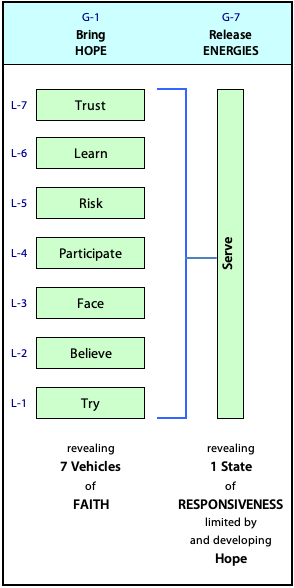
The way that energies permit responsiveness was examined earlier.
in association with the can be enabled by adding an additional adjacent level to form 1 heptad. The heptad will have a new qualifier which needs to fit with . This g7-qualifier is provisionally proposed as «unselfish», meaning to be disinterested, unprejudiced and charitable in all efforts.
The function of releasing energies is to give oneself completely to dealing with the situation. The result is that you become ready to respond in whatever way is appropriate and helpful in relation to the challenge.
Energies may need to be released for many reasons, not least for creative endeavours. But the focus here is different: it is .
Function of serving: To be attuned to needs in order to help in whatever way is most appropriate. Of course, the needs here relate to the basis for attempting the impossible: you would not make the attempt if it was not needed.
In accord with the oscillation previously identified, involve assertion directed outwards and operating independently.
Requirements: calls for surrendering to the situation in which you find yourself. In that milieu, it is essential to be attentive, become attuned and be dedicated to delivering on the challenge.
Serving, as a heptad, integrates all 7 levels, extending from which is practical to which is transcendental. The contribution of each level is elaborated below.
Unlike lower level groupings that can be disrupted by internal states () or externalities (), serving cannot be disrupted. The nature of is such that once it is in place within you, nothing can touch it.
Of course, the world may wish to exploit the server, but this should be perceived and handled to avoid having energies drained. Problems like excessive demands, hostility to the server or misuse of the service are simply part of what makes The World impossible, and these matters must be dealt with positively and realistically, not by retreating and abandoning serving.
Dysfunction: Serving calls for a full release of energies in a positive way. If there is a hidden withholding, positivity will be reduced, which may mean a hedging of commitment, a blind spot, application of inappropriate conditions or some other corruption.
Destructiveness: Resignation is about giving up entirely and concluding that serving is pointless. Any effort to this point in relation to the challenge is undermined and effectively abandoned.
Rationale for Service
is the over-riding requirement in attempting the impossible primarily because:
■ Ego-driven personal force alone will always be insufficient: if it were sufficient, the challenge would not be impossible. Others are required and their knowledge, capabilities and resources will only be fully unlocked if you are perceived as unselfishly serving a cause, the community or particular individuals in need.
In addition:
■ The situation knows more about itself than you do and only by submitting to it so as to attune and respond precisely is it possible to be constructive.
■ Willingness is driven by selflessness and so becoming self-centred will hamper the release of its energies and positivity.
■ The heptadic grouping in all structural hierarchies is held to be pressured by selflessness, with its single group being pressured by autonomy. That fits the notion that it must be your choice to serve unselfishly.
Structure & Threats
In examining what is constituted by, the effect of weakness or absence of the level will also be identified.
G711: , because without attempts to serve there is no service.
So g1 weakness means 
G712: that the request is genuine and the help offered is relevant and worthwhile.
So g2 weakness means
G713: the reality of the situation, the timing of any request, the physical demands, and available resources.
So g3 weakness means.
G714: involves being in an honest communicative relationship throughout the process and following up for feedback.
So g4 weakness means
G715: because it is possible to mistake what is required and not appreciate personal risks in providing the service.
So g5 weakness means
G716: because every act of service is different and adaptation to individuals is required.
So g6 weakness means
G717: consists of assuming that service is needed, meaningful and worthwhile regardless of personal return.
So g7 weakness means
Level Characteristics
The characteristics of the levels discovered earlier appear to apply here—check for yourself:
-
g1 provides for initiation and ensures a foundation for serving
-
g2 involves principles and ensures integrity in serving.
-
g3 calls for contesting and ensures intensity of serving.
-
g4 enables adaptability and ensures sustenance of serving.
-
g5 provides for evaluation and ensures judgements of serving.
-
g6 develops inner stability and ensures mastery of serving.
The final addition, g7, is more speculative because having just one group means cross-checking is unavailable. It is proposed that:
■ g7 demands dedication and ensures fulfilment of serving.
Psychosocial Pressures
Studies in the Architecture Room have determined a standard pattern for pressures in the groupings of structural hierarchies. These studies determined 1° pressures that are structural or identity-based.
The identified 1° pressure for G7 is selflessness. This applies here because a person in a cannot allow self-interest to intrude.
Recent studies in a structural hierarchy identified the presence of a 2° pressure related to operating groups within any grouping. The pressure driving use of the single G7-group——should be autonomy if it follows the standard pattern.
On reflection, autonomy seems fitting because is a choice that must be independently made and owned.
Transition
A heptad enables a move back to the monads. In this case, generates the conditions for . As noted above, , when established, is unstoppable: if it could be disrupted, the cycle would break and despair would reign.
Originally posted: 12-Jun-2026.