Sources of Excellence: G6-Hexads
Invoking Ideals
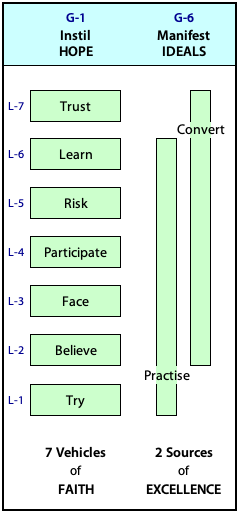
Any particular will only be as good as the values it upholds and the skills in delivery. In any attempt to improve a difficult situation, there will be that can act as a frame of reference for what is done and how. The most relevant ideals need to be invoked and brought into play. These ideals unite and strengthen people by tapping into personal aspirations and general conceptions of goodness.  THEE details
Given that what is being attempted is virtually impossible, is required to have any chance at all. Ideals serve as the reference point here, and in accord with can be enabled by adding an additional adjacent level to form 2 hexads.
Each hexad will have a new qualifier which needs to fit with . This g6-qualifier is provisionally proposed as «intelligent», meaning making sound judgements based on intuition, knowledge and understanding.
The labeling of the hexads is as follows:
The function of invoking ideals is proposed as: to ensure that personal efforts meet the highest expectations.
Requirements: Excellence is founded on aspiration, and is generated by informed guidance and self-discipline in concentration and dedication. An attitude of receptivity to feedback, to teachers, to new perspectives, to one's own imagination is needed for benefits to get internalized.
The hexads reveal a move from a practical executable skill up to an intellectual psychosocial outlook.
Dysfunction: Satisfaction with mediocrity limits quality, and a lack of teachers or the absence of supportive colleagues can interfere with advancement.
Destructiveness: Pretension, by which excellence is claimed without merit, is deceptive and devalues those who are genuine.
Sources of Excellence
Practise-G61
Function: To constantly repeat a difficult activity to refine performance without being sure of reaching the required standard.
Practise is about attaining proficiency in a particular skill so that performance can be to the highest standard.
Example skills: Rebuilding an engine, coding software, flower arranging, tennis, playing a musical instrument.
The change that occurs is usually slow and gradual, with different aspects of the skill cumulating and integrating. The standard that will be reached eventually is uncertain, although some individuals will reveal superior performance early on.
People respond to practise demands differently, but the motivation always draws on inner aspirations which are bolstered by external standards, often traditionally determined.
Practise benefits from teachers, coaches or mentors. But their input needs to be complemented by self-reflection about quality. In the event, others decide the standard that is reached, often comparatively through competitions.
Practising requires heart and soul (as revealed in the hexad's levels) and it goes wrong if it becomes mechanical.
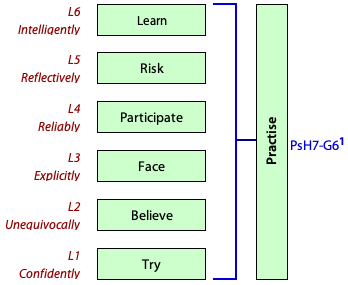
Structure: In examining what is constituted by, the effect of weakness or absence of the level will also be identified.
L1: , because repeated attempts with a positive attitude at all times is the foundation of practising.
So g1 weakness means
L2: that practice is needed and worthwhile, and believing the methods adopted are suitable.
So g2 weakness means
L3: the reality of the time required, the physical demands, and the current quality of the skill.
So g3 weakness means
L4: in the process, typically with a teacher or guide, and belonging to the relevant disciplinary tradition.
So g4 weakness means
L5: because despite all efforts the standard may not be reached due to an intrinsic lack of talent or poor teaching or some external disruption.
So g5 weakness means
L6: because every repetition needs to be viewed as an opportunity to learn, and a teacher's instructions must be carefully listened to and understood.
So g6 weakness means
The Unnecessary Level:
is missing because practising is about working with the known and observable. Trust is precisely what practising has to do without. Practise calls for repeating and refining performance skills. It does not require any assumption that all will go well or that the desired standard will be reached.
Convert-G62
Function: To develop an irreversible but necessary and potentially controversial transformation of thinking that affects self and others.
Converting is about altering a personal understanding and outlook in a particular psychosocial field.
Example fields: scientific paradigm, management thinking, personal relationships, cooking approach, farming method, religious doctrine, political ideology.
The change that occurs following various preliminaries and tentative thoughts can be relatively sudden, and once the conversion occurs it tends to be irreversible. "You can't see it until you see it, and then you can't not see it!"
Masters, gurus, mentors and group courses offer themselves or may be sought. Joining groups and immersion in the relevant culture will enable identification with other believers, and foster understanding of the new ideas.
Others may accept or reject this new perspective. Typically, new paradigms in any field are met with severe criticism and hostility, often leading to personal attacks (cf. writings of Thomas Kuhn). While critical views may have no influence on the substance of the ideas, they confirm that the risk in converting relates to personal identity and relationships, and sometimes social standing.
The motivation for converting is typically an inner dissatisfaction with a current way of thinking, usually based on experiences, evidence and reasoning. When the new and seemingly appropriate outlook is achieved, the feelings are of relief, joy and liberation.
Converting requires heart and soul (as revealed in the hexad's levels) and it goes wrong if it is superficial or insincere.
Structure: In examining what is constituted by, the effect of weakness or absence of the level will also be identified:
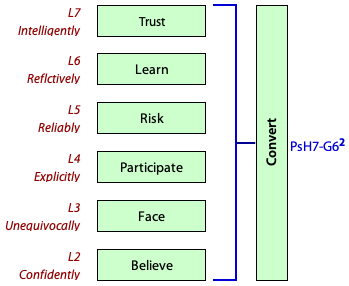
L2: because positively adopting and adhering to new beliefs is the point of converting.
So g1 weakness means
L3: the inadequacy and errors in current beliefs.
So g2 weakness means
L4: because relating to fellow believers and sharing the beliefs is needed to assist, confirm and refine a conversion.
So g3 weakness means
L5: , because misunderstanding can lead to harm from improper use of the ideas. There is also the danger of alienating some allies that can affect social standing.
So g4 weakness means
L6: , because converting must occur thoughtfully with consideration for evidence and debates, as well as implications personally and socially.
So g5 weakness means
L7: that the new ideas will eventually get properly understood and assimilated as well as being useful in due course, despite frustrations and costs incurred during development.
So g6 weakness means
The Unnecessary Level:
is not necessary or appropriate because converting your thinking is not about making attempts: there is nothing specific and tangible to do or produce.
Comparison
Neither nor mean that performance or use of ideas will ultimately be to the highest standard. That will depend on a multitude of factors in the particular situation. However, these two functions are the sources of excellence. In other words, they are necessary but not sufficient for excellence.
The Table below summarizes the differences identified above.
| Source of Excellence |
G61 Practise |
G62 Convert |
|---|---|---|
| Focus | Skills and performance | Understanding and outlook |
| Function | To constantly repeat a difficult activity to refine performance without being sure of reaching the required standard. | To develop an irreversible but necessary and potentially controversial transformation of thinking that affects self and others. |
| Change | Gradual, cumulative and uncertain. | Relatively sudden and certain end-point |
| Time | Requires constant effort to prevent deterioration. | Irreversible. |
| Relation to Others | Individualistic. Others determine the standard and judge whether it has been reached. |
Associational. The in-group offers support while attitudes of outsiders have little influence. |
| Motivation | Inner aspirations bolstered by external standards. | Inner dissatisfaction. |
| Emotions | Variable: depends on the person, skill and situation. | Relief, joy, liberation |
| Assistance | Teachers, coaches, mentors are deliberately sought. | Identification with ideas may occur spontaneously, but exposure to a culture helps. Masters, gurus, mentors offer themselves. Group courses may exist. |
| Risk | To time and resources. | To previous identity and relationships, and hence social standing. |
| Dysfunction | Mechanical | Insincere and superficial |
Internal Characteristics
The characteristics of the internal levels discovered earlier appear to apply here for both and .
-
g1 provides for initiation and ensures a foundation.
-
g2 involves principles and ensures integrity.
-
g3 calls for contesting and ensures intensity.
-
g4 enables adaptability and ensures sustenance.
-
g5 provides for evaluation and ensures judgements.
The reader can check these formulations in the hexads.
Now the nature of g6 must be formulated and here is a reminder of the findings from above:
In , g6 is , which is about ensuring practise is carried out in the right way and understanding cumulates. If this is missing, errors will persist and quality will never rise above the ordinary.
In , g6 is , which is about ensuring there is an openness and receptivity to the new ideas. If this is missing, personal identity will not alter and the ideas will never become sufficiently grasped to be skilfully and spontaneously used.
Conclusion:
g6 provides for inner stability and ensures mastery. In its absence, the function will fail to meet expectations.
Oscillating Pattern
An oscillation between the dominance of personal assertion that gains social confirmation that indicates approval has been identified.Details for G1 to G5
In regard to the , practising and converting are, as would now be predicted, directed inwards to oneself and dependent on social confirmation in relation to reflecting .
Psychosocial Pressures
Studies in the Architecture Room have determined a standard pattern for pressures in the groupings of structural hierarchies. These studies determined 1° pressures that are structural or identity-based.
The identified 1° pressure for G6 is well-being. This applies here because the person needs to feel good about these and about the pursuit of excellence.
Recent studies in a structural hierarchy identified the presence of a 2° pressure related to operating groups within any grouping. The pressure driving use of the two G6-groups——should be selflessness if it follows the standard pattern.
On reflection, selflessness seems fitting because conversion is close to becoming someone else, and practising requires putting ego aside and subordinating everything to developing the skill.
Transition
Both practising and converting ask a lot of a person. Excellence in pursuit of ideals is a worthy goal but it depends on the inner energies available to a person.
There is then the issue of exactly how these energies should be directed to enable excellence. This is the final concern to be addressed when attempting the impossible.
Energy is a constituting feature of willingness. The maximum energy can become available if all forms of willingness are simultaneously activated. That means it is possible to by adding the last additional adjacent level to form the heptad, and this reveals a .
-
The 1 state of responsiveness: G7-Heptad.
Originally posted: 12-Jun-2026.