Identifying the Arenas (PH'3Q)
Clues
Each set of Q-Arenas serves the Domain's primal need, which in the case of the Change Domain is fitness. Fitting in demands handling a particular well-defined sphere of social reality in a way that is socially expected and/or practically required.
As explained earlier, the various appear to target different socio-physical realities, and this will affect the Arenas revealed by the Q-expansion.
Because the literature gives little guidance, and fitting in is so spontaneous and implicit, recognizing and naming the THEE Arenas becomes a challenge.
To meet this challenge, I have used clues from:
-
the two adjacent that define each Arena: the lower appears to be most important in capturing the social entity universally requiring attention; the upper is confirmatory by being an essential guide for handling that social entity.
-
the provisional names for the change-states that were developed by applying the Style Hierarchy to the Typology: the lowest level (α) is critical because it "imposes" the paradigm and forces perception of a particular reality.
-
the two intrinsic psychosocial pressures: for Arena identity and for Arena handling (or operation), as identified in the Architecture Room; and the correspondence to Primary Domains as explained earlier.
Q1: Social Projects
The , as shown in the diagram below, is created from a combination of the and paradigms.
The paradigm is used to capture the reality of a , its formation and development via a team of people who interact dynamically to deliver on its mission. Your participation in a project is about becoming a team member and that entails fitting in—whether you are the leader or in a junior position. Projects are generated by groups of all sorts. Whenever you join, attention to enable a suitable orientation is required.
So «» is the name of the Arena.
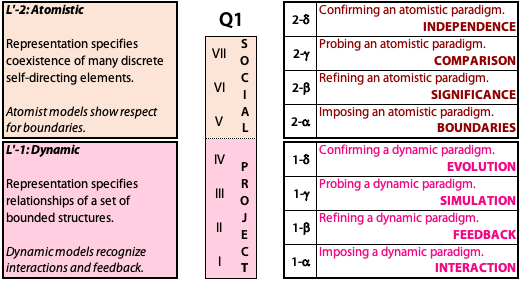
The paradigm is also invariably used when participating in a project. You have to work and that means seeing yourself operating with autonomy and responsibility while coexisting and cooperating with others in the project. Fitting in needs to take these atomistic features into account.
So fitting in to a social project is about submitting to the project mission and interacting with co-workers to progress the project. This requires adjusting yourself and your attitudes so that you can contribute. A person who rubs others up the wrong way and does not contribute is not fitting in.
Example Projects:
Running a business. Extending a house. Campaigning for new members. Organising a conference. Cleaning up a street. Managing a public garden
Frameworks
TET: In order to fit in, a person has to adjust to the current state of the project and its members. There are , which emerge from the depiction states shown in the diagram; and these can be usefully analysed using a Typology Essentials Table (TET):.
Spiral: By converting the ways to modes, it is possible to cumulate them via a spiral trajectory that , so confirming your fit.
Expected Pressures: 1°: Performance; 2°: Understanding.
Projects are about producing an outcome as specified by their mission, and so performance is their identity pressure . We get assigned to projects as part of employment and seek to join other worthwhile projects. Once involved with a project, we need to appreciate what is going on, what our colleagues are doing, and how we can contribute effectively. So handling ourselves in relation to pursuit of the mission with others is subject to an understanding pressure.
Q2: Social Relations
The , as shown in the diagram below, is created (by definition) from a combination of the and paradigms.
The paradigm is used to capture a reality containing independent bounded entities. This fits with a social relation between autonomous individuals. Friendships and intimate relations are built on mutual attraction, emotion, surrender and self-esteem (see PH'4Q3), while social relations are built on autonomy, goals, interests and mutual benefits. A superficial transactional relation suffices for most acquaintances, however some social relations are significant and may even be felt as essential, and these need attention to enable a suitable orientation.
So «» is the name of the Arena.

The paradigm is also used as a guide when developing a because the relation is instrumental: i.e. caused and developed for a reason, and certain consequences are expected to flow from relating.
Fitting in to a social relation is therefore about submitting to the particularities and peculiarities of another person needed who can assist you to reach a desired goal.. Such relations require you to connect pro-actively and, to get the best out of the relation, to become closely engaged to the point of sharing the goal.
Example Relations:
A business partner. An advisor. A travelling companion. A neighbour in rural communities.
Frameworks
TET: In order to fit in, a person has first to make a connection. There are which emerge from the change-states shown in the diagram; and these can be usefully analysed using a Typology Essentials Table (TET).
Spiral: By converting the ways to modes, it is possible to cumulate them via a spiral trajectory that .
Expected Pressures: 1°: Certainty: 2°: Performance.
Certainty is the identity pressure for these relationships because to put in the effort, it is necessary to be sure about your goals and to be sure that this is the right person to help given your situation. Once the relationship is taken seriously, then there is a performance pressure relating to handling the person so as to achieve your goals.
Q3: Social Proposals
The , as shown in the diagram below, is created (by definition) from a combination of the and paradigms.
The paradigm is used to capture reality in which an emergent problem must be explained in terms of a cause, or there is a wish to cause a state of affairs to alter. These are conditions of change, and intrinsically controversial. So, before anything is deliberately "caused", proposals for the change are developed and put to the relevant group for agreement. These are driven by a common need and a claim that the need will be met. Whenever you seek to propose changes, full attention to enable a suitable orientation will be required.
So «» is the name of the Arena.
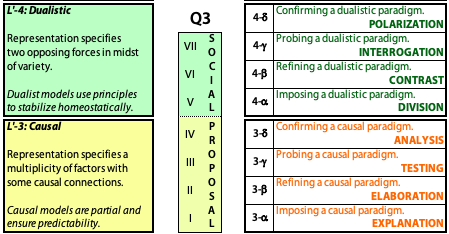
The paradigm guides your handling of because this identifies the controversial and political aspects that, being unavoidable, must be handled. In order to fit in, you must recognize in a balanced way that there will always be those that oppose a proposal as well as those that favour it.
Fitting in with a social proposal is about delivering a proposal that can win group support despite the associated controversy. This requires promoting your proposals effectively. If you do not promote well and then fail to win support, you will ultimately find that the group's needs are not met or other proposals win the day even if they are less satisfactory or less to your liking.
Example Proposals:
A public policy. A change in work-flow. A recreational outing. A shift in project direction. New software features. A revised urban plan. A new condominium car-park.
Frameworks
TET: In order to fit in when making a proposal, a person has to promote it. There are , which emerge from the change-states shown in the diagram. These 7 ways can be usefully analysed with a Typology Essentials Table (TET).
Spiral: By converting the ways to modes, it is possible to cumulate them via a spiral trajectory that .
Expected Pressures: 1°: Acceptability; 2°: Certainty.
Acceptability is the identity pressure for proposals, which accords with their controversial quality. Unless a proposal is developed to be sufficiently acceptable, it will not even be considered. Once there is a willingness to consider a proposal, then a certainty pressure develops in relation to handling. This raises many issues—exactly what is being proposed, why is it being proposed, who is involved, what are the costs and timings, who are the vested interests, are there better alternatives, and so on. The drive for certainty may lead to investigations.
Q4: Social Conflicts
The , as shown in the diagram below, is created (by definition) from a combination of the and paradigms.
The paradigm is used to capture the reality around that endure and cause a division within a group. Transient conflicts are common and unproblematic. Arguments may flare but no fitting in is required. By contrast, enduring conflicts bring a degree of acrimony and can become a feature of your group. Persistence of a division means that neither side easily wins the day, so you will need to take a side or try to sit on the fence. Any groups can develop such divisions and then division cannot be safely ignored. Attention to enable a suitable orientation will be required.
So «» is the name of the Arena.
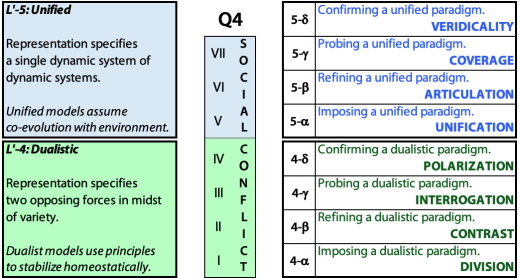
The paradigm guides your handling of persistent because it affirms that the importance of the whole group transcends any divisions. The continuity and well-being of the group must be a concern for all. So any orientation involves recognizing that, if unmanaged, disputes can lead to an irreversible schism in the group.
Fitting in with a social conflict is about positioning vis a vis the division in the group while supporting the group's continuance. Fitting in means navigating the conflict while tolerating the hostility that accompanies such division. It is necessary to become comfortable with the division in the group. If you do not, then you may ultimately become unwilling to remain in the group.
Social Conflicts = Division:
Conflicts within a group can develop over many things, like money, policy, membership, or proposed changes. But either some resolution with compromise is typically sought and found, or the status quo is simply endured. The divisions that result are temporary and the two sides have different supporters in each case.
By contrast, the arena here is formed by social conflicts with emotional dissension that become entrenched as permanent factions. These conflicts are not so easily solved or tolerated because they stem from differences in values and beliefs. They permeate many issues and, being embodied in camps or factions, the handling of seemingly simple matters can be impaired.
Examples :
:
Is such division with acrimony pathological?
Frameworks
TET: In order to fit in with (i.e. accommodate)an enduring social conflict in a group you must navigate your way around the group carefully. There are , which emerge from the change-states shown in the diagram. These 7 ways can be usefully analysed with a Typology Essentials Table (TET).
Spiral: By converting the ways to modes, it is possible to cumulate them via a spiral trajectory that .
Expected Pressures: 1°: Well-Being; 2°: Autonomy.
Well-being is the identity pressure, presumably and paradoxically because conflict and acrimony develop through each side seeking what it believes is best for the group. Once the division is established, then an autonomy pressure affects handling including choice of sides, support for your own side, dealing with the other side, and other related requirements.
Q5: Social Systems
The , as shown in the diagram below, is created (by definition) from a combination of the and paradigms.
The paradigm captures a reality which contains many dynamically interacting systems that evolve internally and with the environment. This is what are: they have a complicated unmapped structure with internal dynamics, and interact with a socio-physical environment. This Arena may not be immediately self-evident.
"Social system" is used here to refer to a combination of inter-related and more or less interdependent social bodies, bureaucratic arrangements and regulations, often with a poorly defined boundary.
Society is the home of the most important systems: institutions like education, and health-care that meet needs, and bureaucratic systems like those associated with taxes, immigration, and construction. However, every large group generates such systems. We are forced to fit in with them as we go about everyday life. Such systems cannot be safely ignored and their ramifications and impact often come as a surprise. Attention to enable a suitable orientation to any system with which we must engage is therefore required.
So «» is the name of the Arena.
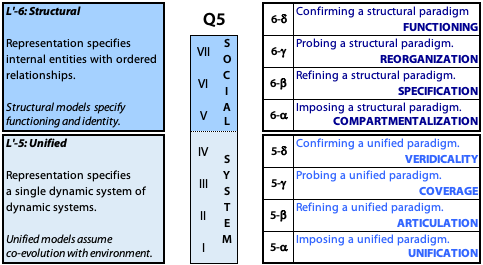
The paradigm guides any because it clarifies components, provides order via structure, and defines functions of importance. The challenging and irritating bureaucratic nature of these systems arises from the structural perspective.
Fitting in with a social system is about mastering the system for your own purposes. We have become involved, knowing that we will be treated as a "case" or an "instance". We must find our way around the system's complexity and bureaucracy either to fulfil certain required duties (e.g. get permissions) or to get our needs met (e.g. for health-care). If we fail to engage and master the system at least to some minimal degree then certain of our important needs will not be met or we will suffer from punitive demands: fines, even imprisonment.
Are Social Systems the same as Societal Institutions?
Example Systems
In society, there is the housing system, transport system, health-care system, tax system and many others. Permissions and licenses seem to be required for a many everyday activities like driving a car, chopping down a tree, or owning a dog.
Large groups and organisations have their bureaucratic systems too: personnel systems, management systems, training systems, complaint systems.
Organisations, social bodies and departments in a social system form a network with multiple outputs related to a particular purpose. So this is not a formal system as defined by system scientists. The multiplicity of outputs associated with a simple purpose is what makes these entities so bureaucratic and unmanageable. Some connections in the system will be tighter than others, but those working in one component will at least know about the existence of other components.
Frameworks
TET: Fitting in with a social systems is required to use them. There are , which emerge from the change-states shown in the diagram. These 7 ways can be usefully analysed with a Typology Essentials Table (TET).
Spiral: By converting the ways to modes, it is possible to cumulate them via a spiral trajectory that which enables its use.
Expected Pressures: 1°: Understanding; 2°: Selflessness.
Understanding is the identity pressure for social systems because of their complexity. The purpose of the system is usually obvious but the way it works often seem impenetrable. Where possible, a complex bureaucratic system is ignored or avoided, but involvement and use is often compulsory and then it becomes evident that it has been constructed for universal application and is impersonal. Because there is minimal adaptation to individuals, any assertion of individuality is doomed to fail or becomes counter-productive. So a selflessnesspressure must be activated when handling the system.
Q6: Social Roles
The , as shown in the diagram below, is created (by definition) from a combination of the and paradigms.
The paradigm captures a reality in which there are numerous related components in some order. Social life is therefore perceived as possessing a structure, and that social structure is constituted by . Roles are the way we appear to exist and function as social beings in our interactions. Should a particular role suit us (e.g. a professional vocation), get chosen (becoming a parent), or be forced upon us (e.g. conscription to the military), then it cannot be ignored. Attention to enable a suitable orientation to the particular social role is therefore required.
So «» is the name of the Arena.
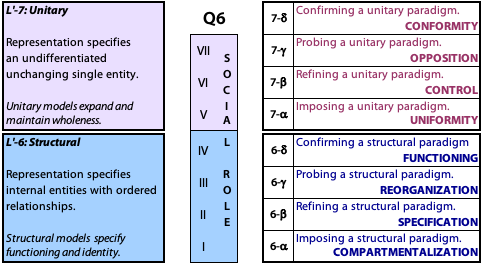
The paradigm guides fitting in to any because roles have certain features and requirements that apply uniformly to all and to which all individuals must conform. Social pressure for conformity can be intense and certain role requirements may be backed by law.
Fitting in to a social role is about adopting a role while retaining your individuality. To fit in, the must be named and distinctive with established norms. The role can then be personalized while acting in accord with social expectations. If you do not personalize and identify with the role, then you will ultimately become socially ostracised or ineffective.
Example Roles:
Citizen. Husband. Parent. Mother, Politician. Professional. Adventurer. Mentor. Eccentric.
Frameworks
TET: In order to function in society, it is necessary to adopt a variety of roles and find a way to fit your individuality into them. There are , which emerge from the depiction states shown in the diagram, and these can be usefully analysed with a Typology Essentials Table (TET).
Spiral: By converting the ways to modes, it is possible to cumulate them via a spiral trajectory that .
Expected Pressures: 1°: Autonomy; 2°:Well-Being
Autonomy is the identity pressure that determines selection of a social role, and this accords with the desire to find social roles that are personally suitable and actively desired. Forcing individuals into a social role is therefore likely to be counterproductive. Once in role, its handling becomes subject to a well-being pressure even if circumstances mean living the role is miserable. These two pressures underpin the importance of personalizing a role and becoming strongly identified with it.
Q7: Group Culture
The , as shown in the diagram below, is created (by definition) from a combination of the and paradigms.
The paradigm is used to capture a reality permeated with control, and where you want conformity and uniformity. Control uniformly applied suggests .
Whereas all previous Arenas were labeled «social» because the phenomena could be purely personal—there can be a personal project, a personal/intimate relation, a proposal for oneself, an intra-psychic conflict, a personal system, a personal role—a culture is intrinsically and only social.
Culture is what most immediately comes to mind when fitting in is mentioned.
The term culture often refers to a society, but culture emerges in every enduring group: large and small. Cultures vary greatly depending on the nature of the group and its context. Cultures refer to norms about the way things are done and the way people think: their uniformity provides predictability, security, stability and belonging. Cultures directly affect what others expect of us and how they will treat us in crucial parts of our life and also what we should expect of others and how we should treat them. Culture can never be safely ignored, and attention to enable a suitable orientation is always required when joining any new group.
So «» is the name of the Arena.
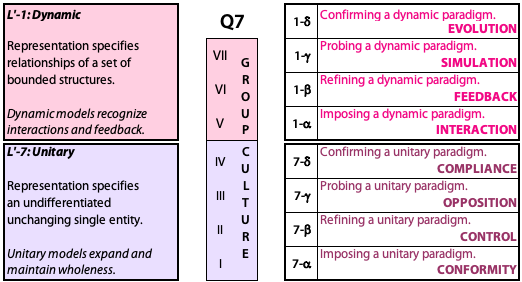
The paradigm is used to as a guide to fitting in to because we have to be culturally sensitive in the midst of the hurly-burly of everyday social interaction. Situations have their own requirements which include but are not limited to culture.
Fitting in with group culture is about belonging to a group through being like everyone else in regard to norms. Norms expressed in attitudes and interactions apply even if underlying values and beliefs differ in the group. The demands of a new group culture over-ride personal preferences and previous socialization. To fit in you are required to adapt yourself and comply with cultural norms without questioning so that you become (or in a society almost become) a group member. A person who neither adapts nor assimilates will initially be subject to pressures and even hostile reactions, and ultimately will be forced to exit or find themselves excluded.
Example:
Culture, depending on the group, can cover forms of civility, modes of dress, hygiene rules, sexual mores, relations with staff, methods of discipline, attitudes to work, dealing with bureaucratic systems.
Frameworks
TET: In order to fit in with the norms of any group, it is necessary to actively uphold them, even if that is not always easy. There are , which emerge from the change-states shown in the diagram, and these 7 ways can be usefully analysed using a Typology Essentials Table (TET).
Spiral: By converting the ways to modes, it is possible to cumulate them via a spiral trajectory that .
Expected Pressures: 1°: Selflessness; 2°: Acceptability.
Because culture is a group phenomenon that exists independently of individualistic preferences and beliefs, selflessness is the identity pressure . However, once the culture is taken as given, then an acceptability pressure from within and without compels assimilation to it—or provokes a resistance that forces avoidance or exit from the group.
-
Preview the taxonomic structures relevant to these frameworks.
OR
-
Plunge in to a detailed examination of fitting in to social projects—the Q1 Arena.
Originally posted: 26-Jan-2026.