Q6: Social Roles (I)
Preview
The , as shown in the diagram below, is created (by definition) from a combination of the and paradigms.
The paradigm captures a reality in which there are numerous related components in some order. Social life is therefore perceived as possessing a structure, and that social structure is constituted by . Roles are the way we appear to exist and function as social beings in our interactions. Should a particular role suit us (e.g. a professional vocation), get chosen (e.g. becoming a parent), or be forced upon us (e.g. conscription to the military), then it cannot be ignored. Attention to enable a suitable orientation to the particular social role is therefore required.
So «» is the name of the Arena.
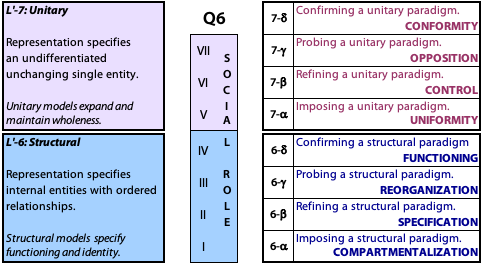
The paradigm guides fitting in to any because roles have certain features and requirements that apply uniformly to all and to which all individuals must conform. Social pressure for conformity can be intense and certain role requirements may be backed by law.
Fitting in to a social role is about adopting a role while retaining your individuality. To fit in, the must be named and distinctive with established norms. The role can then be personalized while acting in accord with social expectations. If you do not personalize and identify with the role, then you will ultimately become socially ostracised or ineffective.
Example Roles:
Citizen. Husband. Parent. Mother, Politician. Professional. Adventurer. Mentor. Eccentric.
Frameworks
TET: In order to function in society, it is necessary to adopt a variety of roles and find a way to fit your individuality into them. There are , which emerge from the depiction states shown in the diagram, and these can be usefully analysed with a Typology Essentials Table (TET).
Spiral: By converting the ways to modes, it is possible to cumulate them via a spiral trajectory that .
Expected Pressures: 1°: Autonomy; 2°:Well-Being
Autonomy is the identity pressure that determines selection of a social role, and this accords with the desire to find social roles that are personally suitable and actively desired. Forcing individuals into a social role is therefore likely to be counterproductive. Once in role, its handling becomes subject to a Well-Being pressure even if circumstances mean living the role is miserable. These two pressures underpin the importance of personalizing a role and becoming strongly identified with it.
Ways to Personalize a Role
Fitting in to a role means personalizing its normative features.
: imposing a structural paradigm: state = compartmentalization
The social structure can be conceived as being compartmentalized via roles. While not all roles are available to everyone, many are. These roles carry expectations from others as to activities and relationships and embody various rights and duties. Fitting in to a role means adapting your individuality to it, but that assumes a role has been selected: which is therefore the foundation of this framework. Any selection is a personal matter with considerable consequences, so deliberation is required.
Selection appears to be characterized by a minimal and a maximal version.
Proposed t1 Name:
Minimum: without much experience in the role.
Maximum: after the role has been lived.
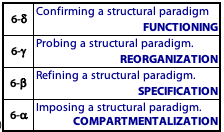
: refining the compartmentalization: state = specification
While there are generalized and widely understood social expectations which guide role selection (t1), there is not a complete set of prescriptions for any social role. That leaves open the opportunity to interpret role norms and guidelines according to one's own preferences and personality.
Proposed t2 Name:
: probing the integrity of compartmentalization: state = reorganization
Once a role is in use, it becomes apparent that its operation is dependent on situations, and one's own personal state. The handling of such things is governed by self-interest and what is convenient or easiest; and this assessment will vary from person to person.
Proposed t3 Name:
: confirming the validity of compartmentalization: state = functioning
Any social role carries rights which may be desired while imposing duties which may be shirked. Some expectations and norms may be welcomed and others disliked and disregarded. The pattern of adoption and application of role components will therefore vary from person to person and this determines functioning in an individualized way.
Proposed t4 Name:
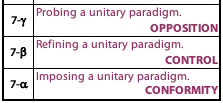
: imposing a unitary paradigm: state = conformity
Roles accord with norms into which everyone is socialized. These norms are taken for granted and when we follow norms that are part of our socialization, we feel that we are acting autonomously.
Proposed t5 Name:
: refining the conformity: state = significance
Roles lend themselves to stereotyping e.g. the mother role can be the stay-at-home mother, the career mother, the nurturing mother; the father role can be as a bread-winner, an alpha-male, a protector, a stoic, a decision-maker. Conforming to a particular stereotype can validate preferred attitudes and behaviours as well as engendering a sense of importance.
Proposed t6 Name:
: probing the uniformity of conformity: state = opposition
Within never-prespecified limits, roles can be what you make them. Society and its social structures continually evolve and that means social roles naturally evolve. That evolution occurs as particular individuals assert their view of what the role should entail based on the world they experience themselves living in.
Proposed t7 Name:
Plotting on a TET
The Executing Duality
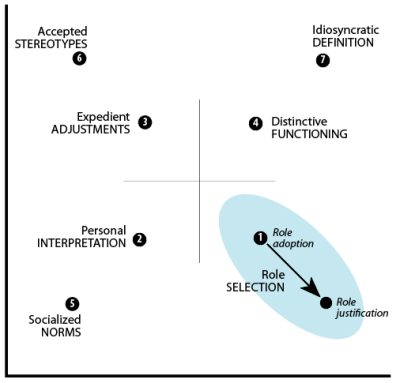
The layout of a set of Q-types on a TET is is standard. So we can immediately generate the diagram shown at right. Accepting this layout as correct then poses two demands:
a) to identify appropriate axes (the psychosocial executing duality);
and then
b) to check that the named ways are appropriately located.
The X-axis typically captures the social output: in this case the expected or desired result of personalizing the role.
Roles exist to be used in social life to produce socially expected outcomes.
So the X-axis is named: Focus on Role Fulfilment.
The Y-axis captures the psychological input: in this case the inner requirement that conditions fulfilment of the role.
Roles are societally given, not personally created. They operate within a social structure and milieu that exists equally and impersonally for all.
So the Y-axis is named: Need for Personal Submission.
Checking Locations
 High Fulfilment & Low Submission
Low Fulfilment & Low Submission
Low Fulfilment & High Submission
High Fulfilment & High Submission
Layout Features
Quadrants
Ways in the lower two quadrants give a sense of being in charge, while those in the upper two quadrants generate a sense of demands to be met.
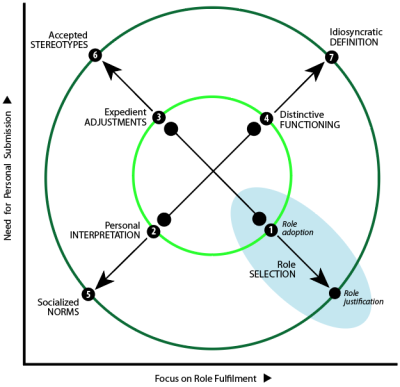
Ways in the two quadrants on the right side are about performance while those in the left two quadrants are about modification.
Ways in diametrically opposite quadrants engender a degree of antagonism:
• LR enables general opportunity, while UL demands a specific adaptation;
• LL is about existence, while UR is about performance.
The arrows indicate preferences for guidance i.e. in role selection (), adopting a role is guided by justifications for the role; personal interpretations () are guided by a person's socialized norms (), adjustments to a role () are guided by accepted stereotypes (), finally distinctive functioning in role () is guided by idiosyncratic definitions of the role ).
Circles
The inner circle defines personalization that is self-oriented and practical.
The outer circle defines personalization that is societally-oriented and conceptual.
The two circles fuse in which shifts from the practicality of adopting to a conceptual justification of the selection.
Diagonals
These define the Apollonian-Dionysian duality (or approach duality).
The Apollonian diagonal runs from LL to UR. It contains ways that demand assertion: via , then via , then via and finally via . Moving up the diagonal, the assertion is ever more individualistic. So these are: increasingly individualistic assertive ways of personalizing roles.
The Dionysian diagonal runs from LR to UL. It contains ways that are intrinsically reactive: via from what is available, then via to unavoidable situations, then via held in the social milieu. Moving up the diagonal, the ways are ever more controlling. So these are increasingly controlling reactive ways of personalizing roles.
Originally posted: 26-Jan-2026.