Q2: Social Relations (I)
Preview
The , as shown in the diagram below, is created (by definition) from a combination of the and paradigms.
The paradigm is used to capture a reality containing independent bounded entities. This fits with a social relation between autonomous individuals. Friendships and intimate relations are built on mutual attraction, emotion, surrender and self-esteem (see PH'4Q3), while social relations are built on autonomy, goals, interests and mutual benefits. A superficial transactional relation suffices for most acquaintances, however some social relations are significant and may even be felt as essential, and these need attention to enable a suitable orientation.
So «» is the name of the Arena.

The paradigm is also invariably used as a guide when developing a because the relationship is instrumental: i.e. caused and developed for a reason, and certain consequences are expected to flow from relating.
Fitting in to a social relation is therefore about submitting to the particularities and peculiarities of another person needed who can assist you to reach a desired goal. Such relations require you to connect pro-actively and, to get the best out of the relation, to become closely engaged to the point of sharing the goal.
Example Relations:
A business partner. An advisor. A travelling companion. A neighbour in rural communities. A work colleague. A personal assistant. More
More
Frameworks
TET: In order to fit in, a person has first to make a connection. There are , which emerge from the depiction states shown in the diagram, and these can be usefully analysed using a Typology Essentials Table (TET).
Spiral: By converting the ways to modes, it is possible to cumulate them via a spiral trajectory that .
Expected Pressures: 1°: Certainty; 2°: Performance.
Certainty is the identity pressure for these relationships because, given the effort required, it is necessary to be sure about your goals and to be sure that this is the right person to help. Once the relationship is taken seriously, then there is a performance pressure relating to handling the person so as to achieve your goals.
Ways to Connect with Another Person
Fitting in to another person is about fitting in to their personality and characteristics, and this will only occur if there is a good reason to do so.
In pursuing our goals in life, we invariably discover that we need to get on with specific others and win their active support. Often there is no choice of the person; or, if there is a choice, it is developed on rational grounds. Sometimes a transactional approach will suffice, but often getting the job done involves making the relationship work. The basic requirement here is to make a connection.
Note: This is a different challenge to the desire to connect for intimacy and friendship, where relationships are chosen on the basis of sentiment and sympathy: see more here.
: imposing an atomistic paradigm: state = boundaries
You seek a relationship with someone whose assistance you need for specific personal goals, and you believe they might find these interesting or relevant to their own concerns. By explaining your intentions, you can find out whether or not there is a connection. The connection will be greater the more the other person shares those goals.
So the t1 entity is characterized by a minimal and a maximal version.
Proposed t1 Name:
Minimum: .
Maximum: .
: refining boundaries: state = significance
A connection can be developed by activating interests that you share with the other person. Every person seeks to pursue their own interests and enjoys discussing those interests, so compatibility in this regard is a powerful way to link.
Proposed t2 Name:
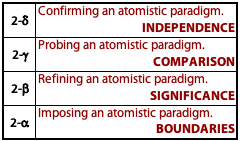
: probing the operation of boundaries: state = comparison
Relationships make you aware that every person is unique. When you compare yourself to the other person, you see that commonality brings you together, but differences broaden your combined scope of operation. In helping you pursue your goals, the other person may be prepared or even flattered to act on your behalf by using abilities and contacts that you lack.
Proposed t3 Name:
: confirming the nature of boundaries: state = independence
Each party in a relation has their own expectations, and a connection can develop from expectations that are appropriate and fitting. Expectations have a force of their own, so meeting their expectations of you provides a link, and if you make your expectations clear then the other person may respond and that can solidify a connection.
Proposed t4 Name:
: imposing a causal paradigm: state = explanation
Any relationship places demands on both parties. You may be able to take advantage of another's demands on you, and this might even be the initial form of connection before you want to develop a relation. Alternatively, you may connect by making a demand. As long as your demand is contextually appropriate and not excessive, a positive response will set up the link.
Proposed t5 Name:
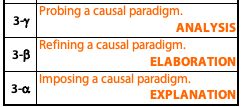
: refining the explanation: state = elaboration
Carefully chosen inducements can be persuasive and appropriate. Presenting a gift, theatre tickets, a monetary donation or something similar can potentially get a person on side and interested in you. Often special favours, sometimes sexual, are used as an inducement. Reciprocity is a powerful innate force and the greater the largesse the greater the expectation and likelihood of something in return.
Proposed t6 Name:
: probing details of the explanation: state = analysis
Relations work best when they are rock-solid and dependable, which means a strong bond between the two individuals. Bonding represents the finding of a kindred spirit and the sense of union, or possible union, at a deep level. While it is the most powerful form of connection, bonding is not as overtly emotional and demonstrative in relationships that are social rather than personal.
Proposed t7 Name:
Plotting on a TET
The Executing Duality
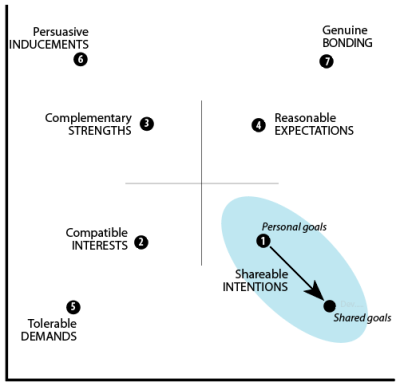
The layout of a set of Q-types on a TET is standard. So we can generate the diagram shown at right. Accepting this layout as correct immediately poses two demands:
a) to identify appropriate axes (the psychosocial executing duality);
and then
b) to check that the named ways are appropriately located.
The X-axis typically captures the social output, which in the case of a social relation relates to ensuring the other will actually engage with you.
Proposed X-axis label: Likelihood of the Other's Commitment.
The Y-axis typically captures the psychological input, which in the case of a social relation relates to motivation in the other to cooperate and assist you in reaching your goal.
Proposed Y-axis label: Boost to the Other's Motivation.
Checking Locations
High Commitment & Low Motivation Boost
Low Commitment & Low Motivation Boost
Low Commitment & High Motivation Boost
High Commitment & High Motivation Boost
Layout Features
Quadrants
Ways in the lower two quadrants are more specific, available and unambiguous, while those in the upper two quadrants are more uncertain, difficult and ambiguous.
Ways in the right two quadrants are more direct and positive, while those in the left two quadrants are more indirect and supportive.
Ways in diametrically opposite quadrants typically engender a degree of antagonism.
• LR is about direction, while UL is about methods;
• LL is more certain, while UR is more intangible.
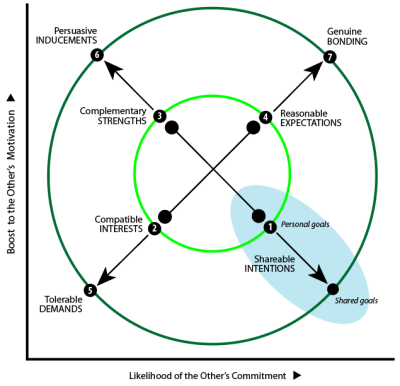
The arrows indicate preferences for guidance and support i.e. in shareable intentions (), personal goals are guided and supported by shared goals; interests () are guided and supported by demands (), strengths () are guided and supported by inducements (), finally expectations () are guided and supported by bonding ).
Circles
The inner circle defines ways that are the basis for any instrumental relation.
The outer circle defines ways that provide requirements for deepening the relation.
The two circles fuse in which changes from seeking personal goals to pursuing shared goals.
Diagonals
These define the Apollonian-Dionysian duality (or approach duality).
The Apollonian diagonal runs from LL to UR. It contains ways that enable interpersonal harmony, , , and . Moving up the diagonal, these ways are progressively more compelling in regard to the relationship. So these are: increasingly compelling harmonizing ways.
The Dionysian diagonal runs from LR to UL. It contains ways that are activating: , , , and . Moving up the diagonal, activation becomes increasingly forceful or even demanding. So these are increasingly demanding activating ways.
Originally posted: 26-Jan-2026.