Q2: Social Relations (II)
The Story so Far
The , based on applying and paradigms, deals with as explained in the previous topic. The ways in which it is possible to primarily to pursue your own goals are also developed there and plotted on a Typology Essentials Table (TET).
Strengthening Engagement with Another (Q2C)
In this next framework, the , having been plotted on the TET, are viewed as . These modes comprise distinctive sets of values and principles for fitting in with another person.
Given the aim is not life-long friendship or intimacy, the only reason to make the effort to fit in with another person is that it will help you achieve a particular goal of yours. So engaging with another person commences in Stage-1 by expressing your intentions and sharing on the expectation that there will be some receptivity.
The strengthening process builds on this foundation with 6 further Stages over 2 Cycles that move your shareable intentions to actually shared goals.
Cycle-1 focuses on getting aligned with each other once your intentions have been stated (μ1): initially by , then by , and finally by .
Cycle-2 focuses on drawing closer together. This entails initially , then , and finally with the other.
The Spiral is an effortful process that reflects interaction between two autonomous individuals. It can therefore stop at any Stage if engagement is judged to be sufficient or if the other person is unwilling or unable to proceed further. Progression is driven by (a) the other person's intrinsic importance for your goals, (b) your interest and comfort with the person, (c) social expectations, and (d) by limitations of previous modes.
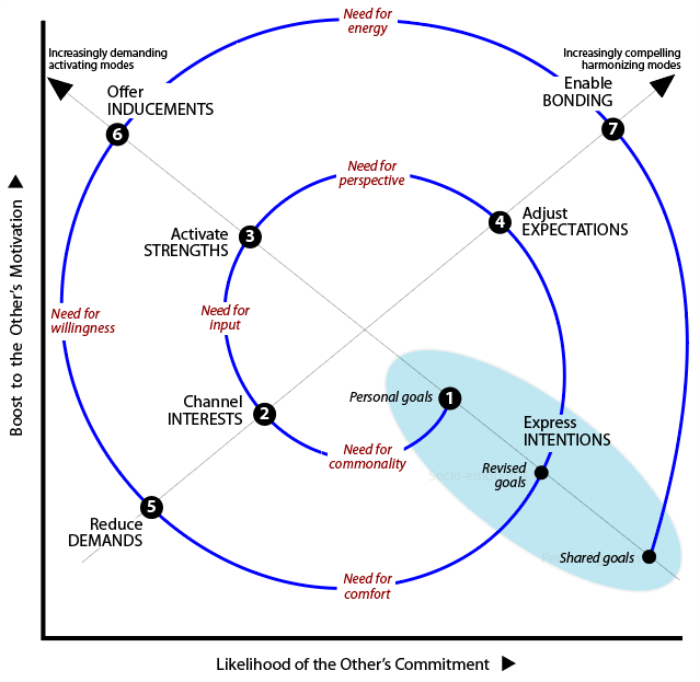
Cycle-1: Getting Aligned with Each Other
 Stage-1: Express Intentions
Stage-2: Channel Interests
Stage-3: Activate Strengths
Stage 4: Adjust Expectations
Cycle-2: Drawing Closer Together
Stage-5: Reduce Demands
Stage-6: Offer Inducements
Stage-7: Enable Bonding
Parallels between the Two Cycles
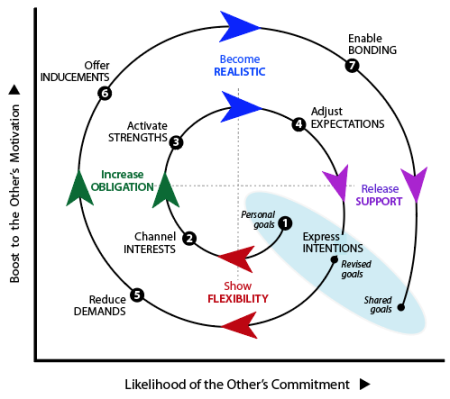
The two cycles show parallel moves in relation to the axes:
■ The initial transition is back along the X-axis away from a concern for commitment and with no increased boosting of motivation:
Φ1 → Φ2 & Φ4(μ1) → Φ5
This appears to be about showing flexibility in the relationship.
In Cycle-1, flexibility relates to your activity; in Cycle-2, it relates to the relationship.
■ The next transition is up the Y-axis boosting motivation without additional concern for commitment:
Φ2 → Φ3 & Φ5 → Φ6
This appears to be about increasing obligation in the relationship.
In Cycle-1, obligation flows from results; in Cycle-2, it flows from natural reciprocity.
■ The third transition is along the X-axis towards a greater guarantee of commitment while maintaining the motivational boosting.
Φ3 → Φ4 & Φ6 → Φ7
This appears to be about becoming realistic in the relationship.
In Cycle-1, realism is about what the other can deliver; in Cycle-2, realism is about the quality of relationship required.
■ The final transition down the Y-axis occurs spontaneously.
Φ4 → μ1 & Φ7 →μ1
This appears to be about releasing support for your intentions.
This confirms what might have been expected: fitting in to another person is about managing the relationship in a sensitive and realistic way.
Determinants of Orienting to a Social Relation (Q2CHK)
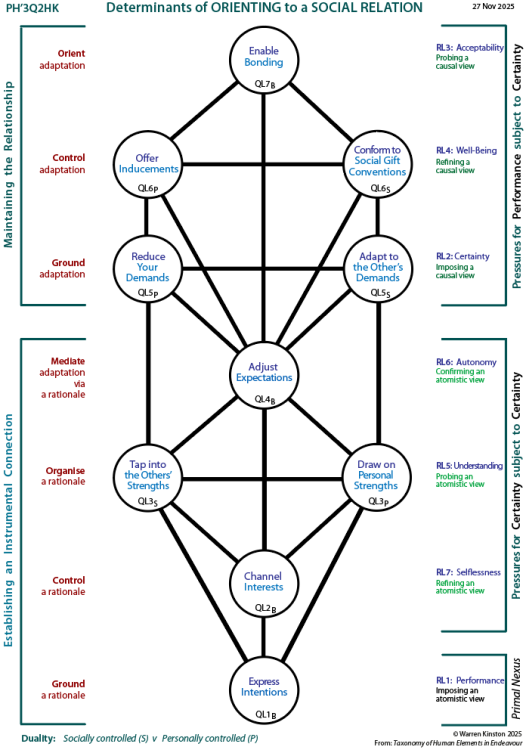
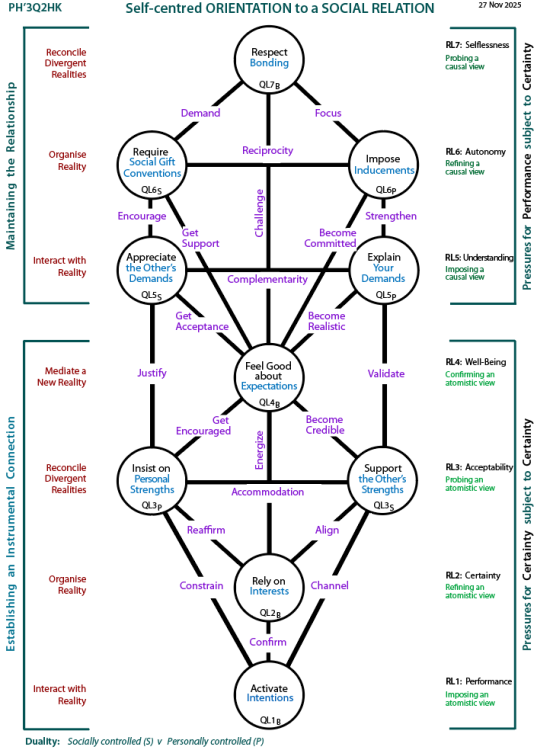
The Tree framework for orientation indicates the near-simultaneous use of all the factors examined in the TET and Spiral. It is likely the way most people will think of fitting in. In bringing the various Centres to life, a person needs to be imbued with a machiavellian spirit, not in a negative sense, but as an expression of realism. You are using the other person instrumentally, subtly or overtly, and for your benefit. More
A Tree framework can be created from the Q-Spiral by focusing on the essence of each of the 7 modes as they might emerge in actual situations. This reveals a dynamic duality as well as influences between the determinants.
Application of the Dynamic Duality
Establishing an Instrumental Connection: L1-L4
The lower pole of the internal duality appears to be "establishing an instrumental connection". It corresponds to the inner circle of the TET ("basis for any instrumental relation") and Cycle-1 of the Spiral ("getting aligned with each other").
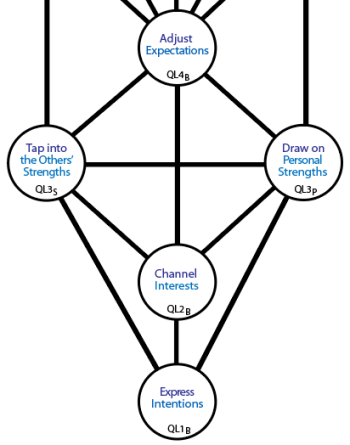
Level 1: Your intentions and how you express them and to whom are all under your personal control. However, you have no control over the social context in which this occurs, and these two factors cannot be disentangled.
So the Centre is balanced and named: .
Level 2: Your interests, which are under your control, must be linked to the self-interest of the other person, which is not. As the goal is to fuse interests, the two sets of interest cannot be addressed separately.
So the Centre is balanced and named: .
Level 3: There are two people with two sets of strengths that are distinct and independent of each other. Your personal strengths are yours to do with as you wish and the other person has been selected because their strengths, not under your control, are complementary. The relation develops if you can find ways to activate those strengths and use what the other contributes.
So there are two Centres here named:
&
The two poles naturally influence each other with appearing to be dominant.
Level 4: Adjusting your expectations is crucial to a constructive satisfying alignment and this is under your control. However, any adjustment is simultaneously a function of the other person as well, which means it is also under their control.
So the Centre is balanced and named: .
Maintaining the Relationship: L5-L7
The upper pole of the internal duality appears to be "maintaining the relationship". It corresponds to the outer circle of the TET ("requirements for deepening the relation") and Cycle-2 of the Spiral ("drawing closer together").
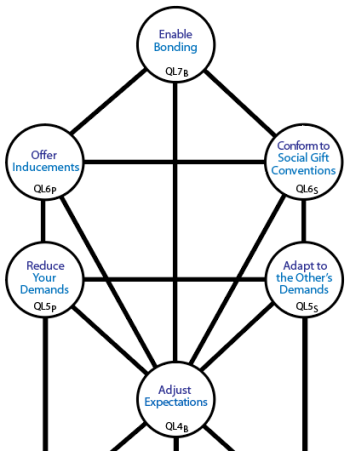
Level 5: You have control of the demands that you are placing on yourself and on the other person. The other person can make demands on you and this is outside your control. You must respond and adapt to those demands.
So there are two Centres here named:
&
The two poles naturally influence each other with appearing to be dominant.
Level 6: You have full control over the offering of inducements to the other person. A positive response to receipt of these inducements will be a function of social conventions and the other person's attitudes, and you have no control over either.
So there are two Centres here named:
&
The two poles naturally influence each other with appearing to be dominant.
Level 7: Enabling bonding is based on empathic relating that is under your control, but it naturally depends on the receptivity and response of the other.
So the Centre is balanced and named: .
Psychosocial Pressures
All psychosocial pressures are underpinned by acceptability as the driving force intrinsic to the domain. This is not shown in the diagrams below.
First there is certainty (1°) based on the Q2 position.
(Performance, 2° in the Q2 position, is not shown in the diagrams below.)
Then, as listed here, certainty (1° from ) in the lower half, and performance (1° from ) in the upper half.
The duplication of performance and certainty is noteworthy.
The requisite and self-interested Trees (below) show level by level pressures based on the Spiral pattern (see left Tree) and Tree structure i.e. Root Hierarchy (see right Tree).
Better viewing: Use browser zoom if needed.
|
|
-
Continue to Fitting in to Social Proposals (Q3).
Originally posted: 26-Jan-2026.