Q7: Group Cultures (I)
Preview
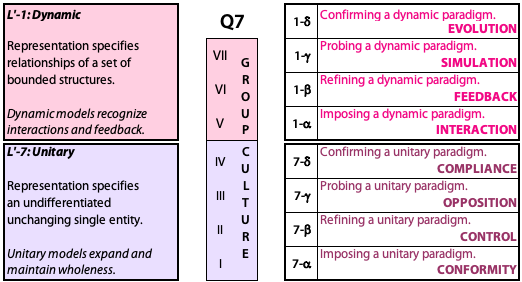
The , as shown in the diagram below, is created (by definition) from a combination of the and paradigms.
The paradigm is used to capture a reality permeated with control and where you want conformity and uniformity. Control uniformly applied suggests .
Whereas all previous Arenas were labeled «social» because the phenomena could have been understood as personal—i.e. there can be a personal project, a personal/intimate relation, a proposal for oneself, an intra-psychic conflict, a personal system, a personal role—a culture is intrinsically and only social.
Culture is what most immediately comes to mind when fitting in is mentioned.
The term culture often refers to a society, but culture emerges in every enduring group: large and small. Cultures vary greatly depending on the nature of the group and its context. Cultures refer to norms about the way things are done and the way people think: their uniformity provides predictability, security, stability and belonging. Cultures directly affect what others expect of us and how they will treat us in crucial parts of our life and also what we should expect of others and how we should treat them. Culture can never be safely ignored, and attention to enable a suitable orientation is always required when joining any new group.
So «» is the name of the Arena.
The paradigm is used to as a guide to fitting in to because we have to be culturally sensitive in the midst of the hurly-burly of everyday social interaction. Situations have their own requirements which include but are not limited to culture.
Fitting in with group culture is about belonging to a group through being like everyone else in regard to norms. Norms expressed in attitudes and interactions apply even if underlying values and beliefs differ in the group. The demands of a new group culture over-ride personal preferences and previous socialization. To fit in you are required to adapt yourself and comply with cultural norms without questioning so that you become (or in a society almost become) a group member. A person who neither adapts nor assimilates will initially be subject to pressures and even hostile reactions, and ultimately will be forced to exit or find themselves excluded.
Example:
Culture, depending on the group, can cover forms of civility, modes of dress, hygiene rules, sexual mores, relations with staff, methods of discipline, attitudes to work, dealing with bureaucratic systems.
Frameworks
TET: In order to fit in with the norms of any group, it is necessary to actively uphold them, even if that is not always easy. There are , which emerge from the depiction-states shown in the diagram. These 7 ways can be usefully analysed with a Typology Essentials Table (TET).
Spiral: By converting the ways to modes, it is possible to cumulate them via a spiral trajectory that .
Expected Pressures: 1°: Selflessness; 2°: Acceptability.
Because culture is a group phenomenon that exists independently of individualistic preferences and beliefs, selflessness is the identity pressure . However, once the culture is taken as given, then an acceptability pressure from within and without compels assimilation to it—or provokes a resistance that forces avoidance or exit from the group.
Ways to Adapt to the Culture
Fitting in to a group means fitting into the group's culture and that means adapting to it and slowly becoming socialized by the group.
In the smallest social groups, you may help shape the culture, but in most groups, large organizations and society, you have to take the culture as it is.
As an exception, leaders in organizations are in the unique position of being expected to regard culture as one of their building blocks (see Ch.10) for success. For everyone else, the culture within the group is a major determinant of continuing presence and comfort. Fitting in to tends to be difficult because of previous group experiences as well as intrinsic individuality.
Socialization results in alien societies seeming particularly strange and inconvenient: many norms seem unnecessary, wrong and even harmful. This leads to frustrations and an intra-psychic negativity. This is why entering a new society can lead to a debilitating "culture shock" followed by constant complaints about local inhabitants and their ways.
: imposing a unitary paradigm: state = conformity
All social groups, communities and societies have implicit and explicit norms to which all are expected to conform. By conforming to these norms, you are demonstrating that you belong to the group.
Conformity appears to be characterized by a minimal and a maximal version. The minimal version is for a newcomer and is based on learning about the norms, usually by asking. The maximal version reflects your socialization into the group and occurs without thinking.
Proposed t1 Name:
Minimum:
Maximum: .

: refining the conformity: state = control
Whereas conformity can be willing, adaptation can be forcefully demanded. If you violate a norm, others notice almost immediately and bring pressure to bear on you to alter your behaviour. This may be via silent facial or bodily expressions indicating disapproval; or you may be taken quietly aside and your violation explained; or you may be noisily upbraided or even threatened.
Proposed t2 Name:
: probing the uniformity of conformity: state = opposition
Every person in a group is unique, while the essence of culture is that its norms are uniform. So you are not automatically allowed to express all your personal preferences and tendencies. When you enter a group you bring your earlier experiences and socializations with you, and you may think those norms are preferable on rational grounds. However, logic does not apply here. To adapt you must restrain yourself.
Proposed t3 Name:
: confirming the nature of conformity: state = compliance
In unfamiliar situations, you may be unsure exactly what the culture calls for. However, you can be confident that norms will be upheld if you make a point of copying the attitudes and behaviours of other group members. That way you will not stand out and you will appear to all to be a typical member of the group.
Proposed t4 Name:
: imposing a dynamic paradigm: state = interaction
You will find yourself in social situations needing to anticipate how interactions will develop. Your expectations could lead you to cause offence or deal you an unpleasant surprise when your seemingly straightforward goals are frustrated. Such situations cannot be analysed in purely practical or logical terms—cultural meanings must be understood. Such understanding will lead you to alter your expectations of yourself and of others. This form of adaptation ensures you handle situations effectively.
Proposed t5 Name:
: refining the interactions: state = feedback
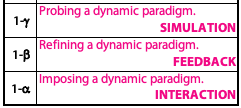
Any culture leads to a mentality shared by members of the group. This mentality or mindset may have a particular focus but it permeates a particular range activities. In a society, this may cover a great deal and become a factor in every interaction e.g. a hierarchical mentality operates in many Asian societies and an egalitarian mentality operates in many Western societies. By recognizing and, if possible, adopting the communal mindset you will be seen to be fitting in.
Proposed t6 Name:
: probing the operation of interactions: state = simulation
Culture confronts individuality. To remain in the group and be respected as a unique member, submission to the culture is required. Fighting culture is a losing endeavour. The final method of adaptation therefore takes the form of a willing surrender.
Proposed t7 Name:
Plotting on a TET
The Executing Duality

The layout of a set of Q-types on a TET is is standard. So we can immediately generate the diagram shown at right. Accepting this layout as correct then poses two demands:
a) to identify appropriate axes (the psychosocial executing duality);
and then
b) to check that the named ways are appropriately located
The X-axis typically captures the social output, which in the case of a group culture relates to enabling the group to be in control.
Proposed X-axis label: Contribution to Uniformity.
The Y-axis typically captures the psychological input, which in the case of a group culture relates to the willingness to allow the group's ways to dominate personal tendencies.
Proposed Y-axis label: Importance of Belonging.
Checking Locations
 High Uniformity & Low Belonging
Low Uniformity & Low Belonging
Low Uniformity & High Belonging
High Uniformity & High Belonging
Layout Features
Quadrants
Ways in the lower two quadrants are straight-forward and expedient, while those in the upper two quadrants require initiative and effort.
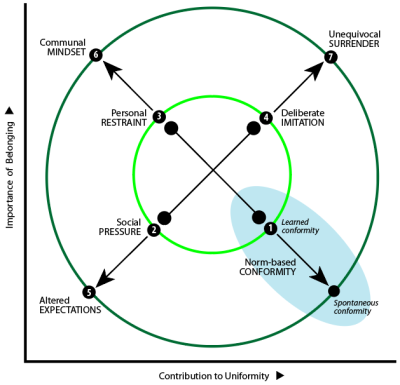
Ways in the two quadrants on the right side are more forceful and certain while those in the left two quadrants are more remedial with uncertain effects.
Ways in diametrically opposite quadrants engender a degree of antagonism:
• LR way is direct, while ULways are indirect;
• LL ways are partial, while UR ways are total.
The arrows indicate preferences for justification i.e. what is learned () is justified by what is spontaneous (), social pressure () is justified by expectations (); personal restraint () is justified by the communal mindset (), finally deliberate imitation () is justified by unequivocal surrender ).
Circles
The inner circle defines ways that are immediate. simple and specific.
The outer circle defines ways that are future-oriented, complicated and general.
The two circles fuse in which can shift between learning something specific and a spontaneity that is general.
Diagonals
These define the Apollonian-Dionysian duality (or approach duality).
The Apollonian diagonal runs from LL to UR. It contains ways that are controlling: via , then via , then via and finally via . Moving up the diagonal, the control is ever more rigid. So these are: increasingly rigid controlling ways of adapting to the culture.
The Dionysian diagonal runs from LR to UL. It contains ways that emphasize awareness: of , of , of a . Moving up the diagonal, the ways are increasing stressful: spontaneous conformity minimally, learned conformity more so, restraint even more, and altering a mindset is maximally stressful. So these are increasingly aware stressful ways of adapting to the culture.
Originally posted: 26-Jan-2026.