Q4: Social Conflicts (I)
Preview
The , as shown in the diagram below, is created (by definition) from a combination of the and paradigms.
The paradigm is used to capture the reality around that endure and cause a division within a group. Transient conflicts are common and unproblematic. Arguments may flare but no fitting in is required. By contrast, enduring conflicts bring a degree of acrimony and can become a feature of your group. Persistence of a division means that neither side easily wins the day, so you will need to take a side or try to sit on the fence. Any group can develop such a division and, if it does, then the conflict cannot be safely ignored. Attention to enable a suitable orientation will be required.
So «» is the name of the Arena.
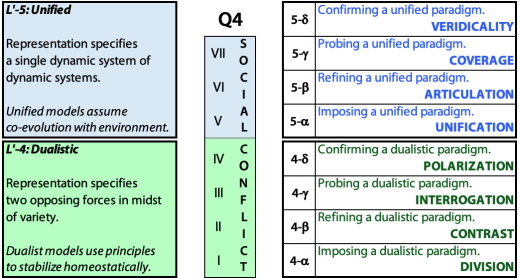
The paradigm guides your handling of a persistent because it affirms that the importance of the whole group transcends any division. The continuity and well-being of the group must be a concern for all, and any orientation involves recognizing that, if unmanaged, disputes can lead to an irreversible schism causing a break-up of the group.
Fitting in with a social conflict is about positioning vis a vis the division in the group while supporting the group's continuance. Fitting in means navigating the conflict while tolerating the hostility that accompanies such division. It is necessary to become comfortable with the division in the group. If you do not, then you may ultimately become unwilling to remain in the group.
Social Conflict = Division:
Conflicts within a group can develop over many things, like money, policy, membership, or proposed changes. But either some resolution with compromise is typically sought and found, or the status quo is simply endured. Any divisions that result are temporary and each issue ends up with different supporters on the two sides.
By contrast, the Arena here is formed by a social conflict with emotional dissension that leads to an entrenched division evidenced by permanent factions. These conflicts are not so easily solved or tolerated because they stem from differences in values and beliefs. They permeate many issues and, being embodied in camps or factions, the handling of seemingly simple matters can be impaired.
Examples  :
:
Is division with acrimony pathological?
Frameworks
TET: In order to fit in with (i.e. accommodate) an enduring social conflict in a group you must navigate your way around the group carefully. There are , which emerge from the depiction states shown in the diagram. These 7 ways can be usefully analysed with a Typology Essentials Table (TET).
Spiral: By converting the ways to modes, it is possible to cumulate them via a spiral trajectory that .
Expected Pressures: 1°: Well-Being; 2°: Autonomy.
Well-being is the identity pressure, presumably and paradoxically because conflict and acrimony develop through each side seeking what it believes is best for the group. Once the division is established, then an autonomy pressure affects handling including choice of sides, support for your own side, dealing with the other side, and other related requirements.
Factors in Navigating a Social Conflict
Fitting in with a social conflict means navigating the various factors in group life associated with its divisiveness while supporting the group and its mission.
The goal here is not necessarily to be on the winning side because sometimes you will be and sometimes you won't. Rather you must become comfortable with the presence of division, and not use it as an excuse to avoid group activities, to disrupt the group, or at the extreme to leave the group.
: imposing a dualistic paradigm: state = division
If there is an entrenched conflict in a social group that you join, you will immediately become aware of the emotional intensity and simmering hostility surrounding a division based in values and beliefs. No one in the group expects the issue causing the division to be resolved, and you have to confront this turmoil and find ways to deal with it.
The t1 entity is characterized by a minimal and a maximal version.
Proposed t1 Name:
Minimum: .
Maximum: .
: refining divisions: state = contrast
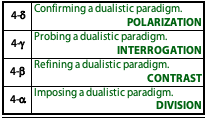
Divisions emerge with various labels—blocs, cliques, cabals, circles, wings, camps, factions—and these may be more or less well-organized. Such sub-groups focus loyalty and reflect deep commitment. In order to interact with other group members in a sensitive fashion and not embarrass yourself or them, you must learn to which faction they belong.
Proposed t2 Name:
: probing effects of divisions: state = interrogation
Factions embody particular values or beliefs and present themselves with a persuasive narrative. In finding your way around the group, managing conversations and predicting likely responses to group issues, it is helpful if you can appreciate the particular perspective of each faction.
Proposed t3 Name:
: confirming the nature of divisions: state = polarization
Either instinctively from an early stage or after careful analysis and reflection, you will find yourself preferring one side rather than another. By adopting and identifying with a preferred side, you join a faction and become a known quantity in the group. Loyalty is expected and your choice of side will guide you in responding to emerging issues.
Proposed t4 Name:
: imposing a unified paradigm: state = unification

The group has it own value that over-rides factional positions, and members need to show solidarity. Any social conflict within the group is a manifestation of natural diversity or expected differences. If taken too far, such division can lead to schism as one of the factions breaks away and forms its own new independent group. Coexistence is a necessity from the perspective of the group-as-a-whole, because infighting is destructive and leads to members leaving, while schism can seriously weaken the group, sometimes fatally.
Proposed t5 Name:
: refining the unification: state = articulation
Entrenched conflict can have consequences for a group, usually not pleasant. For example: it may interfere with recruitment of new members; it may interfere with donations; it may interfere with choices that should be driven by practical criteria. Becoming aware of consequences and often by bringing such potentials out into the open, you may be able to mollify and modify factional behaviour.
Proposed t6 Name:
: probing the quality of unification: state = coverage
While you may desire the conflict with its divisiveness to go away or be ignored, this would be a significant change in group life. People hate change, and the complexity of any resolution may be daunting. Furthermore it will always mean that one or both sides, or powerful individuals on those sides, experience a loss—which is commonly intolerable. So you fit in by recognizing that “leaving things as they are” is not just the path of least resistance—it is the overwhelmingly dominant strategy for most actors most of the time.
Proposed t7 Name:
What could lead to resolution of the division:
Plotting on a TET
The Executing Duality
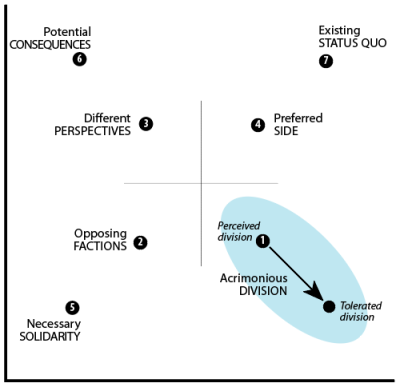
The layout of a set of Q-types on a TET is standard. So we can immediately generate the diagram shown at right. Accepting this layout as correct then poses two demands:
a) to identify appropriate axes (the psychosocial executing duality);
and then
b) to check that the named ways are appropriately positioned in the TET.
The X-axis typically captures the social output, which in the case of fitting in to a social conflict relates to recognizing that there is an ongoing unresolved divide in the group.
Proposed X-axis label: Assumption of Persistence.
The Y-axis typically captures the psychological input, which in the case of a social conflict relates to understanding what is going on in the group and why.
Proposed Y-axis label: Need for Analysis
Checking Locations
High Persistence & Low Analysis
Low Persistence & Low Analysis
Low Persistence & High Analysis
High Persistence & High Analysis
Layout Features
Quadrants
Ways in the lower two quadrants touch on more direct and forceful factors, while those in the upper two quadrants activate emotive and intellectual factors.
Ways in the right two quadrants foster commitment while those in the left two quadrants foster balance.
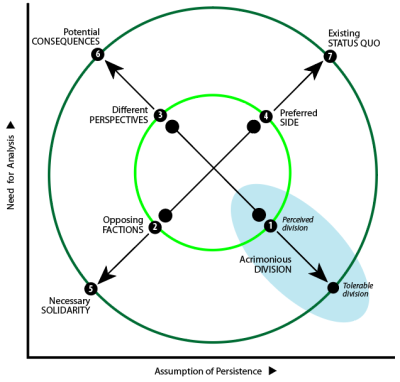
Ways in diametrically opposite quadrants engender a degree of antagonism:
• LR has a specific focus, while UL activates alternative foci;
• LL is given, while UR is chosen.
The arrows indicate preferences for restraint i.e. perceiving a division () is restrained by toleration of the division (), opposing factions () are restrained by necessary solidarity (), different perspectives () are restrained by anticipated consequences (), and your preferred side () gets restrained by the status quo ().
Circles
The inner circle defines immediate, unambiguous, and direct factors in navigating the conflict.
The outer circle defines context-sensitive, longer-term and distancing factors in navigating the conflict.
The two circles fuse in the which moves from being immediately perceived to being tolerated long term.
Diagonals
These define the Apollonian-Dionysian duality (or approach duality).
The Apollonian diagonal runs from LL to UR and contains ways that are all certain. Moving up the diagonal, these ways increasingly solidify the division: solidifies least, solidify more, much more, and the solidifies maximally. So these are: increasingly solidifying certain ways.
The Dionysian diagonal runs from LR to UL and contains ways that are distressing. Moving up the diagonal, a sense of seriousness is increases. Tolerance of the ignores seriousness, perceiving requires some sense of seriousness, clarification of requires more thoughtfulness because it is a serious matter, and potential faces seriousness head on. So these are increasingly serious distressing ways.
Originally posted: 26-Jan-2026.