Q4: Social Conflicts (II)
The Story so Far
The , based on and , deals with as explained in the previous topic. The factors involved in are also developed there and plotted on a Typology Essentials Table (TET).
Strengthening Comfort with Conflict (Q4C)
In this next framework, the , having been plotted on the TET, are viewed as . These modes comprise distinctive sets of principles for fitting in to a divided group.
To an outsider it might appear that the group's divisive conflict is either quite unnecessary, or based in misunderstandings that discussions and good will can handle. Surely the conflict is resolvable with some sensible compromises? But taking such attitudes into the group is not fitting in: it is the exact opposite because it denies the history of entrenchment and the constant (even if subliminal) acrimony. You fit in by accepting the ongoing presence of conflict and becoming so comfortable with it that, like everyone else, you ignore or ridicule anyone who imagines the conflict can be easily resolved.
Bitter conflict is unpleasant and the only reason to make the effort to fit in with it is because the group, despite its divisive conflict, is important to you. So fitting in commences in Stage-1 by .
The process of becoming comfortable builds on this foundation with 6 further Stages (Φ) over 2 Cycles that move your perception, and possible shock, to a condition of tolerance.
Cycle-1 focuses on adopting a stance in the conflict once the : initially by , then by , and finally by .
Cycle-2 focuses on protecting the group from the conflict. This entails initially , then , and finally .
The Spiral is an effortful process which can stop at any Stage if comfort is judged to be sufficient. Progression is driven by (a) personal commitment to the group, (b) the nature of the group and the conflict, (c) social expectations, and (d) limitations of previous modes.
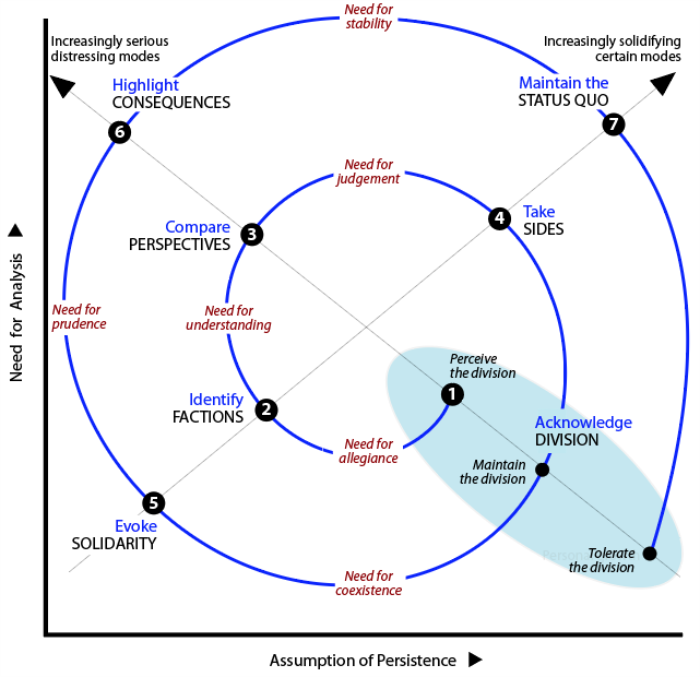
Cycle-1: Adopting a Stance
 Stage-1: Perceive the Division
Stage-2: Identify Factions
Stage-3: Compare Perspectives
Stage 4: Take Sides
Cycle-2: Protecting the Group
Stage-5: Evoke Solidarity
Stage-6: Highlight Consequences
Stage-7: Maintain Status Quo
Parallels between the Two Cycles
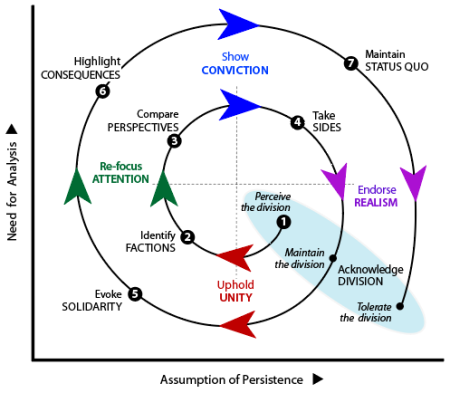
The two cycles show parallel moves in relation to the axes:
■ The initial transition is back along the X-axis away from an assumption of persistence and with no increased need for analysis:
Φ1 → Φ2 & Φ4(μ1) → Φ5
This appears to be about upholding unity in the face of conflict.
In Cycle-1, unity is within the faction; in Cycle-2 unity is within the group.
■ The next transition is up the Y-axis increasing the need for analysis without additional concern for persistence:
Φ2 → Φ3 & Φ5 → Φ6
This appears to be about re-focusing attention on the conflict.
In Cycle-1, attention moves from persons to perspectives; in Cycle-2 attention moves from looking inwards to looking outwards.
■ The third transition is along the X-axis towards a greater likelihood of persistence while maintaining the need for analysis.
Φ3 → Φ4 & Φ6 → Φ7
This appears to be about showing conviction within the group.
In Cycle-1, conviction is about yourself; in Cycle-2 conviction is about the group.
■ The final transition down the Y-axis occurs spontaneously.
Φ4 → μ1 & Φ7 →μ1
This appears to be about endorsing realism.
This confirms what might have been expected: fitting in to with an entrenched conflict is about coming to terms with it while supporting the group-as-a-whole.
Determinants of Orienting to a Social Conflict (Q4CHK)
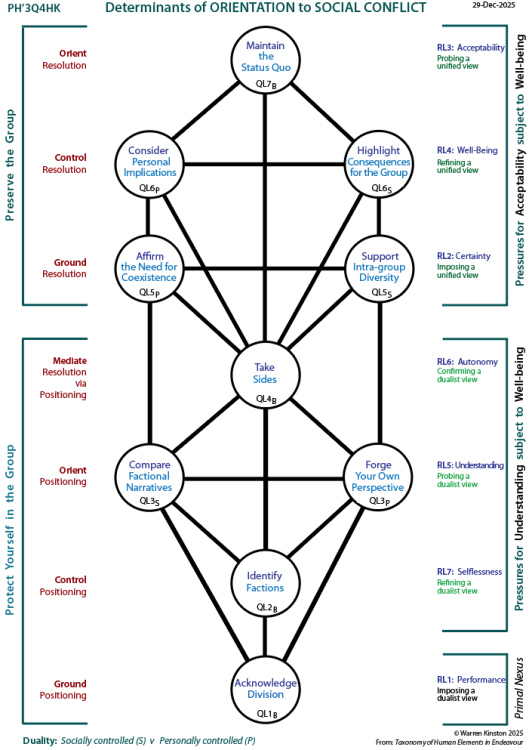
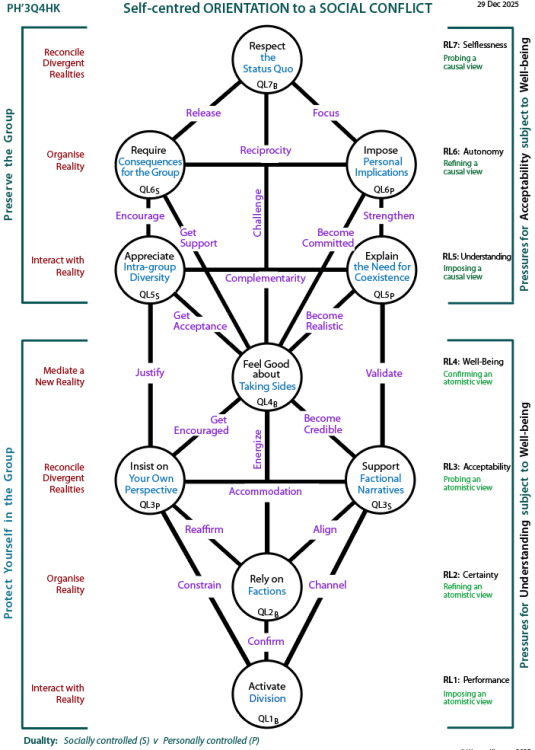
The Tree framework for orientation indicates the near-simultaneous use of all the factors examined in the TET and Spiral. It is likely the way most people will think of fitting in. In bringing the various Centres to life, a person needs to be imbued with a respectful spirit. While there may be disagreement and acrimonious episodes, denigration of colleagues and constant in-fighting are in no-one's interest. Respect for differences is vital in managing the situation.
A Tree framework can be created from the Q-Spiral by focusing on the essence of each of the 7 modes as they might emerge in actual situations. This reveals a dynamic duality as well as influences between the determinants.
Application of the Dynamic Duality
Protecting Yourself in the Group: L1-L4
The lower pole of the internal duality appears to be "protect yourself in the group". It corresponds to the inner circle of the TET ("immediate, unambiguous, and direct" ways of navigating), and Cycle-1 of the Spiral for becoming comfortable ("taking a stance").
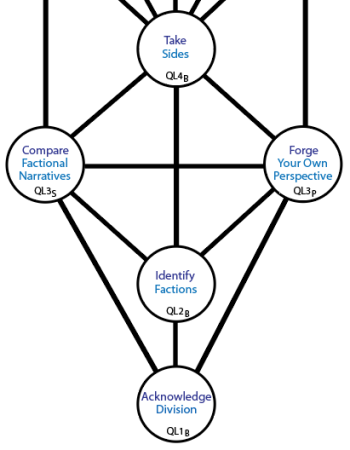
Level 1: You have no control over the existence of a division in the group but you are in control of acknowledging the division, and these two factors cannot be disentangled.
So the Centre is balanced and named: .
Level 2: In a similar fashion, factions exist in the group as a social phenomenon, but you control identification. The two aspects cannot be disentangled.
So the Centre is balanced and named: .
Level 3: Each faction will have its own perspective on the conflict and the division. While their narratives are not under your control, you can compare them. You can also, quite independently, forge your own perspective on the conflict and division.
So there are two Centres here named:
&
The two poles naturally influence each other with appearing to be dominant.
Level 4: Taking sides is both under your control and a function of the social milieu that defines the sides.
So the Centre is balanced and named: .
Preserving the Group: L5-L7
The upper pole of the internal duality appears to be "preserve the group". It corresponds to the outer circle of the TET ("context-sensitive, longer-term and distancing" ways) and Cycle-2 of the Spiral ("protecting the group").
Level 5: In evoking solidarity, it is necessary to support something over which you have no control: namely, the diversity of members and the differences of opinions which are natural in any group that is not autocratically governed. However, you can control affirmation of the importance of coexistence despite such differences.
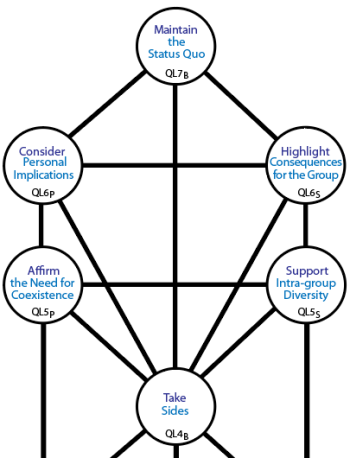
So there are two Centres here named:
.
&
The two poles naturally influence each other with appearing to be dominant.
Level 6: In highlighting consequences, your focus is on the infighting between the group's factions. You have no control over the state of the group, much less the consequences. However, you do control considering what the entrenched conflict means for yourself.
So there are two Centres here named:
.
&
The two poles naturally influence each other with appearing to be dominant.
Level 7: Maintaining the status quo is partly under your control and partly a function of others in the group whom you cannot control.
So the Centre is balanced and named: .
Psychosocial Pressures
All psychosocial pressures are underpinned by acceptability as the driving force intrinsic to the domain. This is not shown in the diagrams below.
First there is well-being (1°) based on the Q4 position.
(Autonomy, 2° in the Q4 position, is not shown in the diagrams below.)
Then, as listed here, understanding (1° from ) in the lower half, and acceptability (1° from ) in the upper half.
The duplication of acceptability is noteworthy.
The requisite and self-interested Trees (below) show level by level pressures based on the Spiral pattern (see left Tree) and Tree structure i.e. Root Hierarchy (see right Tree).
Better viewing: Use browser zoom if needed.
|
|
-
Continue to Fitting in to a Social System (Q5).
Originally posted: 26-Jan-2026.