Q3: Social Proposals (I)
Preview
The , as shown in the diagram below, is created (by definition) from a combination of the and paradigms.
The paradigm is used to capture reality in which an emergent problem must be explained in terms of a cause, or there is a wish to cause a state of affairs to alter. These are conditions of change, and intrinsically controversial. So, before anything is deliberately "caused", proposals for the change are developed and put to the relevant group for agreement. These are driven by a common need and a claim that the proposal meets the need in practice. Whenever you seek to propose changes, full attention to enable a suitable orientation will be required.
So «» is the name of the Arena.
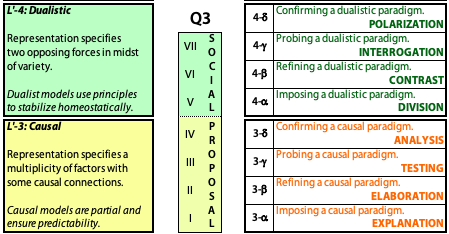
The paradigm guides your handling of because this identifies the controversial and political aspects of change that are unavoidable. In order to fit in, you must recognize in a balanced way that there will always be those that oppose a proposal as well as those that favour it.
Fitting in with a social proposal is about delivering a proposal that can win group support despite the associated controversy. This requires promoting your proposals effectively. If your promotion fails to win support, you will ultimately find that needs are not met or other proposals win the day, even if they are less satisfactory or less to your liking.
Example Proposals:
A public policy. A change in work-flow. A recreational outing. A shift in project direction. New software features. A revised urban plan. A new condominium car-park.
Frameworks
TET: In order to fit in when making a proposal, a person has to promote it. There are , which emerge from the depiction states shown in the diagram. These 7 ways can be usefully analysed with a Typology Essentials Table (TET).
Spiral: By converting the ways to modes, it is possible to cumulate them via a spiral trajectory that .
Expected Pressures: 1°: Acceptability; 2°: Certainty.
Acceptability is the identity pressure for proposals, which accords with their controversial quality. Unless a proposal is developed to be sufficiently acceptable, it will not even be considered. Once there is a willingness to consider a proposal, then a certainty pressure develops in relation to handling. This raises many issues—exactly what is being proposed, why is it being proposed who is involved, what are the costs and timings, who are the vested interests, are there better alternatives, and so on. The drive for certainty may lead to investigations.
Ways to Promote a Proposal
You fit in here by ensuring your proposal fits in terms of the need and the expectations of group members. That means promoting it in ways that enhance its acceptability.
Others will be judging your proposal using the same criteria that you are using to promote it. If it is acceptable, they also want to sure about what it offers and why it is necessary.
: imposing a causal paradigm: state = explanation
In relation to any proposal, you must present its essence, i.e. the rationale for the proposal, and use that to promote it. The proposal must be explained as the way to meet a currently unmet, poorly served, or newly emergent need.
The t1 entity is characterized by a minimal and a maximal version.
Proposed t1 Name:
Minimum: .
Maximum: .
: refining an explanation: state = elaboration
You can promote the proposal by finding people with relevant credentials and explaining to them the proposal in more detail. Getting the backing of specific influential supporters enhances the proposal's credibility. Any proposal gets judged by assessing the proposers and the credibility of its most outspoken supporters. When it seems that vested interests are in play, that may weaken confidence.

Proposed t2 Name:
: probing the explanation: state = analysis
Proposals that have the backing of many are more likely to be adopted. While this may say little about the quality of the proposal, popularity is a factor commonly used for judging proposals. The more people valuing the proposal, for whatever reason, the more likely it is to be supported by the remainder of the group.
Proposed t3 Name:
: confirming the nature of the explanation: state = consensus
Proposals are focused on meeting certain critical needs, which is the primary benefit. However, there are always side-effects of implementation, many of which are positive. These potential benefits need to be highlighted while undesirable side-effects should be mitigated. Secondary benefits can be powerful inducements, entering into judgements, and helping generate a consensus.
Proposed t4 Name:
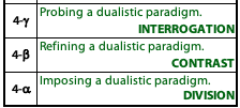
: imposing a dualistic paradigm: state = division
Proposals go out for consultation to get ideas for improvement and to provide a time delay that reduces any surprise and lessens distress at the suggested change. Nevertheless, proposals commonly end up having a faction in favour and an opposing faction. While reasons held by factional members may vary, each faction seeks to be united around their position in order to maximize their influence. The presence of a sizeable supporting faction is a positive sign.
Proposed t5 Name:
: refining the divisions: state = contrast
Individuals or factions may seek to be constructive by raising alternatives to the submitted proposal. They offer plausible possibilities that may be appealing, for example by dramatically reducing costs or inconvenience. However, due to the lack of time and resources, such alternatives are likely to be weakly developed or have serious flaws. By having an open debate, The proposal can often be promoted by comparing it to these suggested alternatives.
Proposed t6 Name:
: probing the effect of divisions: state = interrogation
The proposal can also be looked at from a social demand perspective. Circumstances may generate a pragmatic imperative for proceeding with the proposal. Or there may be a moral imperative for addressing the need at this point in time in this way. Imperatives tend to be both persuasive and unifying.
Proposed t7 Name:
Plotting on a TET
The Executing Duality
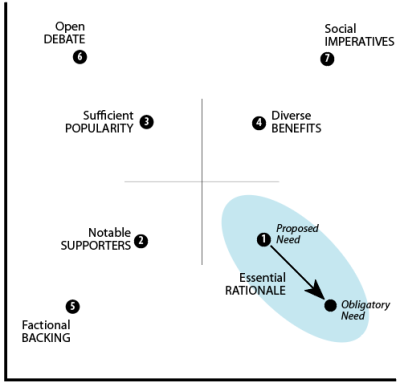
The layout of a set of Q-types on a TET is standard. So we can immediately generate the diagram shown at right. Accepting this layout as correct then poses two demands:
a) to identify appropriate axes (the psychosocial executing duality);
and then
b) to check that the named ways are appropriately positioned in the TET.
The X-axis typically captures the social output, which in the case of a social proposal relates to ensuring the proposal is likely to be endorsed even if not fully desired or understood.
Proposed X-axis label: Inherent Persuasiveness.
The Y-axis typically captures the psychological input, which in the case of a social proposal relates to an inner disposition to pay attention and take the proposal seriously,.
Proposed Y-axis label: Need for Receptivity.
Checking Locations
 High Persuasiveness & Low Receptivity
Low Persuasiveness & Low Receptivity
Low Persuasiveness & High Receptivity
High Persuasiveness & High Receptivity
Layout Features
Quadrants
Ways in the lower two quadrants are more direct and forceful, while those in the upper two quadrants are more emotive and intellectual.
Ways in the right two quadrants suggest commitment while those in the left two quadrants generate argument.
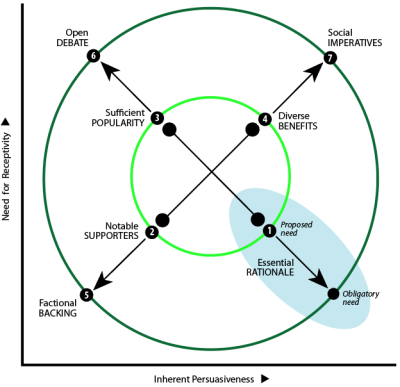
Ways in diametrically opposite quadrants engender a degree of antagonism:
• LR is logically-driven, while UL is emotionally-driven;
• LL is subgroup-oriented, while UR is whole group-oriented.
The arrows indicate preferences for establishing legitimacy i.e. the rationale's proposed need () is legitimated by the obligatory need (), notable supporters () are legitimated by their faction (), sufficient popularity () is legitimated via an open debate of alternatives (), and diverse benefits () get legitimacy from social imperatives ().
Circles
The inner circle defines direct expedient ways to promote (and judge).
The outer circle defines contextual and controversial ways to promote (and judge).
The two circles fuse in the which moves from a need that is directly proposed to a controversial obligation.
Diagonals
These define the Apollonian-Dionysian duality (or approach duality).
The Apollonian diagonal runs from LL to UR. It contains ways that are provide a specific character i.e. specific , specific , specific , specific . Moving up the diagonal, these ways become ever more forceful and appealing: factions least so, supporters more so, benefits much more so and imperatives maximally. So these are: increasingly forceful characterizing ways.
The Dionysian diagonal runs from LR to UL. It contains ways that are critical for the proposal: its , its , and . Moving up the diagonal, they generate ever more exposure: an obligatory need is minimally exposing, the proposed need can expose the proposer, popularity is much more exposing, and debating is potentially most exposing. So these are increasingly exposing critical ways.
Originally posted: 26-Jan-2026.