Q3: Social Proposals (II)
The Story so Far
The , based on and , deals with as explained in the previous topic. The 7 different ways ensure you are that is a good fit are also developed there and plotted on a Typology Essentials Table (TET).
Strengthening Support for the Proposal (Q3C)
In this next framework, the a social proposal, having been plotted on the TET, are viewed as the proposal. These modes comprise distinctive sets of principles for becoming sufficiently certain your proposal will fit and be agreed. For others in the group, the modes could be viewed as modes of evaluating that develop belief in the proposal
Ensuring that your proposal will fit with the group commences by because that involves identifying and explaining a need that you must know will be widely shared. Others potentially fit in by coming to believe that the proposal is required.
The promoting process is progressive and develops with 6 further Stages (Φ) over 2 Cycles that move you from explaining a proposed need to confirming that need and ultimately to insisting that the need must be met.
Cycle-1 focuses on developing interest within the group following : initially by , then by of the proposal, and finally by .
Cycle-2 focuses on forging a group consensus. This entails initially , then , and finally .
The Spiral is an effortful process which can stop at any Stage if support is judged to be sufficient. Progression is driven by (a) personal commitment to the proposal, (b) the intrinsic importance of the proposal, (c) social expectations, and (d) limitations of previous modes.
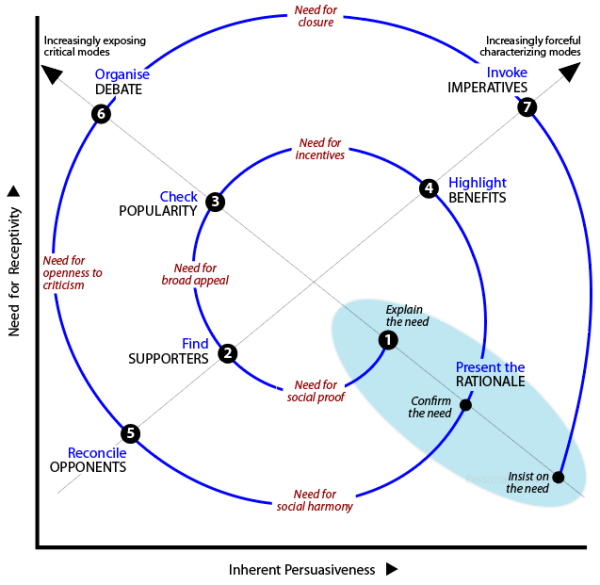
Cycle-1: Developing Group Interest
 Stage-1: Present the Rationale
Stage-2: Find Supporters
Stage-3: Check Popularity
Stage 4: Highlight Benefits
Cycle-2: Forging a Group Consensus
Stage-5: Reconcile Opponents
Stage-6: Organise Debate
Stage-7: Invoke Imperatives
Parallels between the Two Cycles
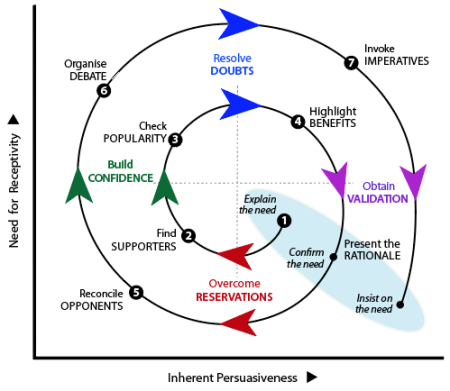
The two cycles show parallel moves in relation to the axes:
■ The initial transition is back along the X-axis away from a concern for persuasiveness and with no increased need for receptivity:
Φ1 → Φ2 & Φ4(μ1) → Φ5
This appears to be about overcoming reservations to the proposal.
In Cycle-1, the focus is on reservations of supporters; while in Cycle-2, the focus is on reservations of opponents.
■ The next transition is up the Y-axis increasing the need for receptivity without additional persuasiveness:
Φ2 → Φ3 & Φ5 → Φ6
This appears to be about building confidence in the proposal.
In Cycle-1, confidence builds via unity; while in Cycle-2, confidence builds via diversity.
■ The third transition is along the X-axis towards a greater persuasiveness while maintaining the need for receptivity.
Φ3 → Φ4 & Φ6 → Φ7
This appears to be about resolving doubts about the proposal.
In Cycle-1, doubts are removed using incentives; while in Cycle-2, doubts are removed using forcefulness.
■ The final transition down the Y-axis occurs spontaneously.
Φ4 → μ1 & Φ7 →μ1
This appears to be about obtaining validation for your rationale.
This confirms what was expected: fitting in is about winning support, which means ensuring the proposal is evaluated positively by others.
Determinants of Orienting to a Social Proposal (Q3CHK)
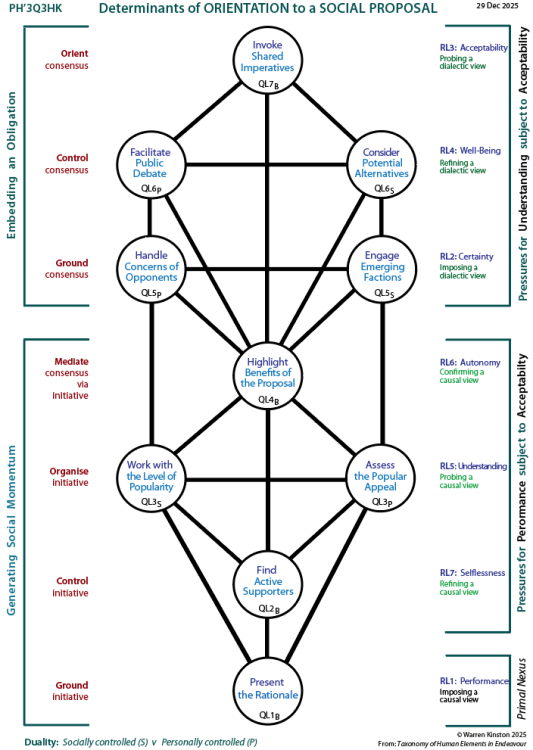
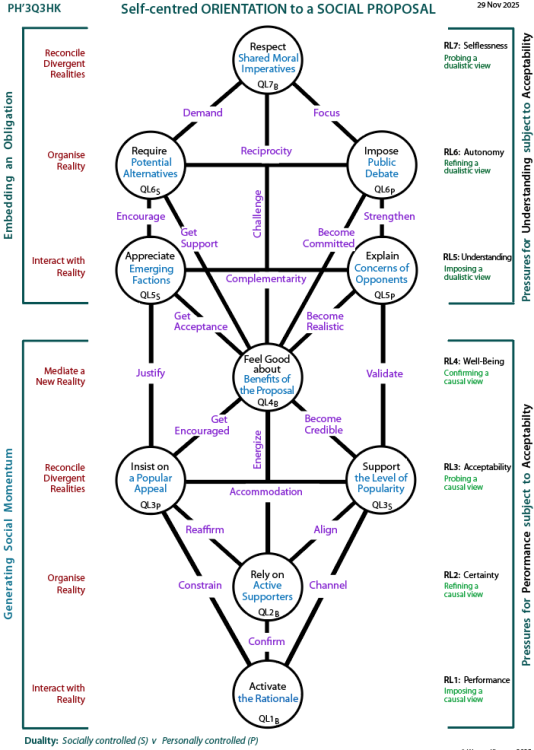
The Tree framework for orientation indicates the near-simultaneous use of all the factors examined in the TET and Spiral. It is likely the way most people will think of fitting in. In bringing the various Centres to life, a person needs to be imbued with a political spirit. That means things like being sensitive to opinions, interests and attitudes of others, expecting some controversy, showing a readiness to explain, listen and compromise.
A Tree framework can be created from the Q-Spiral by focusing on the essence of each of the 7 modes as they might emerge in actual situations. This reveals a dynamic duality as well as influences between the determinants.
Application of the Dynamic Duality
Generating Social Momentum: L1-L4
The lower pole of the internal duality appears to be "generating social momentum". It corresponds to the inner circle of the TET ("direct expedient ways") and Cycle-1 of the Spiral ("developing group interest").
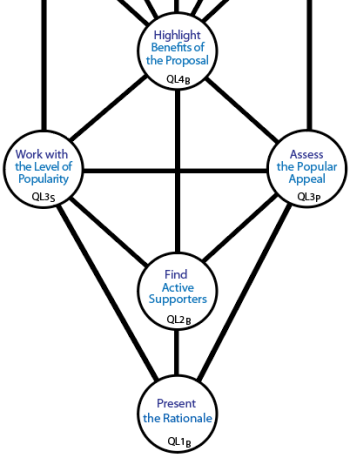
Level 1: You are in control when developing and presenting the rationale for your proposal. However, you have no control over the needs and social milieu that forces you to generate the proposal. These two perspectives cannot be disentangled.
So the Centre is balanced and named: .
Level 2: Your selection and engagement of individuals prepared to actively support your proposal is under your control. But this depends on who is available and their influence, which is given by the milieu. The two factors cannot be addressed separately.
So the Centre is balanced and named: .
Level 3: In checking popularity, there is first of all the actual level of popularity over which you have no control but which you must handle. Then there is your assessment of the popular appeal of the proposal which is under your control. The two are distinct and independent of each other.
So there are two Centres here named:
&
The two poles naturally influence each other with appearing to be dominant given this what you can be most sure about.
Level 4: In highlighting the benefits of the proposal, you are in control of the analysis and the promotion, but the benefits themselves emerge from a milieu which you do not control. These factors cannot be disentangled or divided.
So the Centre is balanced and named: .
Embedding an Obligation: L5-L7
The upper pole of the internal duality appears to be "embedding an obligation". It corresponds to the outer circle of the TET ("contextual and controversial") and Cycle-2 of the Spiral ("forging a group consensus").
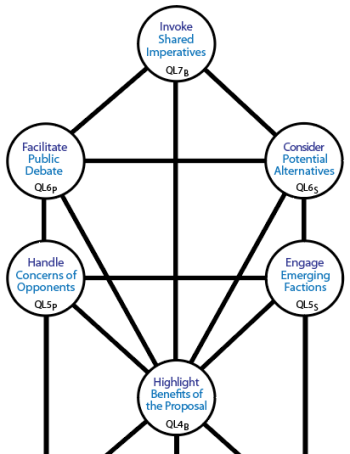
Level 5: Change is controversial and you cannot control the emergence of opposition. Opponents may even coalesce to form a factions in response to your proposal. However, you can take the concerns of opponents seriously and deal with them constructively.
So there are two Centres here named:
&
The two poles naturally influence each other with appearing to be dominant because that is most achievable.
Level 6: You have control over your defense of your proposal in any debate, and you should strongly support a debate. However, you do not control the potential alternatives on offer, nor the arguments against your proposal, even if these deserve your consideration.
So there are two Centres here named:
&
The two poles naturally influence each other with appearing to be dominant because that will determine your handling.
Level 7: Invoking imperatives is something under your control, but it only works if others share those imperatives and that is outside your control. You will only choose imperatives that are shared so there can be no disentanglement.
So the Centre is balanced and named: .
Psychosocial Pressures
All psychosocial pressures are underpinned by acceptability as the driving force intrinsic to the domain. This is not shown in the diagrams below.
First there is acceptability (1°) based on the Q3 position.
(Selflessness, 2° in the Q3 position, is not shown in the diagrams below.)
Then, as listed here, performance (1° from ) in the lower half, and understanding (1° from ) in the upper half.
The duplication of acceptability is noteworthy.
The requisite and self-interested Trees (below) show level by level pressures based on the Spiral pattern (see left Tree) and Tree structure i.e. Root Hierarchy (see right Tree).
Better viewing: Use browser zoom if needed.
|
|
-
Continue to Fitting in with Social Conflicts (Q4).
Originally posted: 26-Jan-2026.