Q1: Social Projects (I)
Preview
The , as shown in the diagram below, is created from a combination of the and paradigms.
The paradigm captures the reality of any , its formation and development via a team of people who interact dynamically to deliver on its mission. Personal participation in a project is about becoming a team member and that entails fitting in—whether you are the leader or the most junior participant. Projects are generated by groups of all sorts. Whenever you join, attention to enable a suitable orientation is required.
So «» is the name of the Arena
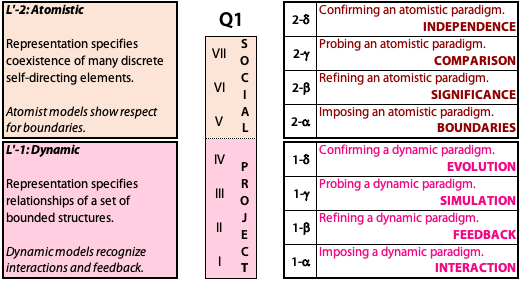
The paradigm also applies to any project. Every project is set up with a continuing mission until completion or termination. So it has definite boundaries with an identity and independent existence. Each must recognize and deal with the presence of other projects. Fitting in naturally takes these atomistic features into account.
So fitting in to a social project is about submitting to the project mission and interacting with co-workers to progress the project. This requires adjusting yourself and your attitudes so that you can contribute. A person who rubs everyone up the wrong way and does not contribute is not fitting in.
Example Projects:
Extending a house. Campaigning for new members. Organising a conference. Cleaning up a street. Managing a public garden. Introducing a new service.
Frameworks
TET: In order to fit in, a person has to adjust to the current state of the project and its members. There are , which emerge from the depiction states shown in the diagram, and these can be usefully analysed using a Typology Essentials Table (TET).
Spiral: By converting the ways to modes, it is possible to cumulate them via a spiral trajectory that , so confirming your fit.
Expected Pressures: 1°: Performance; 2°: Understanding.
Projects are about producing an outcome as specified by their mission, and so performance is their identity pressure. We get assigned to projects as part of employment and join other worthwhile projects pro bono. Once involved with a project, we need to appreciate what is going on, what our colleagues are doing, and how we can contribute effectively. So handling ourselves in relation to pursuit of the mission with others is subject to an understanding pressure.
 Terminological Note
Why "Social Project"?
This phrasing may seem clumsy. But the issue of fitting in does not apply to a personal project involving no-one else e.g. creating your rose garden.
Which "Social Project"?
The simplest conception is joining a self-contained and currently running project. Such a project could be set up as its own organisation.
If the project is completely new, there will be some differences in the dynamics but the principles to be developed do not change.
If the project is within an existing organization, then the dynamics will be slightly different because you will likely already know other staff and have an informal role. However, the principles to be developed do not change.
Ways to Adjust to a Project
Fitting in to a project demands adjusting to its mission and its current state as well as to the team in place.
Before even starting, you get an appointment or assignment to the project. You will be told your position and your authority relationships, and usually you will be given a set of duties with immediate priorities and tasks. However, all that is theoretical. Once you are in the project, you find that it is not designed for you, nor you for it. You need to adjust yourself or you won't last.
: imposing a dynamic paradigm: state = interaction
Entering a project immediately plunges you into its culture and its interactional dynamics. By observing the nature and effect of interactions within the team (including yourself) and between the team and outsiders, you can determine how best to adjust your approach. However, you must start by interacting.
Initially you test the waters and so interactions are tentative. Once you are settled in, your interactions will become routinely acceptable. The goal is to be so attuned that your interactions are invariably constructive.
Proposed t1 Name:
Minimum: .
Maximum: .
: refining interactions: state = feedback
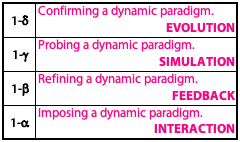
You can get feedback on your participation and give feedback to others on their contribution to the project. Exchanges of information like this play an important role in helping you adjust.
Proposed t2 Name:
: probing the interactions: state = simulation
The interactions that occur in any project are the visible manifestation of the relationships that develop between team members. This network of relationships must be understood and used for effective participation. Adjusting to most co-workers may be straightforward. However, achievement not personality is the issue. Certain relationships that are useful, even essential, must be developed regardless of how unpleasant or difficult the other party may be.
Proposed t3 Name:
: confirming the nature of interactions: state = evolution
Dynamic systems evolve and that will apply to any project and its team. The progress of the project never ceases. You need to adjust yourself so as to get on board with it wherever it happens to be and in whichever direction it happens to be going: even if you judge there to be errors, possibly severe.
Proposed t4 Name:
: imposing an atomistic paradigm: state = boundaries
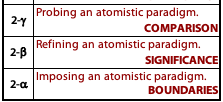
Informal roles, are required for effective performance by any work group. Belbin, for example, identified a variety of distinct behavioral patterns (which are not personality types) with three broad orientations: social (eg "networker"), thinking (e.g. "creative"), and task (e.g. "finisher"). Each pattern's strengths come with associated weaknesses. Social pressure may force you to take on a missing role even if it is not particularly comfortable. You also need to respect the value of others who have taken on specific informal roles.
Proposed t5 Name:
: refining the boundaries: state = significance
The nature of projects is that they come up against blockages and disruptions which pose challenges. Such challenges, which are unavoidable, can lead to failure or even collapse of the project. So you have to adjust to them. Challenges may demand deviation from your usual work pattern and often call on strengths which may not be habitual or preferred.
Proposed t6 Name:
: probing the boundaries: state = comparison
You join the project with certain expectations and understandings but as matters evolve, changes become required, often major ones and often without any input from you e.g. key personnel alter, an important policy is modified, expected resources vanish. Adjusting to changes is often the most challenging and distressing demand.
Proposed t7 Name:
Plotting on a TET
The Executing Duality
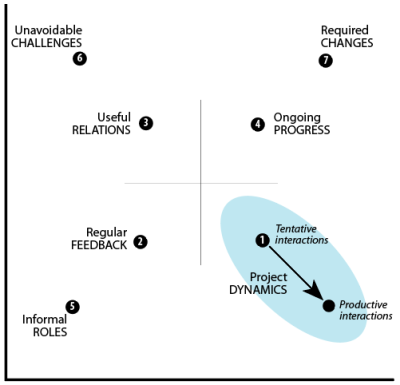
The layout of a set of Q-types on a TET is standard. So we can generate the diagram shown at right. Accepting this layout as correct immediately poses two demands:
a) to identify appropriate axes (the psychosocial executing duality);
and then
b) to check that the named ways are appropriately located.
The X-axis typically captures the social output: in this case the output must demonstrate and be the result of a fit with the project.
Projects are set up to achieve something. We adjust to the project's demands and dynamics because we want to contribute to that achievement i.e. the output axis involves an Orientation to Outcomes.
The Y-axis typically captures the psychological input: in this case the requirement involves understanding what is going on in the project.
Project processes get complicated due to the variety of people involved and inherent delivery challenges. We have to check that whether and how we adjust is appropriate i.e. the input involves a Need for Exploration.
Checking Locations
High Outcomes & Low Exploration
Low Outcomes & Low Exploration
Low Outcomes & High Exploration
High Outcomes & High Exploration
Layout Features
Quadrants
Ways in the lower two quadrants are more direct and productive, while those in the upper two quadrants are more indirect and speculative.
Ways in the right two quadrants are about deliverables, while those in the left two quadrants are about being supportive.
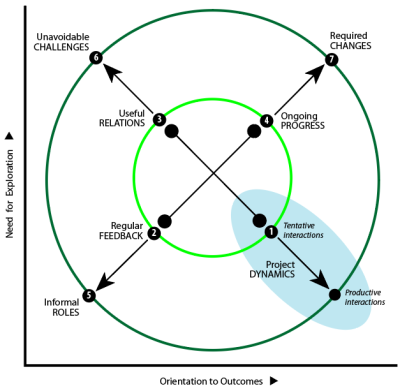
Ways in diametrically opposite quadrants engender a degree of antagonism:
• LR is the essence of contributing, while UL are contextual factors; • LL has a behavioral focus, while UR has a results focus.
The arrows indicate preferences for guidance i.e. in project dynamics (), tentative interactions are guided by productive interactions; feedback () is guided by informal roles (), relationships () are guided by challenges (), and finally progress () is guided by required changes),
Circles
The inner circle focuses on adjusting to the project.
The outer circle focuses on making the project personal.
The two circles fuse in which is about adjustment involving both project factors and personal factors.
Diagonals
The two diagonal sets define the Apollonian-Dionysian duality (or approach duality).
The Apollonian diagonal runs from LL to UR. It contains ways that create order: via , then via , then via and finally via . Moving up the diagonal, there is a more and more instrumental demand on the person. Looking at the extremes: an informal role needs to suit the personality, whereas changes must be adapted to regardless. So these are: increasingly instrumental ordered ways.
The Dionysian diagonal runs from LR to UL. It contains ways that initiate activity: via , then via , then via . Moving up the diagonal, initiation is more and more personal. Looking at the extremes: productive interactions are minimally personal while challenges are maximally personal. So these are increasingly personal initiating ways.
Originally posted: 26-Jan-2026.