Q1: Social Projects (II)
The Story so Far
The , based on applying and , deals with as explained in the previous topic. The 7 different ways in which it is possible to in order to fit in are also developed there, and plotted on a Typology Essentials Table (TET).
Strengthening Contribution to the Project (Q1C)
Projects demand that participants contribute. In this next framework, the to a project, having been plotted on the TET, are viewed as . These modes comprise distinctive sets of principles that assist you to fit in.
commences with because when you start you are unsure about the situation and how others will respond to your efforts.
The developmental process builds on this Stage-1 foundation with 6 further Stages (Φ) over 2 Cycles that move you from tentative interactions hoping to forward the project to productive interactions where there is no doubt.
Cycle-1 focuses on becoming part of the project following tentative interactions (). This is initially by about your activities, then by with co-workers, and finally by of the project.
Cycle-2 focuses on becoming a valuable participant. This entails initially , then , and finally in the project.
The Spiral is an effortful process which can stop at any Stage if your contribution is judged to be satisfactory. Progression is driven by (a) your interest in the project, (b) the project's intrinsic importance, (c) social expectations, and (d) limitations of previous modes.
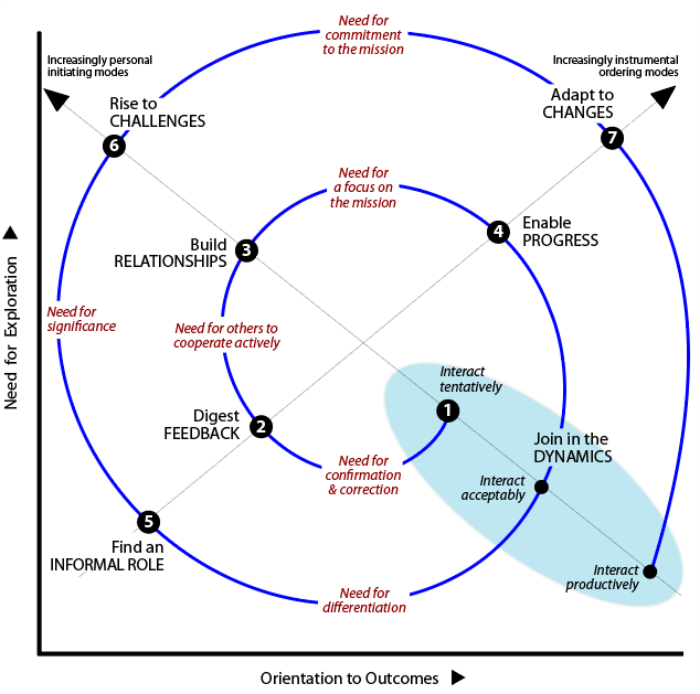
Cycle-1: Becoming Part of the Project
 Stage-1: Join in the Dynamics
Stage-2: Digest Feedback
Stage-3: Build Relationships
Stage 4: Enable Progress
Cycle-2: Becoming a Valuable Participant
Stage-5: Fill an Informal Role
Stage-6: Rise to Challenges
Stage-7: Adapt to Changes
Parallels between the Two Cycles
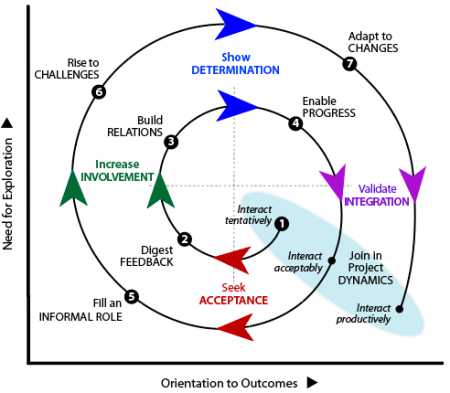
The two cycles show parallel moves in relation to the axes:
■ The initial transition is back along the X-axis away from a focus on outcomes
Φ1 → Φ2 & Φ4(μ1) → Φ5
and appears to be about seeking acceptance by the project team.
In Cycle-1, acceptance comes from responding; in Cycle-2, it comes from initiating.
■ The next transition is up the Y-axis for greater exploration but with no additional concern for outcomes
Φ2 → Φ3 & Φ5 → Φ6
and appears to be about increasing involvement with the project team.
In Cycle-1, involvement is a consequence of relating; in Cycle-2, it is a consequence of immersion in the challenge.
■ The third transition is along the X-axis with a greater focus on outcomes.
Φ3 → Φ4 & Φ6 → Φ7
and appears to be about showing determination in regard to the mission.
In Cycle-1, determination produces results; in Cycle-2, it is about overcoming disruption or disappointment.
■ The final transition down the Y-axis occurs spontaneously.
Φ4 → μ1 & Φ7 →μ1
and appears to be about validating your integration within the project.
This confirms what might have been expected: fitting in to the project is to a large extent about working with the people already there.
Determinants of Orienting to a Social Project (Q1CHK)
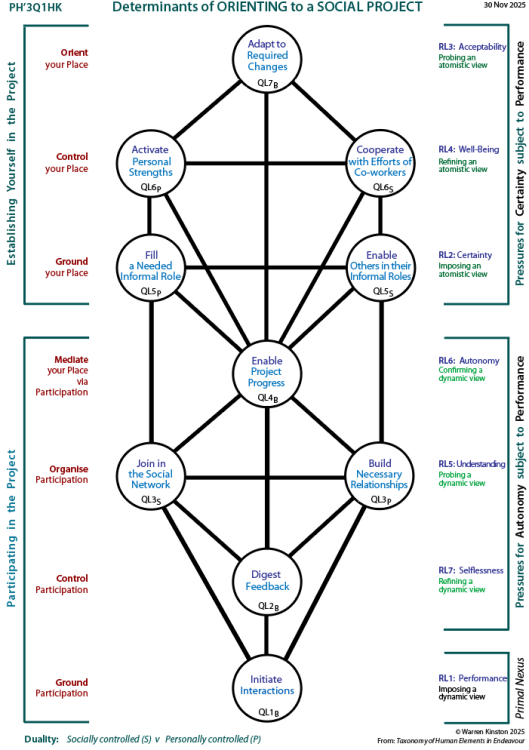
The Tree framework for orientation indicates the near-simultaneous use of all the factors examined in the TET and Spiral. It is likely the way most people will think of fitting in. In bringing the various Centres to life, a person needs to be imbued with a practical spirit. There is little point in doing or saying anything without envisaging the practical implication.
A Tree framework can be created from the Q-Spiral by focusing on the essence of each of the 7 modes as they might emerge in actual situations. This reveals a dynamic duality as well as influences between the determinants.
Application of the Dynamic Duality
Participating in the Project: L1-L4
The lower pole of the internal duality appears to be "participating in the project". It corresponds to the inner circle of the TET ("adjusting yourself to the project") and Cycle-1 of the Spiral ("becoming part of the project").
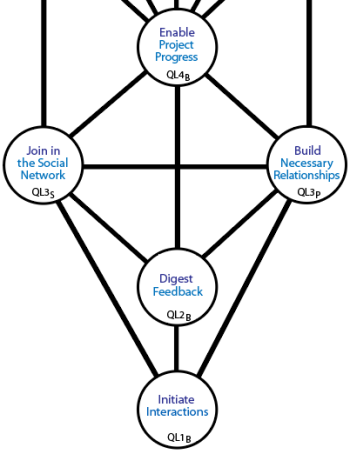
Level 1: Projects operate and develop through an ongoing multiplicity of interactions amongst those working within them, and between project insiders and outsiders. The foundation of participation is therefore pro-active interaction on the basis of your specific appointment or assignment. While the interaction is under your control, it is also determined by the project and its people.
So the Centre is balanced and named: .
Level 2: You can control feedback by requesting it and making yourself listen to it and reflect on it. However, feedback simultaneously requires others to be willing and able to speak to you about your interactions and work activities. Neither can exist without the other.
So the Centre is balanced and named: .
Level 3: When you enter a project, you find yourself plunged into a network of dynamic social relationships not subject to your control. However, you can and should find ways to join in. At the same time, you can actively identify individuals with whom it is important to build a positive relationship in order to get your work done and that is under your control.
So there are two Centres here named:
.
&
The two poles naturally influence each other with your need for relationships appearing to be dominant.
Level 4: Progress of the project entails working with an awareness of the mission and currently agreed plans and activities—and this is subject to your personal control. However, the project's evolution, both plans and practicalities, is simultaneously under social control and your efforts must be hand-in-glove with that.
So the Centre is balanced and named: .
Establishing Yourself in the Project: L5-L7
The upper pole of the internal duality appears to be "establishing yourself in the project". It corresponds to the outer circle of the TET ("making the project personal") and Cycle-2 of the Spiral ("becoming a valuable participant").
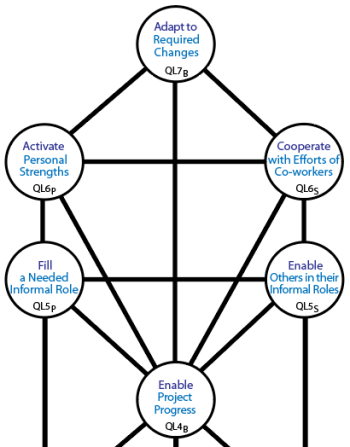
Level 5: Informal team roles exist as possibilities that can be shared out and realized amongst project staff. Each comes with weaknesses, but the benefits of the various informal roles complement each other. You can usually find one of these roles that suits you and is needed by the project team. Others will also take on informal roles without reference to you or your interests, and they require support from you just as you do from them.
So there are two Centres here named:
&
The two poles naturally influence each other with helping others appearing to be dominant.
Level 6: Rising to challenges is a whole team effort. While you cannot be in control, you can independently mobilize your resources and activate your personal strengths. At the same time, you should be cooperating with the efforts of others to manage the crisis.
So there are two Centres here:
&
The two poles naturally influence each other and cooperation with co-workers appears to be dominant.
Level 7: While adaptation is under your control, the need to adapt because of required change is under the control of the social milieu.
So the Centre is balanced and named: .
Psychosocial Pressures
All psychosocial pressures are underpinned by acceptability as the driving force intrinsic to the domain. This is not shown in the diagrams below.
First there is performance (1°) based on the Q1 position.
(Understanding, 2° in the Q1 position, is not shown in the diagrams below.)
Then, as listed here, autonomy (from ) in the lower half, and certainty (from ) in the upper half.
Note the 2 missing pressures: well-being and selflessness.
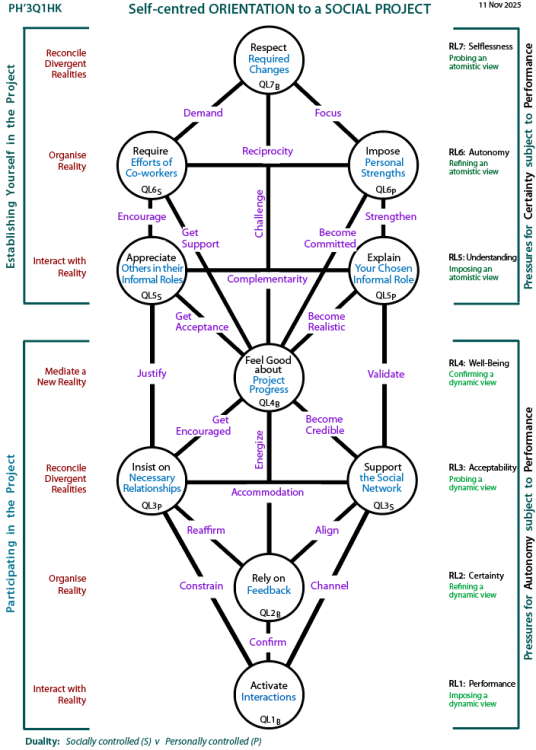
The requisite and self-interested Trees (below) show level by level pressures based on the Spiral pattern (see left Tree) and Tree structure i.e. Root Hierarchy (see right Tree).
Better viewing: Use browser zoom if needed.
|
|
-
Continue to Fitting in to Social Relations (Q2).
Originally posted: 26-Jan-2026.