Q5: Social Systems (I)
Preview
The , as shown in the diagram below, is created (by definition) from a combination of the and paradigms.
The paradigm captures a reality which contains many dynamically interacting systems that evolve internally and with the environment. This is what are: they have a complicated unmapped structure with internal dynamics, and interact with a socio-physical environment. This Arena may not be immediately self-evident.
"Social system" is used here to refer to a combination of inter-related and more or less interdependent social bodies, bureaucratic arrangements and regulations, often with a poorly defined boundary.
Society is the home of the most important systems: institutions like education, and health-care that meet needs, and bureaucratic systems like those associated with taxes, immigration, and construction. However, every large group generates such systems. We are forced to fit in with them as we go about everyday life. Such systems cannot be safely ignored and their ramifications and impact often come as a surprise. Attention to enable a suitable orientation to any system with which we must become involved is therefore required.
So «» is the name of the Arena.
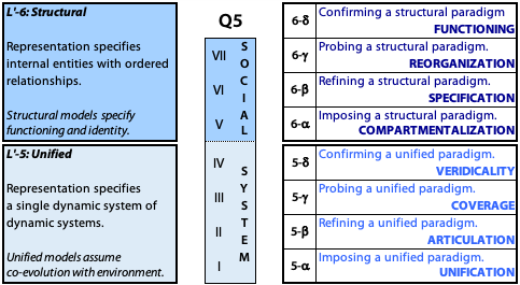
The paradigm guides any because it clarifies components, provides order via structure, and defines functions of importance. The challenging and irritating bureaucratic nature of these systems arises from the structural perspective.
Fitting in with a social system is about mastering the system for your own purposes. We have become involved, knowing that we will be treated as a "case" or an "instance". We must find our way around the system's complexity and bureaucracy either to fulfil certain required duties (e.g. get permissions) or to get our needs met (e.g. for health-care). If we fail to engage and master the system at least to some minimal degree then certain of our important needs will not be met or we will suffer from punitive demands: fines, even imprisonment.
 Are Social Systems the same as Societal Institutions?
Example Systems
In society, there is the housing system, transport system, health-care system, tax system and many others. Permissions and licenses seem to be required for a many everyday activities like driving a car, chopping down a tree, or owning a dog.
Large groups and organisations have their bureaucratic systems too: personnel systems, management systems, training systems, complaint systems.
Organisations, social bodies and departments in a social system form a network with multiple outputs related to a particular purpose. So this is not a formal system as defined by system scientists. The multiplicity of outputs associated with a simple purpose is what makes these entities so bureaucratic and unmanageable. Some connections in the system will be tighter than others, but those working in one component will at least know about the existence of other components.
Frameworks
TET: Fitting in with a social system is required to use them but their complexity must be accommodated. There are , which emerge from the depiction states shown in the diagram. These 7 ways can be usefully analysed with a Typology Essentials Table (TET).
Spiral: By converting the ways to modes, it is possible to cumulate them via a spiral trajectory that and enables its use.
Expected Pressures: 1°: Understanding; 2°: Selflessness.
Understanding is the identity pressure for social systems because of their complexity. The purpose of the system is usually obvious but the way it works often seem impenetrable. Where possible, a complex bureaucratic system is ignored or avoided, but involvement and use is often compulsory and then it becomes evident that it has been constructed for universal application and is impersonal. Because there is minimal adaptation to individuals, any assertion of individuality is doomed to fail or becomes counter-productive. So a selflessness pressure must be activated when handling the system.
Ways to Accommodate a System
Fitting in to a social system is required to use it, and it is either personally necessary or socially obligatory to work with the system as it stands.
Social systems are complicated beyond belief. Just think of housing. To enjoy a roof over your head, you have to realize that there are complex laws and social bodies around building, owning and renting houses; and then there are real estate agents, insurance firms, maintenance services, utilities (electricity, gas, water, internet, telecommunications), rates and taxation requirements, borrowing and banking, and so on.
From the system's perspective, you are a "case" to be handled. The system will not change for you, so you have to change for it. From your perspective, the system demands your involvement to the point of enmeshment and confusion. You have to accommodate the system and this can occur in a number of ways.
: imposing a unified paradigm: state = unification
Involvement with a system is rarely optional. You discover that you have a need that must be met via social means (e.g. accommodation, healthcare) or you find that the system is asserting that you have an obligation (e.g. a license, a tax return) that cannot be avoided without penalties, often severe.
So you take some action that, often irrevocably and permanently, enmeshes you in the system as client or customer or member or supplicant. In any case, you must do something and so you make some contact with a component of the system.
Much later when you are experienced and immersed, you take the system for granted and easily navigate your involvement, working out how to get the best out of the situation.
So involvement appears to be characterized by a minimal and a maximal version.
Proposed t1 Name:
Minimum: .
Maximum: .
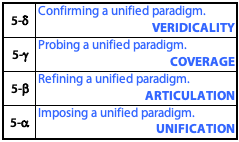
: refining the unification: state = articulation
Systems typically provide written and online material that informs users of what is on offer, the conditions of engagement, and how to proceed. With your concern in mind, it is possible to access websites, pamphlets and other documentation. However, there are typically dozens, hundreds, even thousands of pages and documents, often obscurely legal or technical. Because of this complexity, it is essential to have a clear focus as you investigate in relation to your specific need.
Proposed t2 Name:
: probing the uniformity of unification: state = coverage
Because of the complexity and bureaucratic requirements, it is commonly impossible for a newcomer to know how to handle their own situation. Unfortunately, common-sense is likely to take you down the wrong path. Systems usually have a variety of mediating mechanism that bridge the gap between a person's ignorance and naivety and the system's demands and methods. In most systems, there will be advisors, intermediaries and advocates—experts and professionals who work on a fee-for-service basis. In the Tax System, for example, there are accountants, specialist tax lawyers, as well as voluntary and government-sponsored bodies. Professions like social work exist to assist needy individuals know how and where to engage with the system.
Proposed t3 Name:
: confirming the nature of unification: state = veridicality
The system becomes concretized when a person finds themselves actually using it e.g. calling an ambulance (and realizing a payment is required), applying for a driving license (and realizing there is a local government registry for dozens of licenses), renting a property via a real estate agent (and being advised of the obligations and rights of a tenant).
Proposed t4 Name:
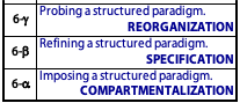
: imposing a dynamic paradigm: state = compartmentalization
The complexity of any social system is generated by the multiplicity of related services and functions that are generated by a particular need. To be able to handle any system, it is necessary to understand how various functions are organised within it and what the rules and regulations are. Knowing the services provided by the various organizations, including their limits and demands, will enable you to adjust your expectations and to engage appropriately when issues arise.
Proposed t5 Name:
: refining the conformity: state = specification
Every system develops its own language and culture. But there are also numerous subcultures. In relation to housing, for example, the world of house sales is significantly different to the world of mortgage finance, which is different again to the world of maintenance, which is different to the world of insurance, and so on. Accommodating to the values and practices in each of these worlds and using the right language helps you become involved in a suitable way.
Proposed t6 Name:
: probing the uniformity of conformity: state = reorganization
Society is a dynamic environment and most social systems are in a more or less constant state of flux. As well as changes that are being implemented, there are numerous proposals for change, small and large, that may or may not eventuate and affect you. Awareness of such changes maximizes the likelihood of managing your involvement in an effective way.
Proposed t7 Name:
Plotting on a TET
The Executing Duality

The layout of a set of Q-types on a TET is standard. So we can immediately generate the diagram shown at right. Accepting this layout as correct then poses two demands:
a) to identify appropriate axes (the psychosocial executing duality);
and then
b) to check that the named ways are appropriately positioned in the TET.
The X-axis typically captures the social output: in this case that refers to a positive result from becoming involved with the system.
Systems exist for a purpose. We accommodate to the system and its dynamics because we want our needs, desires and obligations to be met
i.e. the output axis involves a Focus on Personal Benefit.
The Y-axis typically captures the psychological input: in this case that means using the system effectively.
Systems are so difficult due to their impersonality and bureaucracy. Although they frustrate our preferences and make things more complicated than seems necessary, we must not expect anything better. Complaining is futile
i.e. the input axis involves a Focus on Self-Control.
Checking Locations
High Benefiting & Low Self-Control
Low Benefiting & Low Self-Control
Low Benefiting & High Self-Control
High Benefiting & High Self-Control
Layout Features
Quadrants
Ways in the lower two quadrants invite user activity, while those in the upper two quadrants suggest user passivity.
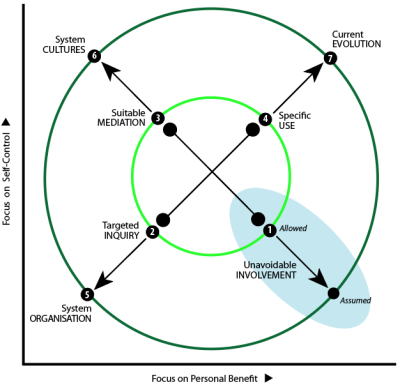
Ways in the right two quadrants suggest practicalities dominate, while those in the left two quadrants suggest awareness dominates.
Ways in diametrically opposite quadrants engender a degree of antagonism:
• LR is internally-oriented, while UL is externally-oriented;
• LL is knowledge-oriented, while UR is activity-oriented.
The arrows indicate preferences for support i.e. an allowed involvement () is supported by an assumption of involvement (), targeted inquiries () are supported by awareness of the system organisation (), suitable mediation () is supported by accommodating system cultures (), and any specific use () is supported by the current state of system evolution ().
Circles
The inner circle accommodation is practical and efficient.
The outer circle accommodation is defining and difficult.
The two circles fuse in which moves from being allowed because that is practical to being assumed because it defines an unavoidable context.
Diagonals
These define the Apollonian-Dionysian duality (or approach duality).
The Apollonian diagonal runs from LL to UR and contains ways that are all objective. Moving up the diagonal, these ways reflect increasing involvement: awareness of least so, a little more so, of the system much more so and awareness of calls for maximal involvement. So these are: increasingly involved objective ways.
The Dionysian diagonal runs from LR to UL and contains ways that activate and manipulate the system. Moving up the diagonal, these ways become more powerful. has minimal power, is a little more powerful, increases your power significantly, and accommodating provides most power. So these are increasingly powerful manipulative ways.
Originally posted: 26-Jan-2026.