Q5: Social Systems (II)
The Story so Far
The , based on applying and , deals with as explained in the previous topic. The 7 different ways in which it is possible to with all its complexities in order to fit in are also developed there, and plotted on a Typology Essentials Table (TET).
Strengthening Mastery of the System (Q5C)
Social systems demand that participants take responsibility for their use—or suffer the consequences. In this next framework, the to a system, having been plotted on the TET, are viewed as . These modes comprise distinctive sets of principles that assist you to fit in.
commences by . When you start, you have to use the system while being unsure about how it is going to turn out in your case.
The developmental process builds on this Stage-1 foundation with 6 further Stages (Φ) over 2 Cycles that move you from allowing involvement based on hope for the best to exploiting your involvement based on knowing the system.
Cycle-1 focuses on getting the system working for you following (). This is initially by , then by , and finally by .
Cycle-2 focuses on increasing security and gains from the system. This entails initially , then , and finally .
The Spiral is an effortful process which can stop at any Stage if your mastery is judged to be sufficient. Progression is driven by (a) the nature of the system, (b) personal circumstances, (c) social requirements, and (d) limitations of previous modes.
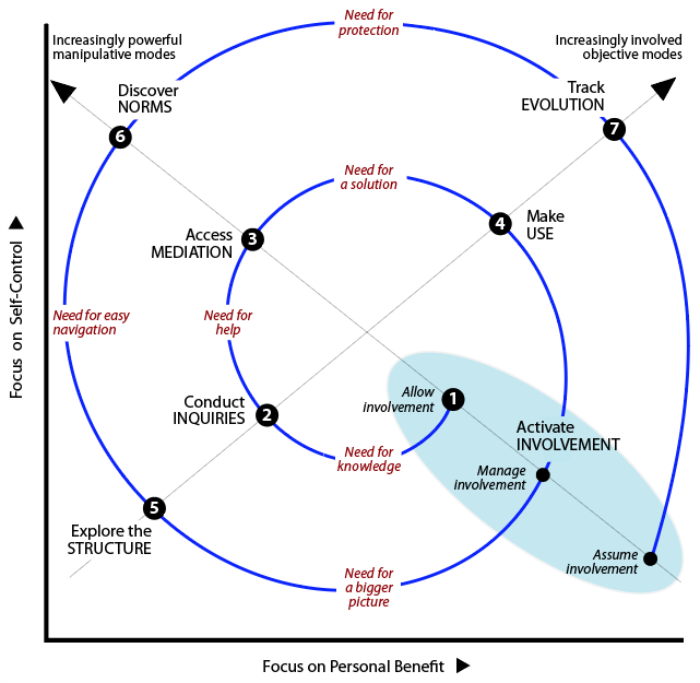
Cycle-1: Getting the System Working for You
 Stage-1: Allow Involvement
Stage-2: Conduct Inquiries
Stage-3: Access Mediation
Stage 4: Make Use
Cycle-2: Increasing Security and Gains
Stage-5: Explore the Structure
Stage-6: Discover Norms
Stage-7: Track Evolution
Parallels between the Two Cycles
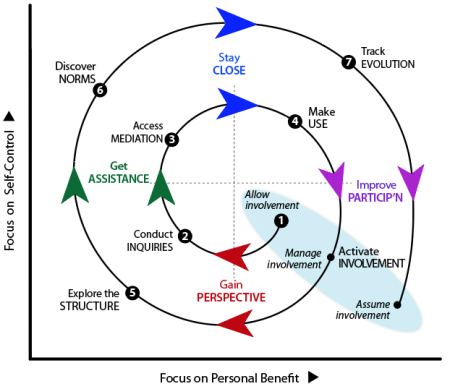
As the diagram at right indicates, the two cycles show parallel moves in relation to the axes:
■ The initial transition is back along the X-axis away from a focus on personal benefit and with no increased need for self-control:
Φ1 → Φ2 & Φ4(μ1) → Φ5
This appears to be about gaining perspective on the system's complexity.
In Cycle-1, the perspective is specific; in Cycle-2 the perspective is general.
■ The next transition is up the Y-axis increasing the need for self-control without additional concern for benefit:
Φ2 → Φ3 & Φ5 → Φ6
This appears to be about getting assistance to master the complexity.
In Cycle-1, assistance is obtained from a dedicated intermediary; in Cycle-2 assistance is obtained by exploiting norms within the system.
■ The third transition is along the X-axis towards a greater focus on benefit while maintaining a high level of self-control.
Φ3 → Φ4 & Φ6 → Φ7
This appears to be about staying close to the functioning of the system.
In Cycle-1, closeness means using a service or facility; in Cycle-2 closeness is about keeping in touch with potential and actual developments.
■ The final transition down the Y-axis occurs spontaneously.
Φ4 → μ1 & Φ7 →μ1
This appears to be about improving participation in the system.
This confirms what might have been expected: fitting in to with a social system is about accepting involvement and learning, while depending on a specialist intermediary.
Determinants of Orienting to a Social System (Q5CHK)
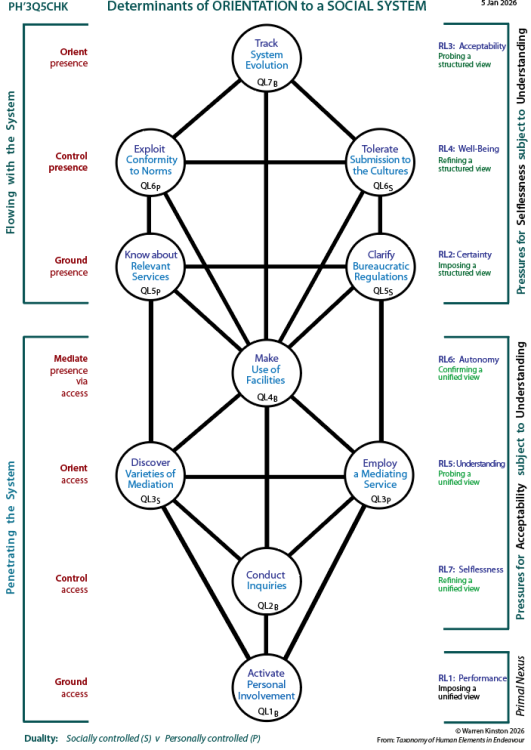
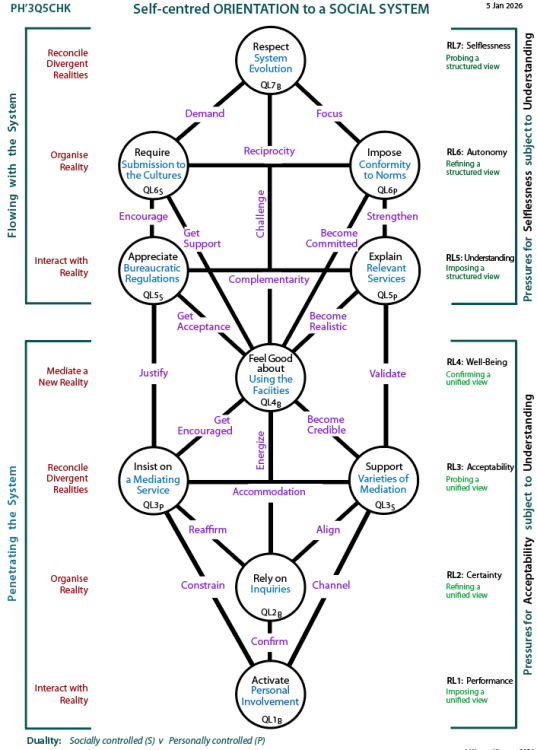
The Tree framework for orientation indicates the near-simultaneous use of all the factors examined in the TET and Spiral. It is likely the way most people will think of fitting in. In bringing the various Centres to life, a person needs to be imbued with an impersonal spirit. Nothing that happens, infuriating as it may be, is targeted at you. Distancing yourself and removing emotions as much as possible gives you the best chance of a positive result.
A Tree framework can be created from the Q-Spiral by focusing on the essence of each of the 7 modes as they might emerge in actual situations. This reveals a dynamic duality as well as influences between the determinants.
Application of the Dynamic Duality
Penetrating the System: L1-L4
The lower pole of the internal duality appears to be "penetrating the system". It corresponds to the inner circle of the TET ways of accommodating("practical, efficient") and Cycle-1 of the Spiral for mastery of the system ("getting the system working for you").
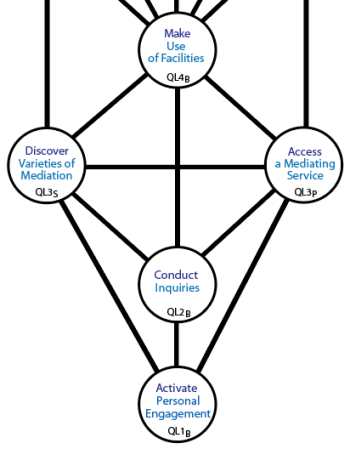
Level 1: You are faced with a system that has a long history and is essential for handling a particular personal or social need. You may choose to engage or the system may take the first step (e.g. requiring you to provide information or make a payment). In all cases your response remains under your control, even if there is often little choice in practice.
So the Centre is balanced and named: .
Level 2: In a similar fashion, when you conduct inquiries into the system, interests driving your inquiry and the nature of the system cannot be disentangled.
So the Centre is balanced and named: .
Level 3: There are typically a variety of mediating mechanisms available for use, and these are not under your control at all. However, surveying the field and employing a particular mediation service is fully under your control.
So there are two Centres here named:
&
The two poles naturally influence each other with appearing to be dominant.
Level 4: Using facilities in the system is under your control but simultaneously a function of the presence of those facilities which is under social control.
So the Centre is balanced and named: .
Flowing with the System: L5-L7
The upper pole of the internal duality appears to be "flowing with the system". It corresponds to the outer circle of the TET ways of accommodating ("system complexity and development" ) and Cycle-2 of the Spiral for mastery of the system ("increasing security and gains").
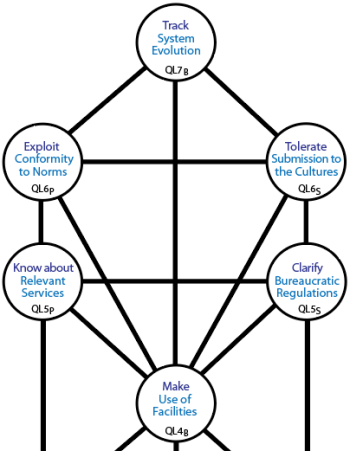
Level 5: In exploring the system, it is necessary to focus on services and functions that are relevant to your concerns, and this is under your control. However, you have no control over the system's facilities and their rules, regulations and bureaucracy, and these cannot be avoided.
So there are two Centres here:
&
The two poles naturally influence each other with appearing to be dominant.
Level 6: You can discover norms in play, but culture can never be under your control because it is a group phenomenon. Flouting the culture is dangerous given you enmeshment in an impersonal system, and submission is almost mandatory. However, you can control your use of conformity and interact with staff in ways that get the best out of the system.
So there are two Centres here:
&
The two poles naturally influence each other with appearing to be dominant.
Level 7: Tracking system evolution is under your control in regard to the effort being made, but it is also simultaneously controlled by the evolution that is occurring.
So the Centre is balanced and named: .
Psychosocial Pressures
All psychosocial pressures are underpinned by acceptability as the driving force intrinsic to the domain. This is not shown in the diagrams below.
First there is understanding (1°) based on the Q5 position.
(Certainty, 2° in the Q5 position, is not shown in the diagrams below.)
Then, as listed here, acceptability (1° from ) in the lower half, and selflessness (1° from ) in the upper half.
The duplication of acceptabilityis noteworthy.
The requisite and self-interested Trees (below) show level by level pressures based on the Spiral pattern (see left Tree) and Tree structure i.e. Root Hierarchy (see right Tree).
Better viewing: Use browser zoom if needed.
|
|
-
Continue to Fitting in to a Social Role (Q6).
Originally posted: 26-Jan-2026.