Q7: Group Cultures (II)
The Story so Far
The , based on applying and paradigms, deals with as explained in the previous topic. The ways in which it is possible, or even necessary, to are also developed there, and plotted on a Typology Essentials Table (TET).
Strengthening Assimilation into the Culture (Q7C)
In this next framework, the , having been plotted on the TET, are viewed as . These modes comprise distinctive sets of principles for fitting in with a group's culture.
The effort to fit in here is generated by the desire to belong to a particular group (i.e. a social body, a community or society), and to be fully accepted by its members. So assimilation commences in Stage-1 by .
The strengthening process builds on this foundation with 6 further Stages (Φ) over 2 Cycles that move a conscious willing conformity to a spontaneous version.
Cycle-1 focuses on becoming like others in the group following : initially by , then by , and finally by .
Cycle-2 focuses on functioning effectively within the group. This entails initially , then , and finally to the culture.
The Spiral is an effortful process which can stop at any Stage if compliance is judged to be sufficient. Progression is driven by (a) your commitment to the group, (b) your comfort with group culture, (c) expectations of group members, and (d) limitations of previous modes.
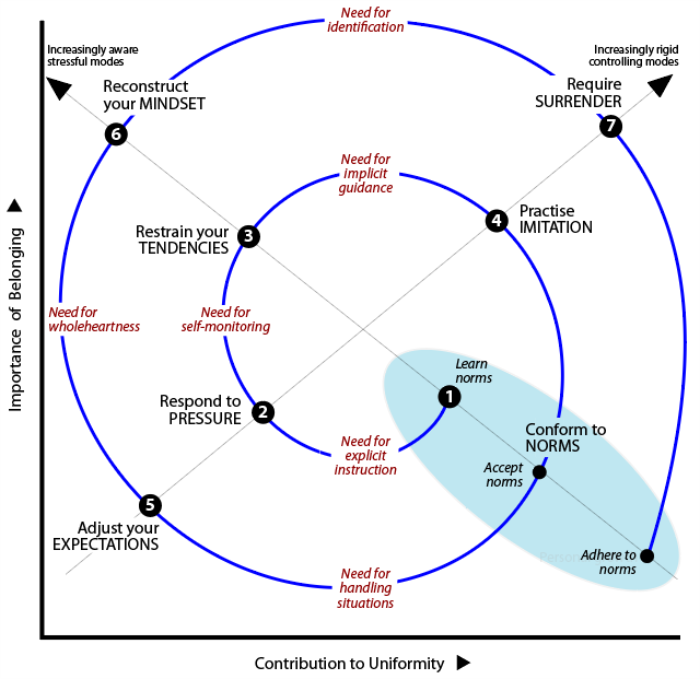
Cycle-1: Becoming Like Others in the Group
 Stage-1: Learn Group Norms
Stage-2: Respond to Pressure
Stage-3: Restrain Your Tendencies
Stage 4: Practise Imitation
Cycle-2: Functioning Effectively in the Group
Stage-5: Adjust your Expectations
Stage-6: Reconstruct your Mindset
Stage-7: Require Surrender
Parallels between the Two Cycles
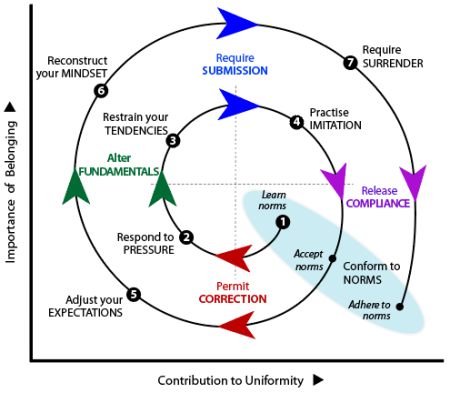
The two cycles show parallel moves in relation to the axes:
■ The initial transition is back along the X-axis away from increasing uniformity and with no increased emphasis on belonging:
Φ1 → Φ2 & Φ4(μ1) → Φ5
This appears to be about permitting correction to your behaviour.
In Cycle-1, correction focus on your conduct; in Cycle-2, correction focuses on your attitude.
■ The next transition is up the Y-axis increasing the importance of belonging without additional effects on uniformity:
Φ2 → Φ3 & Φ5 → Φ6
This appears to be about altering fundamentals of your behaviour.
In Cycle-1, the fundamentals are urges to act; in Cycle-2, the fundamentals are ways of thinking.
■ The third transition is along the X-axis for a greater contribution to uniformity while maintaining a high importance of belonging.
Φ3 → Φ4 & Φ6 → Φ7
This appears to be about requiring submission to the culture.
In Cycle-1, submission refers to specific behaviours; in Cycle-2, submission is about yourself as a whole person.
■ The final transition down the Y-axis occurs spontaneously.
Φ4 → μ1 & Φ7 →μ1
This appears to be about releasing compliance with the culture.
This confirms what might have been expected: fitting in to a group culture is about submerging individuality while embracing something that feels alien.
Determinants of Orienting to a Group Culture (Q7CHK)
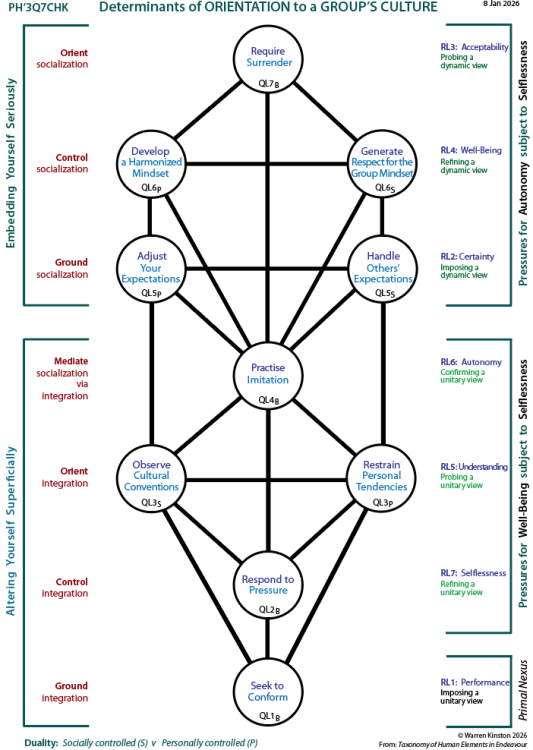
The Tree framework for orientation indicates the near-simultaneous use of all the factors examined in the TET and Spiral. It is likely the way most people will think of fitting in. In bringing the various Centres to life, a person needs to be imbued with a submissive spirit. Cultures dominate and submitting to their requirements is essential for your mental health.
A Tree framework can be created from the Q-Spiral by focusing on the essence of each of the 7 modes as they might emerge in actual situations. This reveals a dynamic duality as well as influences between the determinants.
Application of the Dynamic Duality
Altering Yourself Superficially: L1-L4
The lower pole of the internal duality appears to be "altering yourself superficially". It corresponds to the inner circle of the TET ("direct, immediate, specific ways to adapt") and Cycle-1 of the Spiral ("becoming like others in the group").
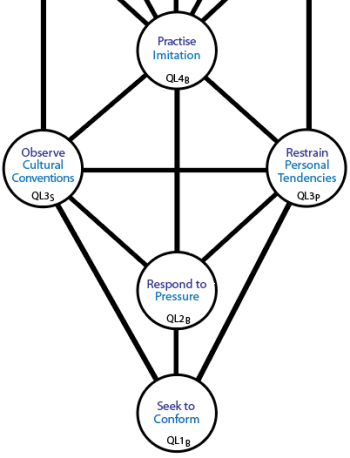
Level 1: Conforming to norms involves both the conformity over which you have full control and the norms over which the social group has control. These two factors cannot be disentangled. Aalthough conformity is a necessity, the ability to conform cannot be taken for granted because cultures are complicated,
So the Centre is balanced and named: .
Level 2: In responding to pressure, responding is something that you have full control over, while the pressure applied is something over which you have no control. That means these two factors must be synthesized or fused.
So the Centre is balanced and named: .
Level 3: Your tendencies are certainly under your control, as is the determination to restrain them. However, the application of restraint depends on existing cultural conventions, over which you have no control. These norms provide an independent context that must be observed.
So there are two Centres here named:
&
.
The two poles naturally influence each other with needing to be dominant.
Level 4: While the practise of imitation is under your control, who and what you imitate is not, and these two factors appear to be entangled.
So the Centre is balanced and named: .
Embedding Yourself Seriously: L5-L7
The upper pole of the internal duality appears to be "embedding yourself seriously". It corresponds to the outer circle of the TET ("general, future-oriented, complicated ways to adapt") and Cycle-2 of the Spiral ("functioning effectively in the group").
Level 5: You have control over your own expectations. But you do not have control over the expectations that others may have, even if you know what they are likely to be. These two factors are distinct.
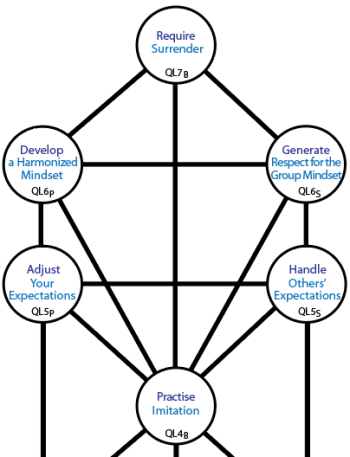
So there are two Centres here named:
&
The two poles naturally influence each other with needing to be dominant.
Level 6: In reconstructing your mindset, you have control over the mindset that you actively develop and this must harmonize with the group mentality. However, you have no control over the group mentality which you are attempting to emulate. The mentality would not persist if it was not useful. Sensitively attuning over time will allow you sympathize with its way of thinking and recognize its value.
So there are two Centres here named:
&
The two poles naturally influence each other with needing to be dominant.
Level 7: Requiring surrender is simultaneously a personal matter and dependent wholly on the circumstances.
So the Centre is balanced and named: .
Psychosocial Pressures
All psychosocial pressures are underpinned by acceptability as the driving force intrinsic to the domain. This is not shown in the diagrams below.
First there is selflessness (1°) based on the Q7 position.
(Acceptability, 2° in the Q7 position, is not shown in the diagrams below.)
Then, as listed here, well-being (1° from in the lower half, and autonomy (1° from ) in the upper half.
The duplication of acceptability is noteworthy.
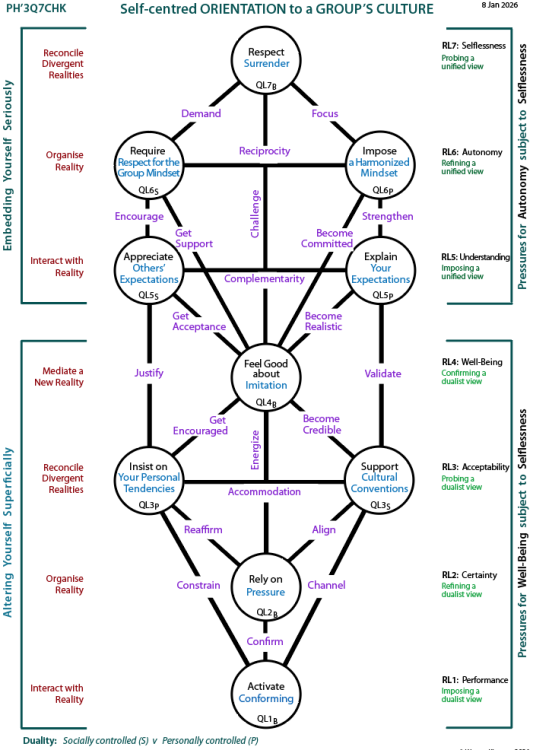
The requisite and self-interested Trees (below) show level by level pressures based on the Spiral pattern (see left Tree) and Tree structure i.e. Root Hierarchy (see right Tree).
Better viewing: Use browser zoom if needed.
|
|
The 7 arenas have been identified and investigated.
Originally posted: 26-Jan-2026.