Q6: Social Roles (II)
The Story so Far
The , based on and , deals with as explained in the previous topic. The 7 different ways in which it is possible to to make it a good fit are also developed there and plotted on a Typology Essentials Table (TET).
Strengthening Identification with the Role (Q6C)
In this next framework, the a social role, having been plotted on the TET, are viewed as with a role. These modes comprise distinctive sets of principles for fitting in to a role.
Fitting in to a role commences by because the foundation of fitting in is acknowledgement that social life requires taking on roles. You then fit in maximally by becoming fully identified with a particular role.
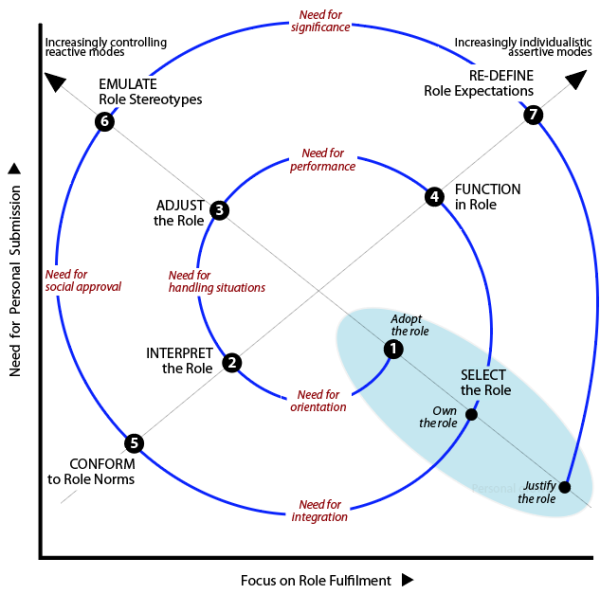
The identification process is progressive and develops with 6 further Stages (Φ) over 2 Cycles that move you from initial adoption to ownership of the role and ultimately to justifying and defending your role.
Cycle-1 focuses on establishing a modus vivendi with a role following its adoption in Stage-1. Living with a role commences initially by , then by to fit your situation, and finally by .
Cycle-2 focuses on embedding your self-in-role within society. This entails initially in your society, then , and finally in an acceptable way.
The Spiral is an effortful process which can stop at any Stage if identification is judged to be sufficient. Progression is driven by (a) the strength of your individualism, (b) the importance of the role in your life, (c) changing social expectations, and (d) limitations of previous modes.
Cycle-1: Establishing a Modus Vivendi
 Stage-1: Select the Role
Stage-2: Interpret the Role
Stage-3: Adjust the Role
Stage 4: Function in Role
Cycle-2: Embedding your Self-in-Role in Society
Stage-5: Conform to Role Norms
Stage-6: Emulate Role Stereotypes
Stage-7: Re-define Role Expectations
Parallels between the Two Cycles
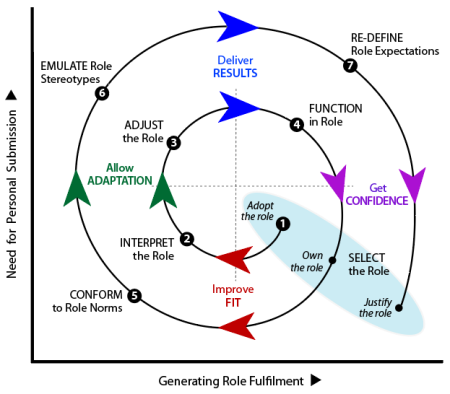
The two cycles show parallel moves in relation to the axes:
■ The initial transition is back along the X-axis away from role fulfilment and with no increased need for submission:
Φ1 → Φ2 & Φ4(μ1) → Φ5
This appears to be about improving the fit with the rolefit is improved socially.
■ The next transition is up the Y-axis increasing the need for submission without additional concern for role fulfilment:
Φ2 → Φ3 & Φ5 → Φ6
This appears to be about allowing adaptation to the role.
In Cycle-1, adaptation is to an actual environment; in Cycle-2 adaptation is to social conceptions.
■ The third transition is along the X-axis towards more generation of role fulfilment while maintaining the same need for submission.
Φ3 → Φ4 & Φ6 → Φ7
This appears to be about delivering results via the role.
In Cycle-1, results are personal; in Cycle-2 results are social.
■ The final transition down the Y-axis occurs spontaneously.
Φ4 → μ1 & Φ7 →μ1
This appears to be about getting confidence in the role.
This confirms what might have been expected: fitting in to with a social role is about fully assuming the role while remaining your own person as far as possible.
Determinants of Orienting to a Social Role (Q6CHK)
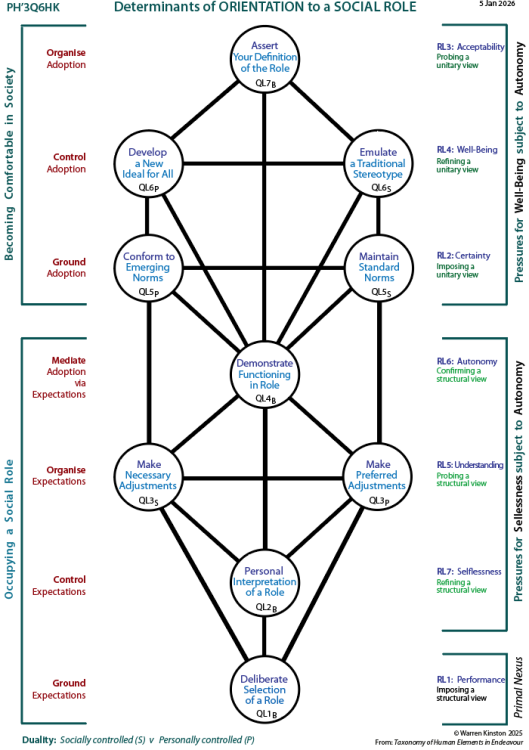
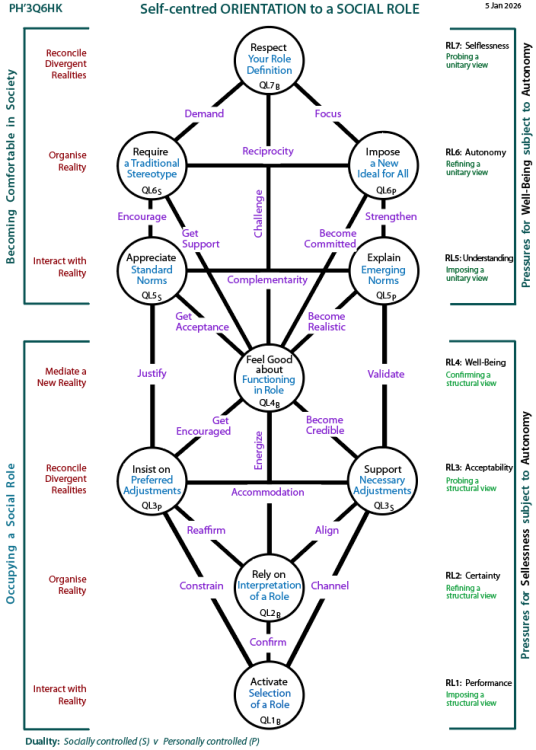
The Tree framework for orientation indicates the near-simultaneous use of all the factors examined in the TET and Spiral. It is likely the way most people will think of fitting in. In bringing the various Centres to life, a person needs to be imbued with an ethical spirit. Acting in role should be concordant with what is right and good.
A Tree framework can be created from the Q-Spiral by focusing on the essence of each of the 7 modes as they might emerge in actual situations. This reveals a dynamic duality as well as influences between the determinants.
Application of the Dynamic Duality
Occupying the Role: L1-L4
The lower pole of the internal duality appears to be "occupying the social role". It corresponds to the inner circle of the TET ("self-oriented, practical") and Cycle-1 of the Spiral ("establishing a modus vivendi with the role").
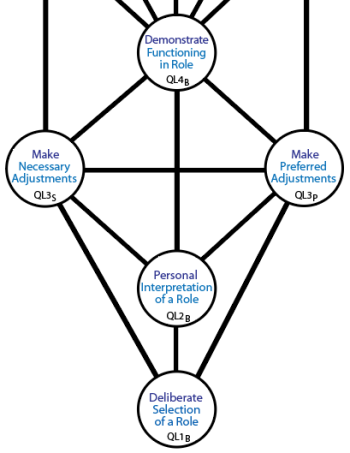
Level 1: Selection of a role requires the person to commit to a choice and society to provide role options. Neither can exist without the other.
So the Centre is balanced and named: .
Level 2: Interpretation of a role is under the control of a person, but possible interpretations are limited by norms and the social environment. Again, neither can exist without the other
So the Centre is balanced and named: .
Level 3: Situations can justify or demand adjustments to roles. A person can take the initiative and determine certain adjustments according to their own preferences. However, the social milieu can also alter so as to require adjustments regardless of personal preference.
So there are two Centres here named:
&
.
The two poles naturally influence each other with appearing to be dominant.
Level 4: Functioning in role is under personal control, but the social milieu determines functioning as well.
So the Centre is balanced and named: .
Becoming Comfortable in Society: L5-L7
The upper pole of internal duality appears t be "becoming comfortable in society". It corresponds to the outer circle of the TET ("societally-oriented conceptual") and Cycle-2 of the Spiral ("embedding your self-in-role in society").
Level 5: Everyone undergoes a socialization into norms that are standard within society. However, norms evolve and when an emerging norm is becoming established, a person can opt to conform to that as well or, sometimes, instead.
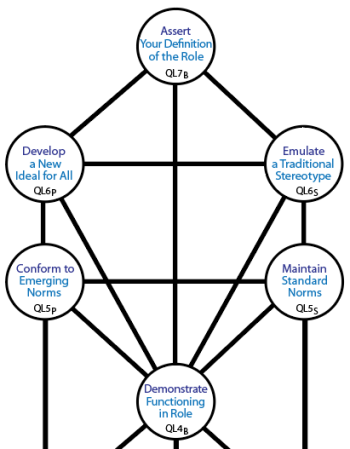
So there are two Centres here named:
&
.
The two poles naturally influence each other with appearing to be dominant.
Level 6: Traditional role stereotypes are entirely under the group's control. However, a person can envisage their own ideal for the role and attempt to live up to that.
So there are two Centres here named:
&
.
The two poles naturally influence each other with emulating stereotypes appearing to be dominant.
Level 7: Re-defining role expectations in the face of societal evolution is a matter for each individual but is dependent on that evolution. Rather than being ideal, this definition is practical. The social milieu has influence but does not have independent control here.
So the Centre is balanced and named: .
Psychosocial Pressures
All psychosocial pressures are underpinned by acceptability as the driving force intrinsic to the domain. This is not shown in the diagrams below.
First there is autonomy (1°) based on the Q6 position.
(Well-Being, 2° in the Q6 position, is not shown in the diagrams below.)
Then, as listed here, selflessness (from the ) in the lower half, and well-being (from the ) in the upper half.
The requisite and self-interested Trees below show level by level pressures based on the Spiral pattern (see left Tree) and Tree structure i.e. Root Hierarchy (see right Tree).
Originally posted: 26-Jan-2026.