28 Styles of Depiction
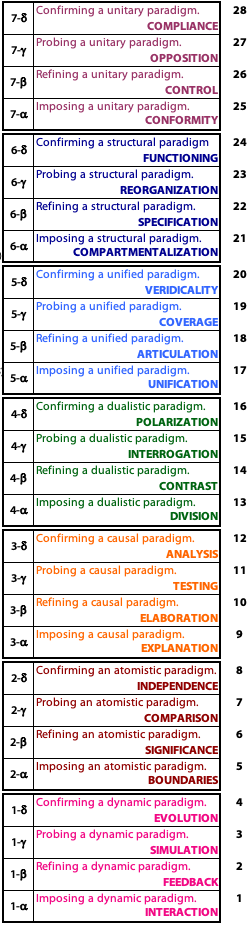
Differentiating the Depiction Paradigms

The Style Hierarchy allows for 4 versions of the each Paradigm.

In the case of PH'1 and PH'2, the versions were roles, while for PH'4 and PH'5 the versions were states or processes. PH'6 generated rationales. See more here.

Now, by applying this Style Hierarchy to each of the Depiction Methods, it has been possible to provisionally conjecture characteristic recognizable states or conditions. These are provisional propositions, and there may well be errors or other possible labels for these conditions. Some are suggested below and shown in the diagram at right.

L'1: ClosedDynamic Paradigm

αInteraction imposes the dynamic paradigm.

βFeedback refines those interactions.

γSimulation probes the operation of interactions.

δEvolution confirms the presence of interactions. Cooperation?

L'2: ClosedAtomistic Method

αBoundaries impose the atomistic paradigm.

βSignificance refines those boundaries. Connection? Relation?

γComparison probes the operation of the boundaries.

δIndependence confirms the presence of boundaries.

L'3: ClosedCausal Method

αExplanation imposes the causal paradigm.

βElaboration refines the explanation.

γTesting probes the details of the explanation.

δAnalysis confirms the presence of an explanation. Predictability?

L'4: ClosedDualistic Method

α: Division imposes the dualistic paradigm. Dichotomization?

βContrast refines the division.

γInterrogation probes the effect of the division.

δPolarization confirms the presence of division.

L'5: ClosedUnified Method

αUnification imposes the unified paradigm.

βArticulation refines the unification.

γCoverage probes the quality of unification.

δVeridicality confirms the presence of unification.

L'6: ClosedStructural Method

αCompartmentalization imposes the structural paradigm. Ordering?

βSpecification refines the compartmentalization

γReorganization probes the integrity of compartmentalization.

δFunctioning confirms the presence of compartmentalization.

L'7: ClosedUnitary Method

αConformity imposes the unitary paradigm. Indivisibility?

βControl refines the conformity.

γOpposition probes the uniformity of conformity.

δCompliance confirms the presence of conformity.


Next step:

Originally posted: 26-Jan-2026.