Unfolding Duality in Stabilization Methods (PH'4)
The unfolding duality developed during the investigation of the mental stabilization methods (PH'4) had a specific focus on perennial controversies that each method reveals. The account below has minor adjustments to terminology and is a slightly amended and standardized version of the previously published topic.
Core v Growth
Thesis + Antithesis = Synthesis
All Principal Typologies are thought to have a dialectical unfolding duality i.e. an intrinsic tension between:
- a ground state that is basic and unavoidable when the Type is operative; &
- a developmental force offering potential for that state to be improved or refined.
For the mental stabilization methods, this duality is proposed as follows:
A core for existing emerges directly when a stabilization method is used and this is therefore the ground state for the method.
With effort, the same method can be used at a higher grade. That requires growth, which is the developmental force intrinsic to the method.
Theory vs Practice
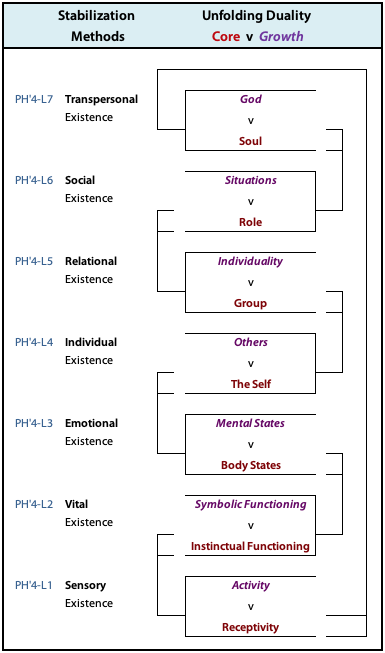
The unfolding duality manifests in the form of a different dialectic within each Type/Level. The core pole is the thesis and the growth pole is its antithesis. The tension at each Level is resolved by synthesis to create a new form of the core at the next higher Level, which in turn activates a new form of growth. The system is cyclic because the duality at L'7 is resolved by the core (thesis) at L'1.
 Method details:
This duality—core v growth—was proposed within the Experience & the Self satellite using slightly different terminology. The full details of the 7 methods as presented there are assumed here, and only alluded to in the propositions below.
This progressive generation of Types is a taxonomic method used to develop the framework's structure and confirm its likely validity. However, the order resembles a developmental sequence that can be discerned in childhood maturation and possibly in the evolution of human consciousness.
In this Domain, how the two polarized forms coexist varies from level to level and depends on the context. Each type/level gives rise to polarized therapies and perennial controversies, as well as social polarization from L'3 upwards.
See the full picture now.
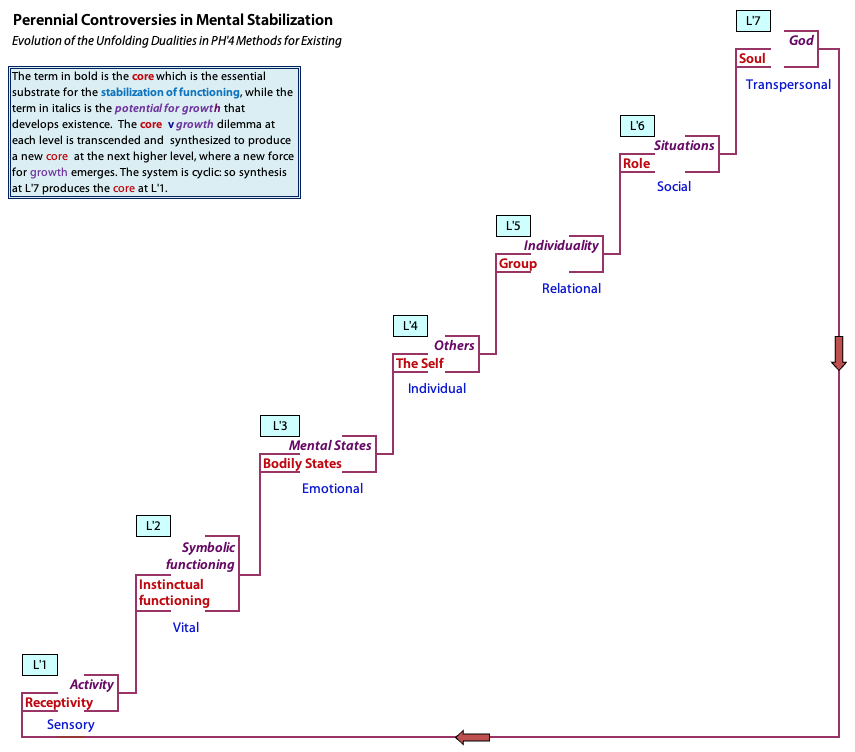
The Seven Dialectical Dualities
L'1: Sensory Existence
Receptivity v Activity
The Sensory method-L'1 assigns primacy to sensation-L1. It entails existing within a socio-physical milieu with a need for constant socio-emotional stimulation. Such an existence naturally has receptivity as its core. The thesis is that taking in whatever stimuli the milieu supplies stabilizes functioning and therefore existence.
The antithesis is for activity that engages in a circle or network and ensures reciprocal stimulation as part of participation in events. Because activity optimizes and extends the quantity and quality of social stimulation, it serves as the means for growth.
Polarization in Therapy
Receptivity-based therapies using direct sensory stimulation include aromatherapy, light therapy, sound therapy, vibration therapy, chromotherapy, massage, autogenic training.
Activity-generating treatments, like behavioural activation therapy, are used to ensure adequate stimulation and sensations for the withdrawn elderly, dementia, depression, and profound learning disability.
Perennial Controversy
Psychologists still argue whether sensation is a matter of passive direct reception or is generated by an active process in the brain, often concluding that sensation is ultimately part of the mystery of consciousness.
Synthesis: As the focus on being active increases, receptivity and activity become synthesized in physiology-based instinctual function—sexuality, for example, is both receptive activity and active receptivity—and this is the thesis in Vital existence.
L'2: Vital Existence
Instinctual functioning v Symbolic functioning
The Vital method assigns primacy to image-L2. It entails picturing existence concretely as physical and embodied, and so depends on keeping fit, which generates a sense of vitality. Such an existence has physiological or instinctual functioning as its core, which means the thesis is that the body's own structures and functions stabilize functioning and therefore existence.
The antithesis is for symbolic functioning that allows instinctual functioning to be visualized and elaborated. Concentration on images, the simplest form of symbolic representation, serves as the means for growth.
Polarization in Therapy
Instinctual functioning treatments, like behavioural therapies using classical conditioning or systematic desensitization, assume the body is in charge and the person only needs to submit without any understanding or attention to meaning.
Symbolic functioning treatments assume the body reorganises itself in response to focused attention on images and specific postures, as in the Alexander Technique. Dance therapy is based on using movement and posture to manage emotions and relieve anxieties.
Perennial Controversy
Theorists argue about whether dream imagery is to be seen as purely reflex and biological (cf. Allan Hobson's The Dreaming Brain, 1988) or whether it is a symbolic production (cf. Sigmund Freud's Interpretation of Dreams, 1899. Dreams are intrinsically biological of course, but personal growth only results if the images are taken seriously as symbols.
Synthesis: As the use of symbols increases, symbolic and instinctual activity become synthesized in body states that cannot be differentiated—and this is the thesis in Emotional existence.
L'3: Emotional Existence
Bodily states v Mental states
The Emotional method assigns primacy to emotion-L3 which exists as a bodily state and provides a core that enables stabilization. The thesis is that states felt diffusely within the body as a whole stabilize functioning and therefore existence.
The antithesis is for emotions to be experienced as mental states so that disruptive feelings like fear, anger and sadness can be identified and mastered, channelled and contained. This mental work ('mentalization') serves as the means for growth through clarifying values and meanings associated with the states.
False Core: Cores at lower levels are given by the organism. From this level on, the core can be manipulated or falsified. Hysterical body states are artificial emotional forms (L'3) that are used to manipulate others or hide away.
It is natural that a dialectical duality of bodily states and mental states has become more succinctly referred to by academics as the notorious mind-body problem. However, the L'3-emotional person sees no issue in experiencing emotions simultaneously in the mind and in the body.
Polarization in Therapy
Bodily state therapies include bio-energetics, vegeto-therapy and other cathartic and abreactive techniques like Peter Levine's somatic experiencing and Pat Ogden's sensorimotor psychotherapy. These can be traced to the ideas of Wilhelm Reich despite their rejection of his "orgone" energy. Reich's method focused on releasing emotional tensions stored in the body using touch and breathing techniques.
Mental state therapies are the constituents of mainstream psychotherapy of which there are numerous variants: for example, Albert Ellis's rational emotive therapy, Aaron Beck's cognitive therapy, Eric Berne's transactional analysis with its attention to parent-adult-child ego states, dynamic psychotherapy and psychoanalysis, especially of the Kleinian variety.
Combination: A therapy like Eugene Gendlin's "focusing" calls for moving back and forth between attending to immediate bodily states and to what thoughts and meanings come to mind.
Polarization in Culture: Somatization v Mentalization—in response to distress
When under stress, some people present with physical symptoms (like headache, stomach churn, breathlessness) and others present with psychological symptoms (like anxiety, depression, obsessive thoughts). Cultures commonly show differences: members of Asian, African and Caribbean cultures have somatic complaints when distressed whereas members of Western cultures present low mood, self-reproach, and worries. In the West, The Paris School of Psychosomatics explained that many physical illnesses were often due to deficiencies in the mentalization process.
Perennial Controversy
Mind-body is perhaps the most notorious of philosophical controversies and it now rages in neuroscience. The modern debate commenced over 300 years ago when Descartes proposed dualism in preference to mentalist (higher level) or materialist (lower level) solutions to the problem of existence. Psychologists have also puzzled over whether emotions are primarily perceptions of body changes (the James-Lange theory) or whether the body reacts in response to mental emotions (the Cannon critique).
Synthesis: Despite the intangibility of mental states and the concreteness of bodily states, increasing mental work on feelings leads to their synthesis as a psychosomatic unity or embodied mind which appears as a specific unique self—and this is the thesis in Individual existence.
L'4: Individual Existence
The Self v Others
The Individual method assigns primacy to idea-L4 and rests on a paramount idea of the self within, expressed as a self-concept and self-images, is the core. The thesis is that the self, given sufficient respect and esteem, stabilizes a person's functioning and therefore existence as a person.
The antithesis is others who resemble the self to a greater or lesser degree and are sought as companions or intimates. Interactions with them serve as the means for growth.
False Core: A false self can be generated as a cocoon or armour that mediates the impact of others and protects the true self, but with serious side-effects. In the presence of a false self, others cannot instigate growth.
Polarization in Therapy
Self-based therapies assume that healing comes if the self gets due attention. Self-psychology, as developed by Heinz Kohut, makes the self in its various forms the unit of treatment. Carl Rogers' person-centred psychotherapy is built on providing unconditional positive regard and empathic support so the self can naturally heal.
Others-based therapies assume problems are the residue of dealings with significant others which must be resolved and healed. Object-relations theory was developed by Ronald Fairbairn and other UK psychoanalysts around this idea. Harry Stack Sullivan viewed interpersonal relationships as the field of disturbance and healing.
Combination: Winnicott kept both poles of the duality in focus, introducing theories and therapeutic methods that simultaneously emphasized the child's maturing self and the mother or facilitating environment that develops it.
Polarization in Culture: Independence v Interdependence—in self-construal
Japanese culture leads people to describe themselves by their relationships, while American culture leads people to describe themselves by their own attributes (cf. ).
Perennial Controversy
Whether a person has a self in their own right and determines its creation (as argued by Sartre) or whether what appears as a self is actually constituted by others (as argued by Hegel) remains an irresolvable philosophical dispute. A similar debate can be found amongst psychological theorists: Erik Erikson argues that a person forges their identity across a lifetime of choices, while Kenneth Gergen argues that the self is made wholly in relationships and has no core of its own.
Synthesis: As others become more dominant, the self becomes inconceivable without others, leading to a synthesis in the form of a group—this is the thesis of Relational existence.
L'5: Relational Existence
Group v Individuality
The Relational method assigns primacy to intuition-L5, which is essential for appreciating another's nature and forming a group that serves as the core. The thesis is that the group stabilizes functioning and therefore existence via diverse forms including a family, team, club, gang, band, or party with the smallest group being a pair.
The antithesis is the individuality of each person that brings pressure to bear on the group, and so serves as a means for growth.
False Core: Transaction-based relationships in which the other is used as a means or instrument without concern for their unique nature do not provide stabilization or lead to personal growth.
Polarization in Therapy
Group therapy, family therapy and therapeutic communities all manifest states and dynamics that are invisible in one-to-one settings. They assume the group is the real unit and that a member is steadied by belonging. The individuality of members allows both the revelation of disturbance and the exertion of meaningful pressure for healthy development.
Individual psychotherapy is based on a relationship forming between the client and a therapist. Such a small group allows a therapist to focus on the individuality of their clients and apply techniques via their own individuality to relieve the client's distressing symptoms and inhibitions.
Combination: Murray Bowen is a family therapist whose theory focused on self-differentiation. His approach kept both poles in focus because it aimed for a person to become more distinctly themselves while remaining connected within the family rather than breaking away.
Polarization in Culture: Collectivism v Individualism—in daily living
Ideologically driven communes like Anabaptist Hutterite colonies prohibit private property, make group decisions and suppress individuality. The early Zionist kibbutzim in Israel also had almost complete resource sharing and very low individual autonomy.
Ideologically driven individualists, like libertarians or anarcho-capitalists, uphold the individual as sovereign. Their commitment to freedom leads them to deny societal goods and avoid community life except with like-minded ideologues. Some become cosmopolitan without group loyalty, some become loners or hermits.
Monastic orders sharply differentiate how they relate for eating, living and working even while sharing the same faith because they can be either cenobitic (community-focused) like Trappists and Benedictines, or eremitic (individual-focused) like Carthusians and Camaldolese hermits.
Perennial Controversy
It is never clear whether a person’s apparently spontaneous choices and private intuitions are a property of the individual or whether social reality interferes so much that they are a product of the group. Since sociology began, social scientists have been divided about whether groups are real and causative in their own right, or whether only individuals are real and the group is a derivation. Émile Durkheim held that social facts exist independently and constrain the individual, while Max Weber held that sociology must explain through individuals and their choices.
Synthesis: As individuality increases, group membership becomes its expression and the two poles fuse through the adoption of roles—and this is the thesis in Social existence.
L'6: Social Existence
Role v Situations
The Social method assigns primacy to identification-L6, which enables adoption of a socially recognized role as the core that embeds a person in a group or community. The thesis is that a role stabilizes functioning and therefore existence.
The antithesis is social situations that emerge and press a person to extend and enhance the role or take on a more sophisticated one, and so serve as a means for growth.
False Core: Roles in organizations may be obtained through nepotism, cronyism or bribery rather than identification. In regard to family and informal social life, the role may be taken on inappropriately in response to social pressures. In all such cases, the group suffers and the person's social existence is constantly under threat.
Polarization in Therapy
Role-based therapies assume a person is steadied by holding a role and being able to fill it. Jacob Moreno built psychodrama on this: role play, role reversal and role training let a person rehearse and extend the roles they hold. Supported employment does it without theory, just recommending the therapist place a disabled person suffering from social isolation into an appropriate job and letting the role do the healing work.
Situation-based therapies assume competence needed for social existence is built one situation at a time. Social skills training, used for social phobia and autism spectrum disorders, practises particular interactions in controlled settings, with praise and reward for suitable responses.
Combination: Both poles are held in tension in existential therapies which assume a social world within which a person must exist. Authenticity is owning the role that is held while acknowledging the situation to be handled. Therapy works on personal choices that flow from values, beliefs and responsibilities.
Polarization in Culture: Ascription v Achievement—in social standing
In ascription cultures, like Japan and Korea, a person's social standing is given by the role they hold, as enabled by age, family and seniority; and this is carried unchanged into every new situation. Business cards are exchanged before conversation begins so that each party knows which role the other is speaking from, and that controls the interaction.
In achievement cultures, like Australia and the USA, a person's social standing is earned by performance in a role, but that has to be reinforced by the handling of each new situation in that role. For the same reason, a person's standing must be re-established when entering a new role in a different setting.
Perennial Controversy
In the psychology, management and political literatures, there is frequently debate about whether choices are contingent on situations or whether they depend on role definition and who is assigned to the role.
Sociologists like Talcott Parsons, Ralph Linton and Robert Merton argue that roles are central to understanding social life. In sharp contrast, Goffman espouses a dramaturgical explanation of social life, emphasizing that individuals respond to situations, manage impressions and even dissociate from the role while performing it.
Synthesis: As situations multiply beyond what any role can meet, the two poles are fused in a core that holds in any and every situation—one that can transcend culture and time. This is experienced as a union with the universe and all humanity and possession of a soul—and this is the thesis in Transpersonal existence.
L'7: Transpersonal Existence
Soul v God
The Transpersonal method assigns primacy to imagination-L7 and uses faith and recognition of a spiritual dimension as the foundation of existence. Such an existence is fulfilled by union with others and with the Cosmos. The core is felt as divine in nature and presents spontaneously as a soul or divine spark within. The thesis is that the soul stabilizes functioning and therefore existence.
The antithesis is God, of whom the soul is experienced as a reflection and towards whom it may be drawn upwards. Movement towards God takes effort and so serves as the means for growth.
False Core: A soul cannot be counterfeited. Phoney gurus stabilize themselves via the sex and money (i.e. L2-Vital). Cult or guru followers stabilize themselves via indulgence in feelings (i.e. L3-Emotional) or group fellowship (i.e. L5-Relational).
Polarization in Therapy
Soul-based therapies assume a person is stabilized by contact with a divine reality already within them. Jungian analysis works to connect the ego to the Self, the image of the divine lying at the centre of every psyche. Roberto Assagioli's psychosynthesis is also built around distinguishing the personal self from a higher Self that is a person's essential Being and which must be explored to enable self-actualization and transpersonal self-realization.
God-based therapies assume stability comes from passing beyond the ordinary self towards a reality above it. Transcendental meditation uses a mantra to settle the mind below thought and towards a pure consciousness; the movement is upward and outward, away from the person's own contents. Other contemplation-based therapies centring for example on prayer or mindfulness may foster dissolution of self rather than provision of insight.
Polarization in Religions: Immanence v Transcendence—of the divine
Immanent traditions place the divine within the world and within the person. In Advaita Vedanta, Atman (the innermost self) is identical with Brahman (the ground of all being): «Thou art that!» is the mantra. Taoism asserts that the way runs through all things rather than being above and distant. In these religions, a person is stabilized by turning to the divine within.
Transcendent traditions place the divine as a source of all, beyond the world and unreachable. Mainstream Judaism and Christianity hold God to be the creator, apart and above creation, who can only be approached through obedience, prayer and grace, not identity. In these religions, a person is stabilized by putting their faith, love and trust in an unknowable God.
This split can be overcome: Chassidic Judaism supports both the unknowable God and commandments from on high while emphasizing God's immanence in the universe. Divine sparks arising from the transcendent God create human uniqueness. Christian mystics like Meister Eckhart taught that there is a Godhead but that God is also the ground of personal awareness and may be attained there by emptying the self.
Perennial Controversy
The perennial philosophical controversy is whether God is utterly other and separated in essence from man (i.e. transcendent), or whether God is ultimately identical with man or within man if only this is realized (i.e. immanent). This dialectic of immanence-transcendence is a version of the duality of soul-God.
Baruch Spinoza held that God and Nature are one and the same, so that nothing stands outside or above the world and to understand nature fully is to know God. This immanent perspective led to his excommunication.
Thomas Aquinas held the opposite: God is the creator, wholly other and related to the world as its cause, not as its substance. Much earlier, Plato proposed that the Divine is eternal, distinct from the universe and not to be found in the mundane world of appearances.
Synthesis: As the impact of God increases, typically assisted by mystical techniques, soul and God are united—an ineffable state beyond comprehension. It is named as union in theistic traditions and as liberation or enlightenment in Eastern ones (e.g. samadhi, nirvana, satori, moksha, wu).
This state appears to be an extinction of self that is virtually identical with receptivity—and this is the thesis at L'1-Sensory existence in which there is a core but no self as such—making the system cyclic as usual.
Unfolding and Oscillating Dualities
Additional illumination of the stabilization methods is provided by juxtaposing the oscillation—private & diffuse bounds and public & defined bounds—with the various dialectical dualities at each level.
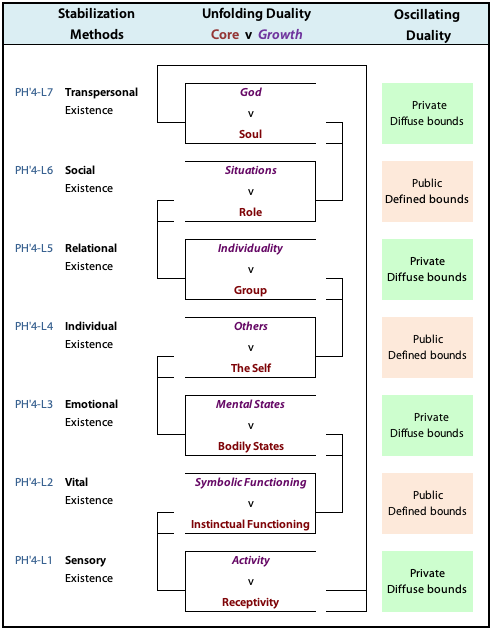
The odd-numbered levels with their private diffusely bounded sense of self ensure continued personal functioning via receptivity, bodily states, group membership and soul—and that sense of self is developed via activity, mental states, individuality and God respectively.
The even-numbered levels with a public definitely bounded sense of self ensure continued personal functioning via instincts, a self concept, and roles—and that sense of self is developed via symbol use, others, and situations respectively.
Originally posted: 15-Oct-2014. Last updated: 1-Aug-2026.