Unfolding Duality in Depiction Paradigms (PH'3)
The unfolding duality originally developed during investigation of the focused on confirming the hierarchical taxonomic ordering. Application of a standardized approach has led to some amendments to the original account.
Configuration v Complexification
Thesis + Antithesis = Synthesis
All Principal Typologies are thought to have a dialectical unfolding duality i.e. an intrinsic tension between:
- a ground state that is basic and unavoidable when the Type is operative; &
- a developmental force offering potential for that state to be improved or refined.
For the , this duality is proposed as follows:
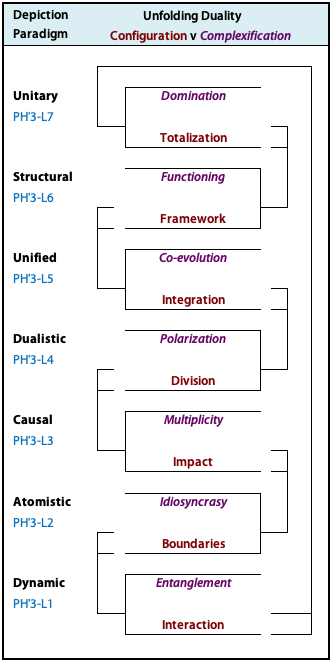
The configuration that emerges directly when the depiction paradigm is applied—which is proposed as the ground state of the method.
With effort, the same method can be used at a higher grade. Configurations can be developed by increasing their complexity, so complexification is proposed as the developmental force for each method.
Neither depiction form is better than the other in any absolute sense, but individuals find themselves habitually working with one or the other. The polarized forms can be combined to generate doctrine-based practices that encapsulate the value of both.
Theory vs Practice
The unfolding duality manifests in the form of a different dialectic within each Type/Level. The configuration pole is the thesis and the complexification pole is its antithesis. The tension at each Level is resolved by synthesis to create a new configuration at the next higher Level, which in turn activates a new form of complexification. The system is cyclic because the duality at is resolved by the configuration (thesis) at .
The cyclic system of progressive generation in the Typology is a taxonomic method used to develop the framework's structure and confirm its likely validity. While progress through the complete system is not something that occurs in psychosocial reality, individual transitions are sometimes recognizable.
What is visible in situations are polarized identities and doctrine-based practices. The polarized identities produce theoretical controversy and disputes about what is more suitable in the situation. The doctrine-based practices, which emerge from fusion of what is valuable in the two identities, are promoted and applied by more sophisticated actors.
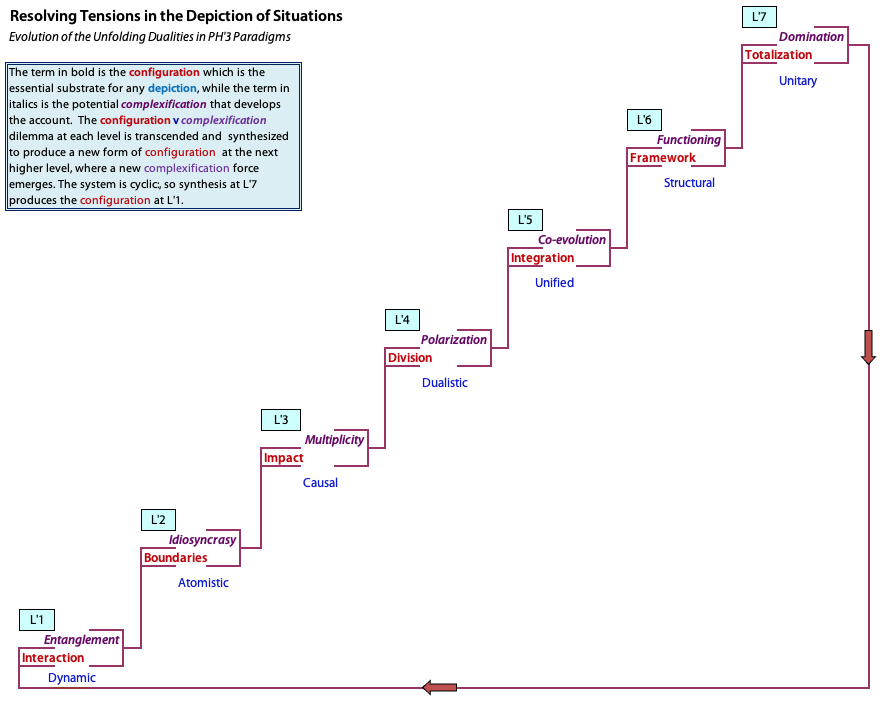
L'1: Dynamic
Interaction v Entanglement
The configuration produced by the reveals a system of interacting elements, not themselves systems, and capable of providing each other with feedback to enable a directed evolution of the situation. The basic pattern is therefore interaction, which is the thesis.
Complexity is introduced when components intensify and multiply their interactions, becoming over-involved and enmeshed with each other. This entanglement is the antithesis which makes the system and its evolution ever more difficult to construe.
 Polarization in Practice: The Systemicist v The Insider.
Synthesis: Entangled interactions become unworkable and drive components to disengage, which naturally gives rise to boundaries between them—which is the thesis at .
L'2: Atomistic
Boundaries v Idiosyncrasy
The configuration produced by the reveals boundaries that generate and define discrete entities or irreducible particles (the thesis). Each bounded entity is perceived as functioning independently and self-sufficiently. Seen from a higher viewpoint, each is just a number, or sometimes a cog or a pawn.
Complexity develops as those entities individuate uniquely and show increasing idiosyncrasy (the antithesis). Similar entities can be depicted by a generic account and simply counted. Idiosyncratic entities must each be grasped in their own terms and generalization becomes difficult.
Polarization in Practice: The Particle v The Individual.
Synthesis: Numerous bounded entities that are idiosyncratically individuated naturally result in impacts between at least some of them—which is the thesis at .
L'3: Causal
Impact v Multiplicity
The configuration produced by the reveals particular components of the situation impacting on specific others with predictable effects (the thesis). Such interactions constitute the essence of causation.
Causal models become more complex and sophisticated if a component has multiple influences and if the number of components having or potentially having an influence on others multiplies (the antithesis).
Polarization in Practice: The Predictor v The Multifactorialist.
Synthesis: Perception of a multiplicity of impacts in a situation becomes overwhelming and eventually incomprehensible, which calls for radical simplification via a binary division—which is the thesis at .
L'4: Dualistic
Division v Polarization
The configuration produced by the reveals a division that represents a dichotomy and posits or generates opposition between the two sides (the thesis).
Complexification results as the dichotomy becomes increasingly polarized (the antithesis). Polarization amplifies, sharpens and systematizes the differences between the two sides. As the degree of conflict escalates, all components get drawn in and the situation becomes more and more structured around the division.
Polarization in Practice: The Dichotomist v The Partisan.
Synthesis: The polarization that emerges from division must be resolved to avert a breakdown of the situation. This is made possible by integration of the opposing positions within a whole—which is the thesis at .
L'5: Unified
Integration v Co-evolution
The configuration produced by the reveals a fully integrated system of components and the environment, with all the inner complexity, differences, divisions and environmental interactions (the thesis).
The situation becomes ever more complex through unstoppable internal developments co-evolving with an ever-changing environment, and so demanding continuous dynamic re-formulation of all internal and environmental interactions (the antithesis).
Polarization in Practice: The Ecologist v The Visionary.
Synthesis: Co-evolution requires integration to be ordered so as to permit monitoring and control, and this leads to definition of a useful stable comprehensive framework—which is the thesis at .
L'6: Structural
Framework v Functioning
The configuration produced by the reveals an ordered usable framework (the thesis) that defines components, their functions and how they interact via roles and rules.
This schema can act as a template and be repeatedly applied. However, using any framework develops complexity because actual functioning (the antithesis) reveals errors and omissions that call for tweaks or extensions or incorporation of sub-units.
Polarization in Practice: The Schematist v The Functionary.
Synthesis: A powerful framework that repeatedly and effectively functions results in a total grasp of that entity or situation—which is the thesis at .
L'7: Unitary
Totalization v Domination
The configuration produced by the reveals an undifferentiated single whole, a totality (the thesis), that simply stays, or may expand or contract—but without concern for internal contents (individuals) or for the environment.
Complexification occurs as the totalization gets progressively extended and elaborated by the need to suppress alternatives, enforce conformity and extend uniformity through unequivocal domination of all entities (e.g. institutions in a society), which is the antithesis.
Polarization in Practice: The Totalist v The Dominator.
Synthesis: Totalization and domination generate a rigidity and homogeneity that provides stability at the price of freezing all independent functioning. But total suppression creates countervailing forces, and individuals eventually start asserting themselves leading to emergence of interaction— which is the thesis of , making the system cyclic as usual.
Unfolding and Oscillating Dualities
Additional illumination of the is provided by juxtaposing the dialectical dualities at each level with oscillations between controversial activating and irrefutable resolving depictions.
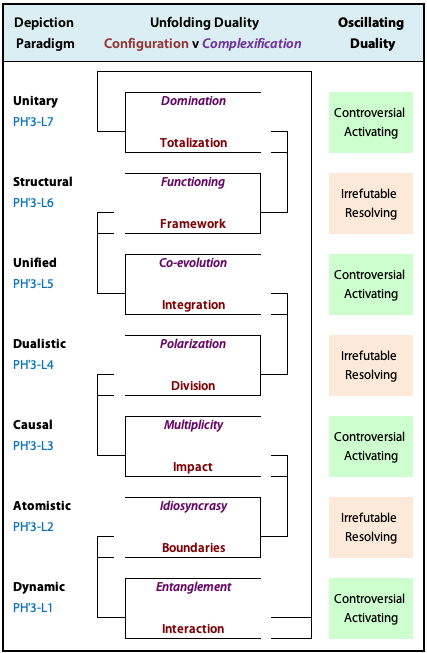
The odd-numbered controversial levels activate people, but the combination of the opposed forms provides acceptable control of depiction for change:
at L'1, participative systemicism creates a workable model of interactions;
at L'3, statistical determinism helps ground predictions;
at L'5, ecological emergentism grounds grand visions in observable inter-dependencies;
at L'7, benign paternalism limits the disturbance from domination.
The even-numbered irrefutable levels resolve differences amongst people and the combination of the opposed forms provides further stabilization:
at L'2, egalitarian individualism ensures justice as well as freedom;
at L'4, regulated adversarialism tempers emotional conflicts;
at L'6, adjustable functionalism integrates variations within the necessary framework.
- Check the unfolding duality for stabilization methods (PH'4).
- Compare the unfolding dualities in the 7 Domains.
Originally posted: 1-Aug-2026.