Unfolding Duality in Ethical Choice (PH'6)
The unfolding duality for —aspiration v constraint—was developed in the 1980's and published in Ch.6 of Working with Values (1995) in the section that summarized the 7 approaches.
At that time, the Taxonomy and its architecture were unknown, and so the duality was not labelled. On review now, there appear to be minor errors in the text. The notion that the Principal Typology dialectic might reflect perennial controversies was also not appreciated then. The topic below reviews and re-specifies the PH'6 system in the standard format, checking that it conforms naturally with current taxonomic principles and identifying special features of the Purpose Domain.
Aspiration v Constraint
Thesis + Antithesis = Synthesis
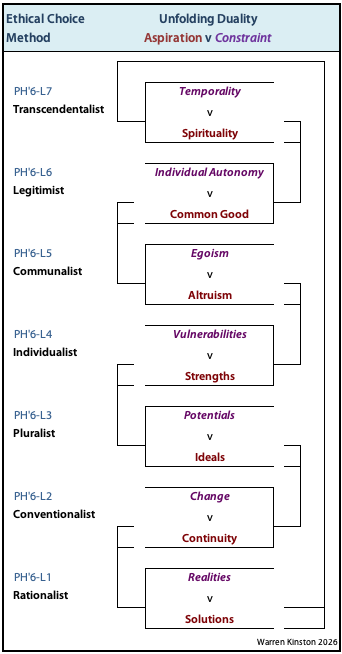
All Principal Typologies are now thought to have a dialectical unfolding duality i.e. an intrinsic tension between:
- a ground state that is basic and unavoidable when the Type is operative; &
- a developmental force offering potential for that state to be improved or refined.
For the , this duality is proposed as follows:
The aspiration emerges directly when a particular ethical choice approach is used—and this conception is proposed as the ground state of the approach.
In practice, there are always limits to be recognized. The aspirational conception can be developed by appreciating a particular constraint, which is therefore proposed as the developmental force for each approach.
Each ethical choice pole turns out to be deficient in practice and only their reconciliation through application of a relevant ethical injunction and exercise of a virtue characteristic of the level produces a satisfactory choice.
Theory vs Practice
The unfolding duality manifests in the form of a different dialectic within each Type/Level. The aspiration pole is the thesis and the constraint pole is its antithesis. The tension at each Level is resolved by synthesis to create a new form of aspiration at the next higher Level, which in turn activates a new form of constraint. The system is cyclic because the duality at is resolved by the aspiration (thesis) at .
What is visible in practice are polarized disputes between two equally deficient positions, and an evident requirement for their reconciliation using the virtue and injunction that is characteristic of the approach.
In the other Principal Typologies, the progressive generation of Types through one level's synthesis becoming the next level's thesis is a taxonomic method to develop the framework's structure and confirm its likely validity. However, in the case of ethical choices, the generation, while not mandatory, can be actually observed in social life.
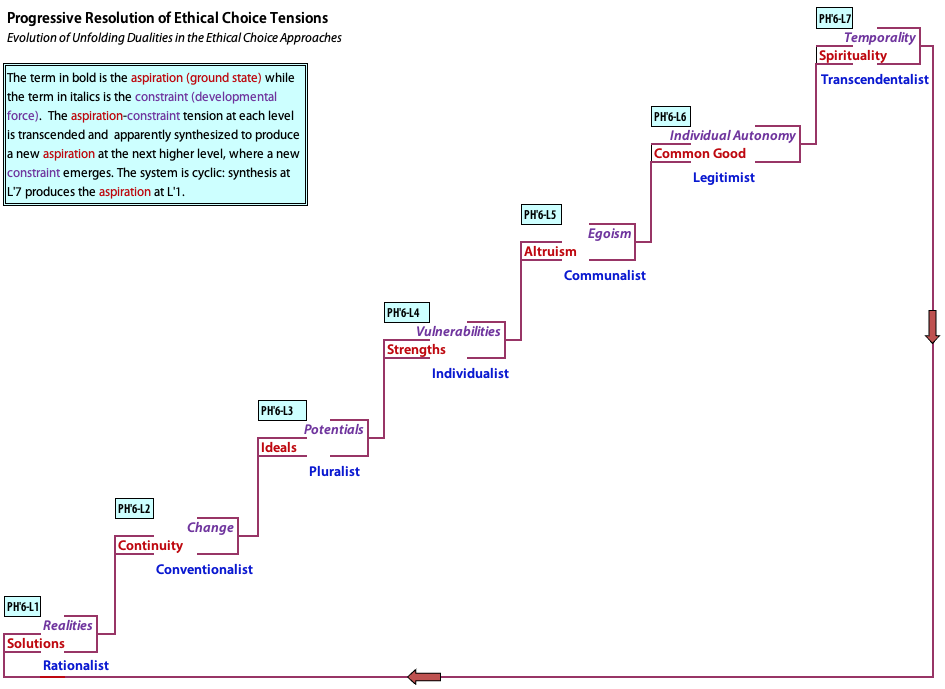
The Seven Dialectic Dualities
L'1: Rationalist
Solutions v Realities
The aspires to determine solutions that meet self-evidently sensible and worthwhile objectives, which is the thesis.
However, solutions must engage with realities of social resistance and political obstacles that constrain what is possible (the antithesis). Integration of these constraints reasonably is an exercise in wisdom, the L'1 virtue that leads to better solutions.
 Polarization in Practice: The Technocrat v The Politician.
Synthesis: The tension between solutions for the group and constraints within the group can be resolved by a course that ensures continuity—which is the thesis at, the next level up.
L'2: Conventionalist
Continuity v Change
The aspires to ensure continuity in regard to widely held views on what is valued and proper within the group (the thesis).
However, desires for continuity will not deal with troubling issues and are constrained by the need for change (the antithesis). Determining change given the aspiration for continuity requires a focus on acceptability as well as moderation, the L'2 virtue that maintains social well-being and cohesion.
Polarization in Practice: The Traditionalist v The Activist.
Synthesis: The tension between continuity and change within the group can be resolved by recognizing ideals—which is the thesis at , the next level up.
L'3: Pluralist
Ideals v Potentials
The aspires to ideals that are preferred, bring wider benefit and can be easily applied. However, the realization of ideals (the thesis) is constrained by the potentials (the antithesis) that exist in the social milieu. Pursuing lofty ideals demands being appropriate at all times and upholding prudence, the L'3 virtue to manage associated risks.
Polarization in Practice: The Idealist v The Pragmatist.
Synthesis: The tension between ideals and potentials that suit the group can be resolved by focusing on the individual's strengths—which is the thesis at , the next level up.
L'4: Individualist
Strengths v Vulnerabilities
The aspires to strength, the thesis, by ensuring security and self-interest in the light of existing power relations.
However, there are always limitations and vulnerabilities (the antithesis) that constrain the development and use of strength. Acting self-advantageously while showing strength despite vulnerabilities calls for courage, the L'4 virtue for dealing with others who are more powerful.
Polarization in Practice: The Fighter v The Appeaser.
Synthesis: The tension between strengths and vulnerabilities and their variability within the group can be resolved through altruism—which is the thesis at , the next level up.
L'5: Communalist
Altruism v Egoism
The aspires to altruism (the thesis) to ensure choices attend to the needs and interests of all concerned in the light of anticipated consequences.
However, the presence of egoism (the antithesis) places a constraint on what can and will be done. Altruism within the limits of egoism is about benefiting all via the exercise of benevolence, the L'5 virtue that focuses on the well-being of others.
Polarization in Practice: The Altruist v The Egoist.
Synthesis: The tension between altruism and egoism in social life can be resolved through appreciating the common good—which is the thesis at , the next level up.
L'6: Legitimist
Common Good v Individual Autonomy
The aspires to protect the common good (the thesis) by setting a rule that can be accepted as right by all in the social group.
However, the value placed on individual autonomy (the antithesis) constrains rule-setting. Reconciling the importance of individual autonomy with the requirement to serve the common good depends on being fair and the exercise of justice, the L'6 virtue that maintains social order.
Polarization in Practice: The Rule-setter v The Libertarian.
Synthesis: The tension between common good and individual autonomy can be resolved through activation of spirituality—which is the thesis at , the next level up.
L'7: Transcendentalist
Spirituality v Temporality
The aspires to a spirituality (the thesis) through activation of ultimate values that transcend time, culture and circumstances and so enable a deep inner sense of what is right and good.
However, the claims of temporality (the antithesis) cannot be ignored and they place a constraint on what can be chosen. A person needs to act authentically and exercise integrity, the L'7 virtue that ensures temporality does not corrupt spiritual energies.
Polarization in Practice: The Seeker v The Worldly-wise.
Synthesis: The tension between spirituality and temporality can be resolved by finding practical solutions needed for group life—which is the thesis for the , making the system cyclic as usual.
Unfolding and Oscillating Dualities
Additional illumination of the is provided by juxtaposing the oscillations between a teleologicaland a deontological orientation with the various dialectical dualities at each level.
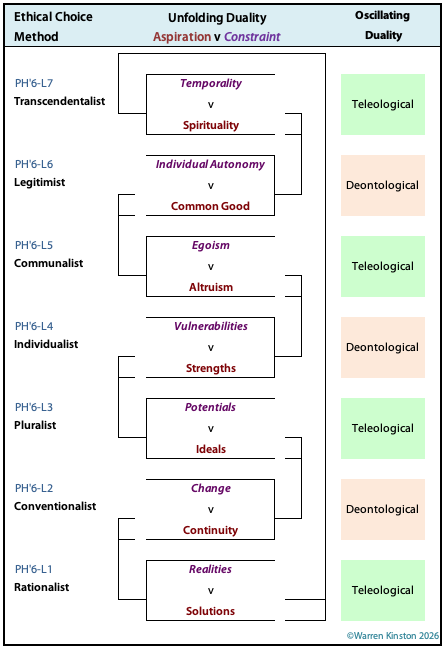
The odd-numbered teleological levels aspire to a good—a solution, an ideal, altruism, spirituality—and the constraints emerge from the world as it is: realities, potentials, egoism and temporality respectively.
The even-numbered deontological levels aspire to a duty—social continuity, personal strength, the common good—and the constraints emerge from social dynamics—change, vulnerabilities, individual autonomy respectively.
Each good generates a duty which generates a good which generates a duty and so on. This system is book-ended by two goods: the immediate practical good and the ultimate transcendental good.
- Check the unfolding duality for capability enhancement (PH'7).
- Compare the unfolding dualities in the 7 Domains.
Originally posted: 1-Aug-2026.