Unfolding Duality in Research Methods (PH'2)
An unfolding duality was not developed during the investigation of the and so is absent from the Satellite.
Representation v Criticism
Thesis + Antithesis = Synthesis
All Principal Typologies are thought to have a dialectical unfolding duality i.e. an intrinsic tension between:
- a ground state that is basic and unavoidable when the Type is operative; &
- a developmental force offering potential for that state to be improved or refined.
For the , this duality is proposed as follows:
The representation that emerges directly when the research method is used—which is proposed as the ground state of the method.
With effort, the same method can be used at a higher grade. Representation can be developed by criticism of the research findings, which is therefore proposed as the developmental force for each method.
Neither research form is better than the other in any absolute sense and so a choice may have to be made in practice. Use of both poles produces the most rigorous research.
Theory vs Practice
The unfolding duality manifests in the form of a different dialectic within each Type/Level. The representation pole is the thesis and the criticism pole is its antithesis. The tension at each Level is resolved by synthesis to create a new form of representation at the next higher Level, which in turn activates a new form of criticism. The system is cyclic because the duality at is resolved by the representation (thesis) at .
However, this progressive generation of Types is not something that occurs in psychosocial reality. It is a taxonomic method used to develop the framework's structure and confirm its likely validity.
What is visible in practice are two polarized positions evident in social interchanges and often appearing as intra-psychic conflicts that must be tolerated. It seems that the most rigorous scientific inquirers actively identify with both poles. However, there are many examples of respected scientists who refused to be critical of their own position when outsiders can see that such criticism is evidently required.
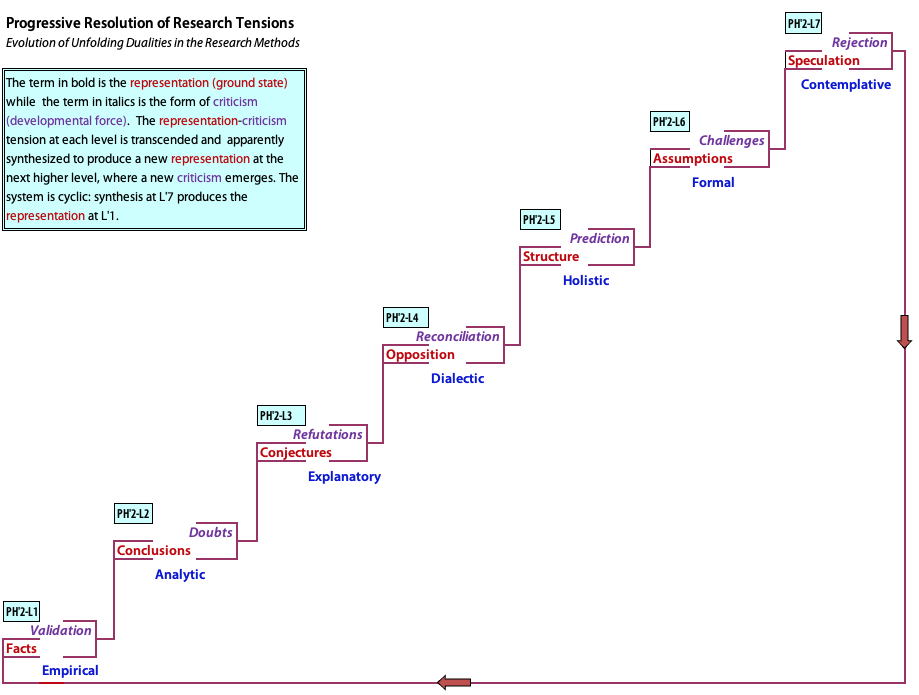
The Seven Dialectic Dualities
L'1: Empirical
Facts v Validation
The represents reality through facts extracted from data—the thesis.
In that process, errors creep in from various sources like bias, faulty instruments, chance events. So all presented facts and statistical analyses require critical scrutiny and validation—the antithesis.
 Polarization in Practice: The Observer v The Validator.
Synthesis: The tension between facts and validation can be resolved by reaching a conclusion—which is the thesis at the next level up.
L'2: Analytic
Conclusions v Doubts
The represents reality with conclusions based on reasoning using available evidence, and this is the thesis.
However, the evidence is always limited and crucial factors may well have been missed, so criticism is necessary. No matter how persuasive, doubts (the antithesis) can be activated to develop arguments that challenge proposed conclusions.
Polarization in Practice: The Analyst v The Doubter.
Synthesis: The tension between a conclusion and doubt can be resolved by conversion into a conjecture—which is the thesis at the next level up.
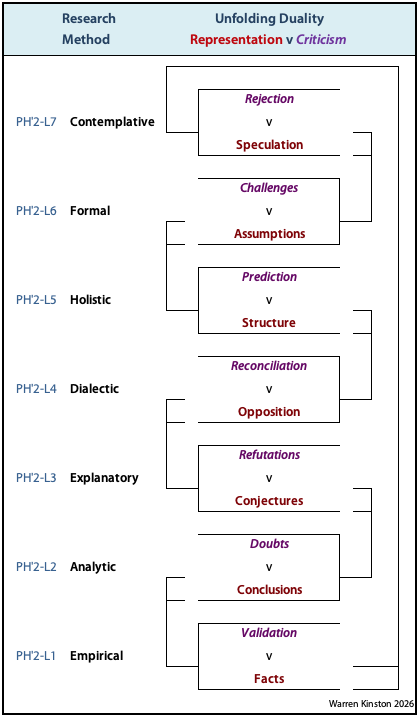
L'3: Explanatory
Conjectures v Refutations
The represents reality with conjectures that seem reasonable and are testable and falsifiable—the thesis.
However, there are typically a large number of possibilities to explain a particular relationship. Criticism is needed to reject and replace conjectures so as to establish a potential for refutation—the antithesis.
Polarization in Practice: The Hypothesizer v The Falsifier.
Synthesis: The tension between a conjecture and its refutation can be resolved by setting them up as a pair in opposition—which is the thesis at the next level up.
L'4: Dialectic
Opposition v Reconciliation
The represents reality using binary oppositions that are polarized—the thesis.
However, oppositions need to be criticized by showing them to be only apparent, and this involves a process of reconciliation—the antithesis.
Polarization in Practice: The Polarizer v The Reconciler.
Synthesis: The tension between opposition and reconciliation can be resolved by structuring the relationship between those factors and others—which is the thesis at the next level up.
L'5: Holistic
Structure v Prediction
The represents reality by imposing structure (the thesis) as the basis of a complete model of a situation.
Such a model is most valuable if it can offer novel predictions (the antithesis) which can be investigated and used to criticize the structure.
Polarization in Practice: The Modeller v The User.
Synthesis: The tension between structure and prediction can be resolved by assumptions that do not need to be proven—which is the thesis at the next level up.
L'6: Formal
Assumptions v Challenges
The represents reality with assumptions (the thesis) that are to be taken as axiomatic and therefore capable of being used for deductions to produce proofs.
However, any assumption may be criticized and subject to a challenge (the antithesis), especially if the axiom or principle is not self-evident or seems obviously false (e.g. the econometrician's "rational man").
Polarization in Practice: The Formalist v The Challenger.
Synthesis: The tension between assumptions and challenges can be resolved by speculation that makes a leap of faith beyond what can be proven to produce an insight—which is the thesis at the next level up.
L'7: Contemplative
Speculation v Rejection
The represents reality with speculations (the thesis) that emerge from the imagination following intense concentration on an object of inquiry and claim to resolve anomalies or long-standing problems.
Speculations of this sort are often weird or tendentious, even if they are illuminating. So they are greeted with ridicule and rejection (the antithesis) and receive the harshest possible criticism.
Polarization in Practice: The Contemplative v The Naysayer.
Synthesis: The tension between speculation and rejection can only be resolved by checking whether it is actually so. That entails providing potentially confirming or disconfirming facts—which is the thesis of the , making the system cyclic as usual.
Unfolding and Oscillating Dualities
Additional illumination of the is provided by juxtaposing the oscillations between realism and idealism with the various dialectical dualities at each level.
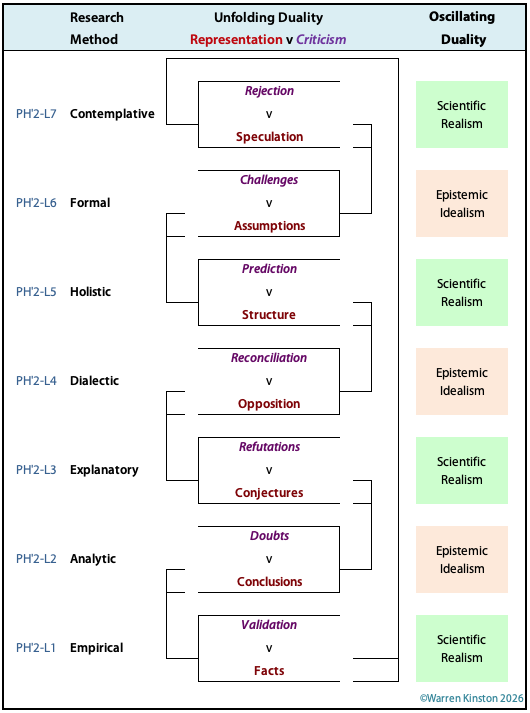
The odd-numbered realist levels represent the world via facts, conjectures, structures, speculations—and confront the posited reality via validation, refutation, prediction and rejection respectively.
The even-numbered idealist levels represent asserted mental constructs via conclusions, oppositions, assumptions—and interrogate those ideas via doubt, reconciliation and challenge respectively.
- Check the unfolding duality for depiction paradigms (PH'3).
- Compare the unfolding dualities in the 7 Domains.
Originally posted: 1-Aug-2026.