Unfolding Duality in Decision-making (PH'1)
An unfolding duality was not developed during the investigation of .
Resolution v Questioning
Thesis + Antithesis = Synthesis
All Principal Typologies are thought to have a dialectical unfolding duality i.e. an intrinsic tension between:
- a ground state that is basic and unavoidable when the Type is operative; &
- a developmental force offering potential for that state to be improved or refined.
For the , this duality is proposed as follows:
The resolution that emerges directly when the decision-method is used—which is proposed as the ground state of the method.
With effort, the same method can be used at a higher grade. Resolution can be developed by questioning, which is therefore proposed as the developmental force for each method.
Neither decision form is better than the other in any absolute sense and so a choice has to be made in practice.
Theory vs Practice
The unfolding duality manifests in the form of a different dialectic within each Type/Level. The resolution pole is the thesis and the questioning pole is its antithesis. The tension at each Level is resolved by synthesis to create a new form of resolution at the next higher Level, which in turn activates a new form of questioning. The system is cyclic because the duality at is resolved by the resolution (thesis) at .
However, this progressive generation of Types is not something that occurs in psychosocial reality. It is a taxonomic method used to develop the framework's structure and confirm its likely validity.
What is visible in situations is controversy, sometimes emerging as social disputes, about which pole is more suitable either for the person or to meet a social demand. There may be rivalry between protagonists within a Type according to which pole they adopt for themselves.
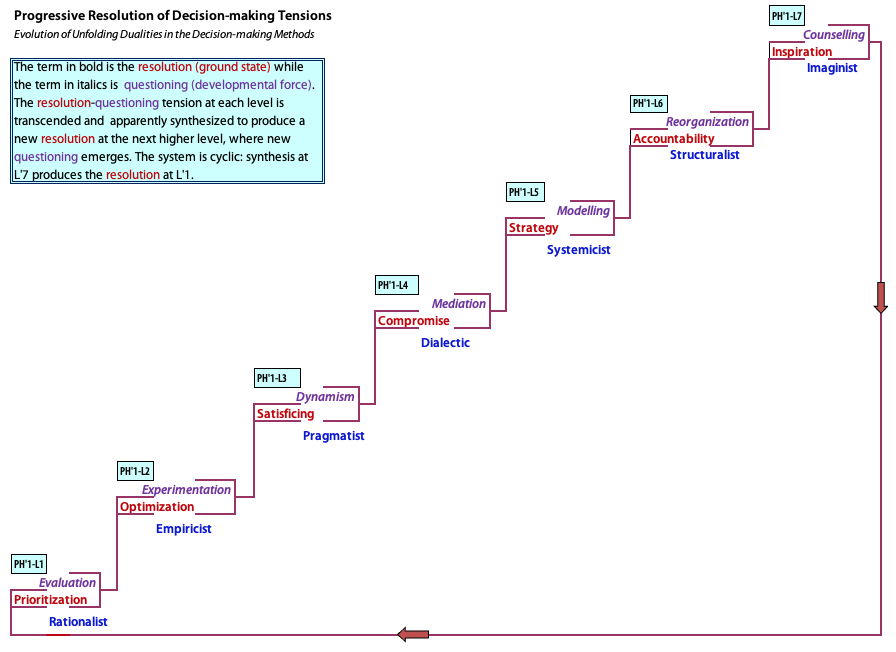
The Seven Dialectic Dualities
L'1: Rationalist
Prioritization v Evaluation
The resolves an issue by applying priorities (the thesis) that are based in previously determined goals and plans. However priorities are derived from aims alone, so those aims are simply assumed to be valid.
Evaluation (the antithesis) questions their appropriateness by comparing results with values and strategic objectives.
 Polarization in Practice: The Designer v The Evaluator.
Synthesis: The tension between priorities and evaluations can be resolved by optimization where the best outcome is targeted—which is the thesis at the next level up.
L'2: Empiricist
Optimization v Experimentation
The resolves an issue by generating an optimal solution , the unique best that available facts point towards (the thesis), and adopting it. The optimizing claim cannot be disputed via reflection and it depends on facts in hand.
Whether the solution is truly optimal can be suitably questioned by experimentation (the antithesis) which sets up pilot studies to generate facts previously unavailable.
Polarization in Practice: The Analyst v The Experimenter.
Synthesis: The tension between optimization and experimentation can be resolved by satisficing that generates a good-enough outcome—which is the thesis at the next level up.
L'3: Pragmatist
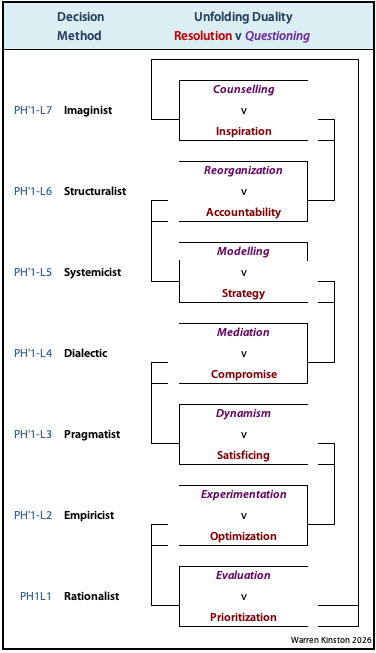
Satisficing v Dynamism
The resolves an issue by satisficing (the thesis), which is based on seizing the most attractive and easiest opportunity for genuine but limited gain.
However, the situation is ever-changing, so seizing the moment is of limited value and can be questioned. The pragmatic style can be developed by dynamism (the antithesis), which enables continuous checking and piecemeal issue resolution, so generating relentless faster progress.
Polarization in Practice: The Satisficer v The Dynamo.
Synthesis: The tension between satisficing and dynamism can be resolved by compromising, which gives attention to the competing interest groups—which is the thesis at the next level up.
L'4: Dialectic
Compromise v Mediation
The resolves an issue by negotiating a compromise that all parties in the conflict will accept (the thesis). However, the compromise is based on what the parties said, not necessarily on what actually divides them.
So compromises can always be questioned, and must be if they unravel or do not deliver the desired resolution. That is handled by mediation (the antitthesis) that carefully clarifies the concerns, expectations and values that underlie the conflict.
Polarization in Practice: The Broker v The Mediator.
Synthesis: The tension between compromise and mediation can be relieved by a strategy that treats the parties as inter-dependent actors within a system—which is the thesis at the next level up.
L'5: Systemicist
Strategy v Modelling
The resolves an issue by using a strategy (the thesis) based on a model of the situation geared to evolving an optimal-feasible scenario.
However, the adequacy of the model and suitability of the scenario can be questioned, and that requires detailed modelling (the antithesis) to put the strategy properly to the test.
Polarization in Practice: The Strategist v The Modeller.
Synthesis: The tension between strategy and modelling can be resolved by accountability that handles both through allocating ownership of the issue—which is the thesis at the next level up.
L'6: Structuralist
Accountability v Reorganization
The resolves an issue by assigning accountability (the thesis) together with appropriate authority for dealing with the matter, as well as arrangements for appraisal. However, the structure within which this occurs is taken for granted.
Questioning accountability means addressing the structure and suggests the need for reorganization (the antithesis).
Polarization in Practice: The Bureaucrat v The Reorganizer.
Synthesis: The tension between accountability and reorganization can be resolved by inspiration that provides a new and penetrating vision for what is required—which is the thesis at the next level up.
L'7: Imaginist
Inspiration v Counselling
The resolves an issue by fostering and crystallizing inspiration (the thesis). However, any inspiration is personal and may not fit with the context, especially the values and goals of others.
As a result, there is a need for a counselling (the antitthesis) to question that idea and ensure it is workable. Often another counsels, but sometimes a person must reflect and take their own counsel.
Polarization in Practice: The Visionary v The Counsellor.
Synthesis: The tension between inspiration and counsel can be resolved through sharing of values and goals that can be realized through prioritization—which is the thesis for the making the system cyclic as usual.
Unfolding and Oscillating Dualities
Additional illumination of the is provided by juxtaposing the oscillations between realism and idealism with the various dialectical dualities at each level.
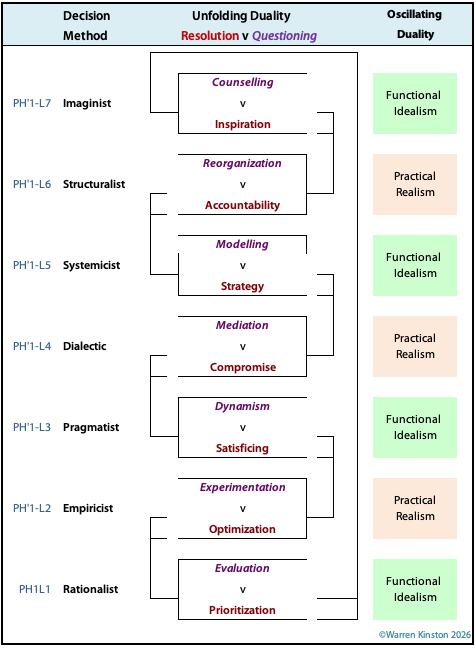
The odd-numbered idealist levels impose on the world via prioritizing, satisficing, strategizing, and inspiring—and action gets channeled via evaluation, modelling and counsel respectively.
The even-numbered realist levels deal with the world as it is via optimization, compromise, accountability—and choices get improved via experimentation, clarification and appraisal respectively.
- Check the unfolding duality for research methods (PH'2).
- Compare the unfolding dualities in the 7 Domains.
Originally posted: 1-Aug-2026.