Unfolding Duality in Language Use (PH'5)
The unfolding duality developed during the investigation of methods for using language (PH'5) was very recently completed and is largely repeated below. That account however had only a limited focus on the polarization of each method in practice, and no comment on the relation of the unfolding and oscillating dualities, both of which are dealt with here.
 Use of AI
As my background knowledge of this subject is limited and I used Claude AI for support in relation to polarization examples, others need to review and revise the account.
Signification v Sophistication
Thesis + Antithesis = Synthesis
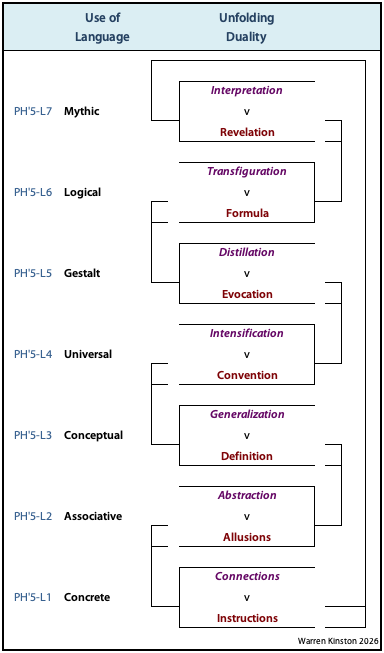
All Principal Typologies are thought to have an unfolding duality i.e. an intrinsic tension between:
- a ground state that is basic and unavoidable when the Type is operative; &
- a developmental force offering potential for that state to be improved or refined.
For the use of language, this duality is proposed as follows:
A signification emerges directly when language is used and this is therefore the ground state of the method.
With effort, the same method can be used at a higher grade. Sophistication is the developmental force for each method enhancing the quality, depth or reach of the basic signification.
Neither form is better than the other in any absolute sense and so a choice has to be made in practice.
This duality applies only to the active communicator. The recipient does not use language but deals with the language that is provided.
Theory vs Practice
The unfolding duality manifests in the form of a different dialectic within each Type/Level. The signification pole is the thesis and the sophistication pole is its antithesis. The tension at each Level is resolved by synthesis to create a new form of signification at the next higher Level, which in turn activates a new form of sophistication. The system is cyclic because the duality at L'7 is resolved by the signification (thesis) at L'1.
However, this progressive generation of Types is not something that occurs in psychosocial reality. It is a taxonomic method used to develop the framework's structure and confirm its likely validity.
What is visible in practice is a controversy, sometimes a paradigm war, about which pole is more suitable either for a person or for a social demand. There may be rivalry between protagonists within a Type according to which pole they adopt for themselves.
See the full picture now:
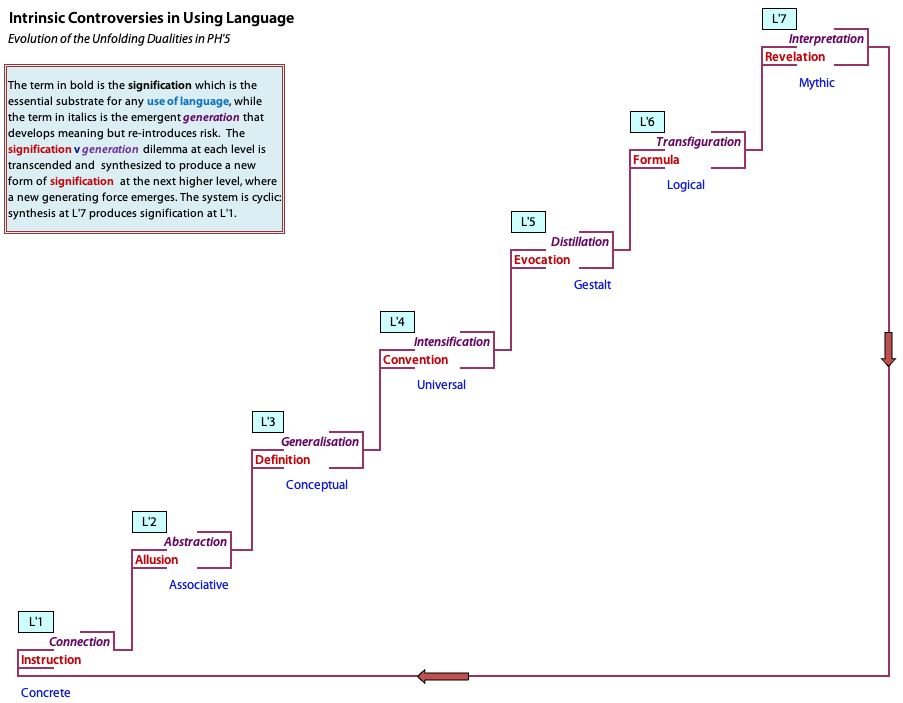
The Seven Dialectic Dualities
L'1: Concrete
Instruction v Connection
The concrete method communicates using instructions (the thesis) based in words and/or pictures that are designed for general use. The signification here is explicit (nothing essential omitted), sparse (nothing unnecessary included), and ordered so that there is no uncertainty about what to do.
However, the difficulty with such instructions is that they exclude the idiosyncratic thinking and background of the recipient, reasons that are meaningful in practice, and contextual factors affecting use of the instructions. The antithesis is therefore the provision of specific connections for a particular recipient, which results in a more sophisticated account.
Polarization in Practice
The instruction form is the standard manual or public sign where there is one text written for everyone. The text assumes nothing about who reads it. The connection form is a customized text with the same basic information but rewritten for a particular person and pitched to what they already know and why they are asking.
Perennial Controversy
The dispute is sharpest in education. Direct instruction, developed by Siegfried Engelmann, teaches through explicit, fully-scripted, standardized lessons that leave nothing to the learner to work out. Against it, the discovery tradition of Jerome Bruner holds that a person only truly learns by building meaning from their own context, so teaching must connect to the particular individual. The dispute continues: Kirschner, Sweller and Clark argued more recently that minimally-guided, discovery-style teaching simply does not work, provoking a vigorous defence from the constructivists.
References: Siegfried Engelmann & Douglas Carnine "Theory of Instruction" (1982). Jerome Bruner "The Act of Discovery", Harvard Educational Review (1961). Kirschner, Sweller & Clark "Why Minimal Guidance During Instruction Does Not Work", Educational Psychologist (2006).
Synthesis: The tension between general instructions and connections meaningful for individual recipients can be relieved by using allusions—which is the thesis at L'2, the next level up.
L'2: Associative
Allusion v Indication
The associative method communicates using allusions (the thesis) which lead to conversations that feel natural, easy and comfortable. But such signification can only operate within an in-group constantly sharing activities, experiences and context.
The difficulty with this signification is that the language is indirect, opaque, obscure and confusing for outsiders. The antithesis therefore involves becoming more sophisticated and directly indicating the particular object or phenomenon to ensure an unambiguous explicit reference.
Polarization in Practice
The allusion form is insider talk: the shorthand, banter and vague or half-complete references that a close group understands without effort, because everyone shares the background. The indication form is the same thing said plainly to guide someone outside the inner circle—pointing or naming or describing the thing outright, assuming nothing. Every group runs on the first among its own and switches to the second for a newcomer.
Perennial Controversy
Whether the insider code is poorer than the explicit one, or merely different, is a long dispute. Basil Bernstein distinguished a restricted code—context-bound, leaning on shared assumption, used among intimates—from an elaborated code that spells meaning out for anyone, whatever they share. William Labov's reply, in "The Logic of Nonstandard English", was that the vernacular of such communities is fully logical and rule-governed: not a deficient standard, simply a different system. The quarrel — deficit versus difference — still runs through education and sociolinguistics.
References: Basil Bernstein "Class, Codes and Control" (1971); William Labov "The Logic of Nonstandard English" (1969).
Synthesis: The tension between allusions and indications can be relieved by providing agreed-upon definitions—which is the thesis at L'3, the next level up.
L'3: Conceptual
Definition v Generalization
The conceptual method communicates using definitions, which is the thesis. Key words are given an agreed explicit meaning within a delimited field. This signification permits coherent, consistent and cumulative development of the field.
The difficulty with this scholarly signification is that it produces a jargon which is only comprehensible to those trained and immersed in the specialist field. More sophisticated communicators use generalizations (the antithesis) so as to allow the meaning to become part of the language used in wider society.
Polarization in Practice
The definition form generates specialist jargon, which is used when a specialist speaks with or writes for peers. Every important term has an unstated but agreed and well-known technical meaning, so the field can develop systematically and explicitly for members of the discipline. The generalization form deals with the same material when an expert turns to outsiders—users, patients, sponsors, funders, authorities. The language trades precision for reach e.g. a doctor's note records "coryza" and "pyrexia" but the patient is told "a cold" and "a temperature."
Perennial Controversy: The Purist v The Popularizer
The purist rejects any compromise in precision. The popularizer seeks to deliver specialist knowledge to the masses. Carl Sagan was a popularizer of science and this led to his nomination for membership of the US National Academy of Sciences in 1992 being rejected. Purists view any translation of specialist knowledge into general language as quietly distorting. The same fight exists in law: plain-language reformers press for documents an ordinary citizen can read, while traditional drafters insist that legal terms carry meanings that plain words lose.
References: Carl Sagan "The Demon-Haunted World" (1995); David Mellinkoff "The Language of the Law" (1963).
Synthesis: The tension between definitions and generalizations can be relieved by communication using widely agreed conventions—which is the thesis at L'4, the next level up.
L'4: Universal
Convention v Intensification
The universal method communicates using conventions (the thesis). Everyone comes to tacitly share phrases, images and references so that understanding what is being said or written requires no effort or deep thought.
The difficulty with using conventions is that they are superficial and only seem true because so many details are ignored. To reach beyond the convention, the communicator must become more sophisticated and deepen the focus on the issue. So the antithesis is an intensification that can go beyond the superficially plausible.
Polarization in Practice
The convention form is used by regular journalists for news items and opinion pieces and fills text with stock phrases, familiar images, and widely shared references. By contrast, investigative journalists use the intensification form and dig for the facts, build on in-depth interviews and create a meaningful narrative which often reports something unknown or unexpected. In the same way, the run-of-the-mill politician's speech and the statesman's may address the same theme, but only the latter carries weight.
Perennial Controversy
Whether conventional public language is harmless shorthand or a slow corruption is a standing dispute. George Orwell took the hard line that conventional ready-made phrases and dying metaphors are not just ugly but let speakers and writers, especially politicians, avoid seeing what they are saying. His cure was intensification: fresh, exact language that forces both writer and reader to confront the thing itself. However, others argue that shared convention is exactly what lets a message reach everyone at once and perpetual freshness is elitist and a counsel few can keep.
Reference: George Orwell "Politics and the English Language" (1946).
Synthesis: The tension between conventional writing and intensified composition can be relieved by ensuring an evocation that directly reveals the experiential truth of a situation—which is the thesis at L'5, the next level up.
L'5: Gestalt
Evocation v Distillation
The gestalt method communicates using evocation as the thesis. Signification here depends on imaginatively combining words, images, sounds, and other stimuli so that the recipient senses that the truth of the situation is being communicated.
The use of ambiguity, paradox, metaphor and other techniques calls for talent in the communicator and a willing receptivity. The evocation is complex, reaching deep but unable to be applied broadly to many situations. To be extended, it is necessary to distil the account in a sophisticated way and reach the felt truth that is believed to be at its core. So the antithesis is distillation.
Polarization in Practice: The Artist v The Critic
The evocation form is used by the great artist—novelist, poet, film-maker, sculptor—who renders a situation whole, combining all elements with metaphor and ambiguity so that the recipient grasps and feels the truth of the human condition. The distillation form is used by the great critic who takes that dense rendering and draws out the artist's inner truth and brings the work to life for the masses who would otherwise be oblivious.
Perennial Controversy
Whether the truth of an artwork lives in the work itself or can be drawn out and stated is an open dispute. Susan Sontag argued that the critic attempting to distil the "real" meaning is an assault that dissipates the art, and people would do better to attend to the sensuous, evocative thing itself. Against this position stands the whole interpretive project, whether based on Freudian or Marxist ideas or popular myths and meanings. In this view, distillation allows art to be understood, appreciated and meaningfully shared. E. D. Hirsch responded to Sontag by arguing that interpretation is a disciplined recovery of a work's true meaning and deepest truths, which is essential for a culture to understand itself.
Reference: Susan Sontag "Against Interpretation" (1966); E.D. Hirsch, "Validity in Interpretation" (1967) and "Cultural Literacy" (1987).
Synthesis: The tension between evocation and distillation can be relieved by developing a formula that reaches a universal fundamental applicable to all such situations—which is the thesis at L'6, the next level up.
L'6: Logical
Formula vPatterning
The logical method communicates using formulae (the thesis) that are concise, precise and veridical. Formulae capture an essence, a universal fundamental, that is available to anyone who is prepared to observe and reflect. Formulae do not depend on social agreement or specialized training.
The difficulty with formulae for signification is that they are impersonal and do not provide guidance in negotiating reality. Formulae lack power to command or transform or align a person with their personal psychosocial world. To get formulae to become more sophisticated, they must be patterned into useful and usable frameworks. So the antithesis is patterning.
Polarization in Practice
Isaiah Berlin identified this conflict within and sometimes between people: there is the Fox who knows many things (formula pole: separate self-standing principles) and the Hedgehog who knows one big thing (patterning pole: the single organizing system into which everything fits).
William of Ockham offered a useful formula: never multiply entities beyond what is needed which stands independent of any system of thought. Ludwig Wittgenstein also refused to build his insights into a system. By contrast, G.W.F. Hegel chose the patterning form to build a system incorporating logic, nature, history, art and religion into one comprehensive picture of Spirit coming to know itself. Johann Fichte, who cast his metaphysical system as thesis-antithesis-synthesis, sought to derive the whole of reality from a single act—the "I" positing itself and the world as its counterpart.
References: Isaiah Berlin "The Hedgehog and the Fox" (1953).
Perennial Controversy: Analytic Philosophy v Continental Philosophy
The Analytic tradition trusts only what can be stated precisely, the formula, and tested logically piece by piece. It views patterning as an empty spinning of words. The Continental tradition builds sweeping systems that engage what matters most for human life. The hostility runs deep: having both traditions in a single Philosophy Department can be problematic. The split is often dated to Davos in 1929 where Martin Heidegger debated Ernst Cassirer with Rudolf Carnap in the audience. A few years later Carnap published his attack: Heidegger's metaphysics are built of pseudo-statements and nonsensical. Heidegger riposted that metaphysics is essential to deal with existential questions and subjective experiences.
References: Michael Friedman, "A Parting of the Ways: Carnap, Cassirer, Heidegger" (2000). Peter Gordon "Continental Divide: Heidegger, Cassirer, Davos" (2010). Rudolf Carnap "The Elimination of Metaphysics Through Logical Analysis of Language" (1932).
Synthesis: The tension between formulae and patterning can be relieved by providing revelations—which is the thesis at L'7, the next level up.
L'7: Mythic
Revelation v Interpretation
The mythic method communicates using revelations (the thesis) that are counter-intuitive or mysterious, spiritual and often seem magical.
A revelation is a signification that demands personal alignment or re-alignment. However, the revelation, being cryptic, cannot easily be acted upon. Interpretation of the revelation calls for a sophistication to construe the transcendent message into something graspable. Because it renders a revelation into an actionable and followable form, it serves as the antithesis.
Polarization in Practice: The Prophet v The Priest
The revelation pole is used by Max Weber's prophet—the charismatic figure who proclaims a new and disruptive truth:"I say unto you"—often claiming the authority of the divine. The interpretation pole is Max Weber's priest: the office-holder who takes that revelation and codifies it, teaches it, and administers it doctrinally within the institution. Weber calls this the "routinization of charisma" that allows religions to cohere and be followed.
Perennial Controversy
Whether the sacred word can reach people directly or can only be safely grasped through an authorized interpreter leads to intense disputes. The Reformation arrived when Martin Luther held that Scripture reveals itself plainly to any believer who reads it, so no priestly mediation is needed. The Catholic Church answered, at the Council of Trent, that Scripture without the Church's authoritative interpretation breeds error and division, and that the teaching authority of the Church (the magisterium) is what keeps the Word both sound and followable. This split is liable to recur wherever a religious orthodoxy has to confront mystics.
Reference: Max Weber, The Sociology of Religion (1922); Diarmaid MacCulloch, Reformation: Europe's House Divided (2003).
Synthesis: The tension between revelation and interpretation can be relieved by conversion into instructions about what to do—which is the signification thesis of the original L'1-Concrete method, making the system cyclic as usual.
Unfolding & Oscillating Dualities
Additional illumination and surprises in relation to these language use methods is provided by juxtaposing the proposed oscillations between demanding and adaptable significations with the various dialectical dualities.
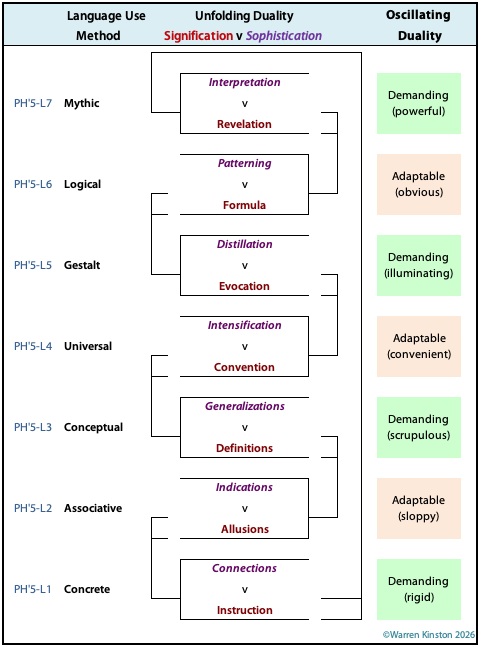
The odd-numbered levels generate fixed demanding communications—an instruction, a definition, an evocation, a revelation—and sophistication is required to communicate this more widely via connection, generalization, distillation and interpretation respectively.
The even-numbered adaptable levels generate flexible adaptable communications—allusions, conventions, formulae—and sophistication is required to render communication more usable via indication, intensification and patterning respectively.
Originally posted: 16-Jul-2026. Last amended: 1-Aug-2026.