Signification v Sophistication
Thesis + Antithesis = Synthesis
All Principal Typologies are thought to have an unfolding duality i.e. an intrinsic tension between:
- a ground state that is basic and unavoidable when the Type is operative; &
- a developmental force offering potential for that state to be improved or refined.
For the , this duality is proposed as follows:
A signification emerges directly when language is used and this is therefore the ground state of the method.
With effort, the same method can be used at a higher grade. Sophistication is the developmental force for each method enhancing the quality, depth or reach of the basic signification.
Neither form is better than the other in any absolute sense and so a choice has to be made in practice.
This duality applies only to the . The does not use language but deals with the language that is provided.
Theory vs Practice
The unfolding duality manifests in the form of a different dialectic within each Type/Level. The signification pole is the thesis and the sophistication pole is its antithesis. The tension at each Level is resolved by synthesis to create a new form of signification at the next higher Level, which in turn activates a new form of sophistication. The system is cyclic because the duality at is resolved by the signification (thesis) at .
However, this progressive generation of Types is not something that occurs in psychosocial reality. It is a theoretical method used to develop the framework's structure and confirm its likely validity.
What is visible in practice is a controversy, sometimes a paradigm war, about which pole is more suitable either for a person or for a social demand. There may be rivalry between protagonists within a Type according to which pole they adopt for themselves.
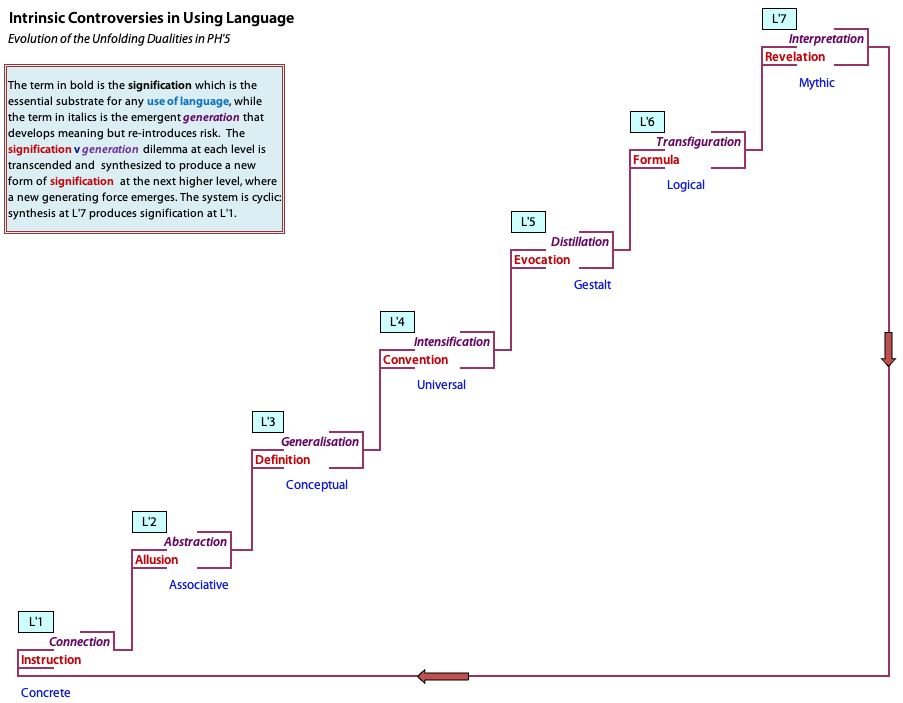
The Seven Dualities
L'1: Concrete
Instruction v Connection Detail
Polarization in Practice: Standard manual (impersonal) v Customized instruction (personalized).
Synthesis: The tension between the thesis of general instructions and its antithesis of connections meaningful for individual recipients can be relieved by using allusions—which is the thesis at the next level up.
L'2: Associative
Allusion v IndicationDetail
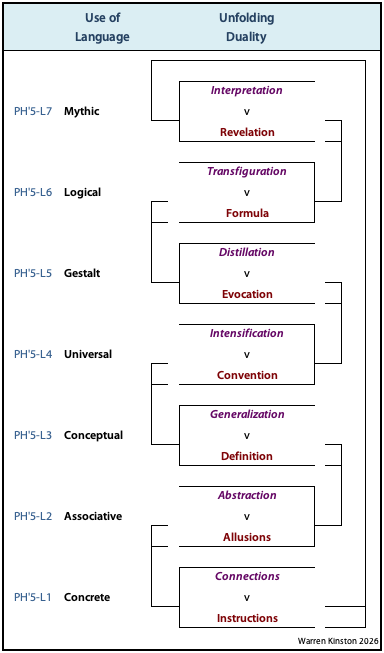
Polarization in Practice: Insider talk (familiar) v Outsider inclusion (polite).
Synthesis: The tension between allusions , the thesis, and indications, its antithesis, can be relieved by providing agreed-upon definitions—which is the thesis at the next level up.
L'3: Conceptual
Definition v GeneralizationDetail
Polarization in Practice: Specialist jargon (in journals, workplace) v Social communication (to customers, sponsors, supporters, authorities).
Synthesis: The tension between definitions and generalizations can be relieved by communication using widely agreed conventions—which is the thesis at the next level up.
L'4: Universal
Convention v IntensificationDetail
Synthesis: The tension between conventional writing (thesis) and intensified communications (antithesis) can be relieved by ensuring an evocation that directly reveals the experiential truth of a situation—which is the thesis at the next level up.
L'5: Gestalt
Evocation v DistillationDetail
Polarization in Practice: Great artist (revealing truths of the human condition) v Art critic (bringing the essence of great art to the masses).
Synthesis: The tension between evocation (thesis) and distillation (antithesis) can be relieved by developing a formula that reaches a universal fundamental applicable to all such situations—which is the thesis at the next level up.
L'6: Logical
Formula v PatterningDetail
Polarization in Practice: Piecemeal logical principles(Ockham, Wittgenstein) v Metaphysical system construction(Fichte, Hegel).
Synthesis: The tension between formulae (thesis) and patterning (antithesis) can be relieved by providing revelations—which is the thesis at the next level up.
L'7: Mythic
Revelation v InterpretationDetail
Polarization in Practice: The Prophet (communicating the Word of a God) v The Priest (preaching, promoting and administering the Word).
Synthesis: The tension between revelation (thesis) and interpretation (antithesis) can be relieved by conversion into instructions about what to do—which is the signification thesis of the original i.e. the system is cyclic as usual.
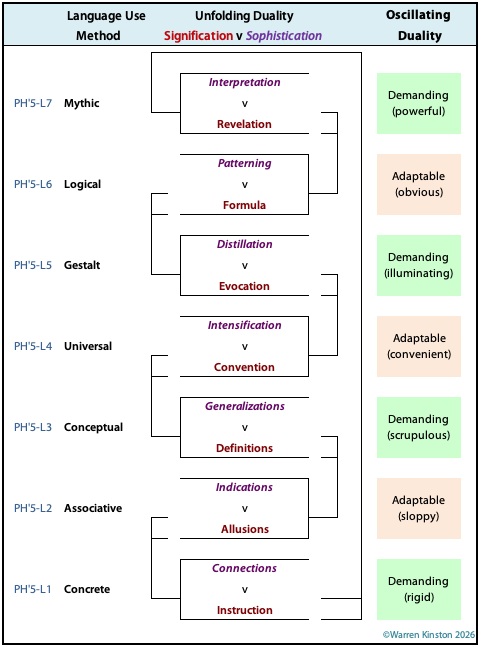
Unfolding & Oscillating Dualities
Additional illumination and surprises in relation to these is provided by juxtaposing the proposed oscillations between demandingand adaptable significations with the various dialectical dualities.
- Back to Review.
- Continue with handling reality.
Originally posted in complete form: 16-Jul-2026.