Seven Ways to Use Language
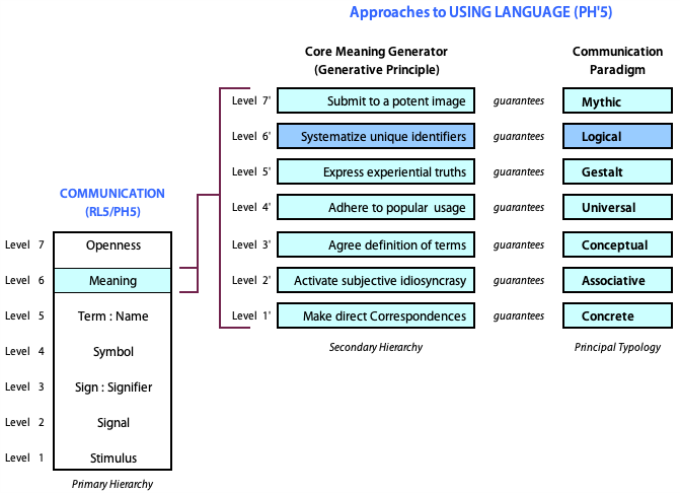
First read the earlier introductory explanation of the . The above diagram shows the nested hierarchy: each governs use of the . The matrix below is an ordered summary of the main points made so far and appears here as a reminder and quick reference.
| Name | Effect | Correspondence | Generation of Meaning | Example | |
|---|---|---|---|---|---|
| L'7 | Mythic
|
Enabling transcendence. | Openness-L7 | Submit to a potent image of a situation even if fully outside present understanding. | Greek myths. |
| L'6 | Logical
|
Determining fundamentals. | Meaning-L6 | Systematize unique identifiers for unique things so meaning is universally unequivocal. | Mathematical foundations. |
| L'5 | Gestalt | Revealing the human condition. | Term-L5 | Express the truth of experience via imaginative use of unrelated terms. | Shakespeare's plays. |
| L'4 | Universal
|
Weaving societal commonality. | Symbol-L4 | Make verbal and non-verbal choices in accord with popular conventions on usage. | Daily newspapers. |
| L'3 | Conceptual | Developing a field of inquiry. | Sign-L3 | Get agreement on definitions of necessary concepts that signify a field. | Exchanges in academic disciplines. |
| L'2 | Associative | Enjoying familiarity. | Signal-L2 | Enable a subjective flow of mental links (verbal and non-verbal) that are immediately understood in the group. | Everyday conversation amongst familiars. |
| L'1 | Concrete | Specifying procedures. | Stimulus-L1 | Point to or illustrate things directly corresponding to elements of the message. | Instructions for assembling flat-pack furniture. |
Does the language reveal the approach used?
Not necessarily.
Reading the Bible it is evident that many sections must be viewed as . However, Judaic biblical exegesis looks at many ordinary sentences in ways that are reminiscent of this typology.
- Peshat: This is the "plain", "simple", "direct" or "literal" meaning: this seems to correspond to the .
- Remez: This is allusive and called the allegorical or symbolic or hidden meaning: this could correspond to the .
- Derash: This is based on deconstruction and comparison with other texts, and is often a legalistic approach, which is a .
- Sod: This is the secret or mystery or esoteric meaning, as given through inspiration or revelation: this corresponds to the .
Two methods have no counterpart. The is absent because it is too idiosyncratic and variable. The is also absent, probably because exegetic categorization is itself conceptual. (It is not because there is no attempt to extend it to cover communication generally, across all societies.)
Structure of this Section
1. Essentials of the Methods
These ways to use language in deliberate communications will be distinguished in terms of:
- Associated thought processes
- Indications for use
- Desired effects
- Criticisms and failure
2. Other Features
- Additional properties
- Dualities: Oscillating and Unfolding
- TET analysis: Quadrants and Diagonals
- Applications
The investigation commences by clarifying the essentials of the Types in order.
- Start with the Concrete Method (L'1).
Originally posted: 25-May-2013.
