Review of the Methods
Recapitulation
Here is the matrix summary as initially provided. For more detailed introductory accounts of the various methods/existences, click on the links in the second column.
| L' | Method or Form of Existence |
Preoccupation (Function) |
Core Stabilizer | Personal Commitment | Psychosocial Emphasis | Sustaining Processes |
|---|---|---|---|---|---|---|
| L'7 | Transpersonal
|
To embrace life's spiritual dimension. |
Faith | To union with humanity and the cosmos. | Experiencing ultimate values. | Being guided & in harmony with the flow of events. |
| L'6 | Social
|
To contribute purposefully. | Participation | To worthwhile projects for a group. | Carrying responsibility. | Organisation & management |
| L'5 | Relational | To cultivate meaningful relationships. | Attunement | To recognition of needs and deeper qualities of others. | Appreciating and gratifying each other's wishes. | Mutuality & dialogue |
| L'4 | Individual
|
To maintain self-esteem. | Respect | To finding and realizing a «true self»: authenticity. | Achievements and self-acceptance. | Self-assertion & self-protection |
| L'3 | Emotional | To have recognizable feelings. | Attachment | To valuing others through exchanges of feelings. | Care-giving, warmth and meeting needs. | Containment, modification & relocation of feelings |
| L'2 | Vital | To keep fit. | Concentration | To physical strength, suppleness and visceral well-being. | Feeling invigorated and exhilarated. | Genuine exertion using postures and movement. |
| L'1 | Sensory | To keep in regular contact with others. | Stimulation | To membership of social circles and networks. | Instigating and supporting enjoyable interactions. | Attentiveness & sensory pleasures. |
Here are some more features of the self/existence that have been presented or proposed at various points.
| L' | Method Existence |
Context | Self Quality |
Self Descriptor |
Self Anxiety |
Self Disorder |
|---|---|---|---|---|---|---|
| L'7 | Cosmos | Being - Humanity God Within |
Enlightened being |
n/a | "Sickness of the soul" | |
| L'6 | Groups | Roles based in culture, institutions & groups. | Socio-political being |
Alienation | Traumatized personality | |
| L'5 |
|
Personal bonding | Dependent on relationships | Interpersonal being |
Guilt anxiety | Neurotic personality |
| L'4 |
|
Autonomy | Self-concept/images True/False Self |
Self-contained being |
Shame anxiety | Narcissistic personality |
| L'3 | Atmospheres | Part-person Emotional roles |
Sensitive being |
Separation anxiety | Borderline personality | |
| L'2 | Bodily States | Biological vitality Physical invigoration |
Active being |
Death anxiety | Psychopathic personality |
|
| L'1 | Socio-physical stimuli | Materially embedded | Receptive being |
Persecutory anxiety | Psychosomatic personality |
TET Revelations
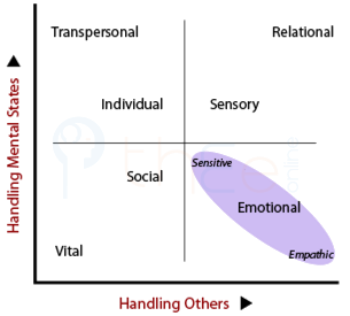
These have been plotted on a TET (Typology Essences Table) whose axes form the psychosocial context for maintaining a in social situations. This context is defined by the need to handle inner mental states (Y-axis: psycho-), and to handle others with whom interaction is required (X-axis: -social).
The result of this plot is to reveal a range of further comparisons and properties that emerge from:
- identifying axes zones;
- recognizing governing auspices via the central-peripheral distinction;
- comparing diagonals for self-assertion and external confirmation;
- finding styles of being based on pairing via the zones and diagonals;
- determining quadrant-based affinities and antagonisms.
See a review of these features.
Evolution of Human Consciousness
A child's mental stability depends primarily on the emotional sensitivity of a caring environment. However, it is possible to trace the emergence of rudiments of these from early infancy through to adolescence.
 Literature Influences:
Each can be seen as a distinct paradigm for . Each therefore generates distinctive theories of the mind or self, whose adherents clash. These different paradigms became apparent to me initially in regard to the intense theoretical conflicts within psychoanalytic societies. Investigation of other non-psychodynamic therapeutic techniques revealed further theories.
It seems that every psychological approach to therapy or self-development, regardless of its theoretical claims, is based primarily on one or more of the .
The marked difference between psychotherapy and psychoanalysis is something else. Its nature emerged during one of the investigations in the Architecture Room: See summary.
Psychoanalytic Schools
Lloyd deMause
 .
Ken Wilber
Potentials for Misunderstanding
If we look deeply into ourselves, it is likely that one or two of the feel more real, more necessary, more practical, higher and/or more beneficial. It is these that we use for personal growth and often to shape important life choices.
Those who are stabilized in one way may dismiss or devalue different , as unnecessary, unhelpful, irrelevant or misconceived. They may go further and seriously advise others to emulate their own preference. This is unlikely to be helpful.
All methods exist. All are needed by some. Society seems to agree, because it recognizes them all in the form of the (see Ch.7).
A major problem in conversations trying to be helpful lies in the use of everyday terms that have different meanings, much as found with the decision methods.
All approaches must deal with the same basic issues of human living: self-esteem, relationships, self-assertion, distress, satisfaction and so on. But similar words can mean almost entirely different things and have radically different implications in the different approaches.
Examples :
More...
- Combine the various TET comparisons.
- An alternative for the X-axis?
- Consider the effects of destabilization.
- Understand «Loners» better.
- Check potential correspondences with other taxonomic .
Originally posted: 15-Oct-2014. Last updated: 5-Feb-2016.