Review: Plotting the 7 Arenas
The Expected Pattern
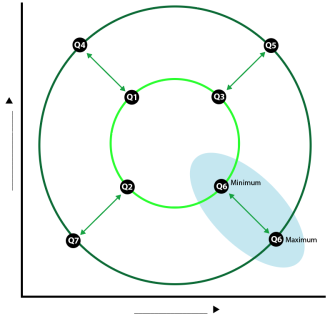
In the Architecture Room investigation of the Q-expansions, a particular pattern of Arenas in a Domain was identified based initially on pairing. The result is shown in the diagram at right.
This pattern was initially worked out in the .
Checking the , , , and provided confirmation. In each Domain, the next challenge was to identify appropriate axis labels.
Applying this finding to the results in the pattern shown in the 2nd diagram at right. The task now is to determine the axes and appreciate the quadrants in this TET.
Interpretation
Axes
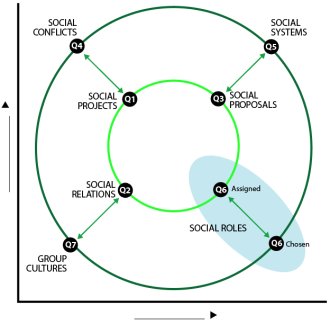
This is not a standard TET. However, it appears that the same principles can be applied:
i.e. the X-axis should relate to the desired social output, while the Y-axis should relate to the psychological input required to generate that output. This framework continues to be appropriate.
X-Axis: What is sought in fitting in is a measure of control over the process. The horizontal axis appears to differentiate arenas according to the degree of personal choice, independence and creativity that can be brought to bear in the various arenas.
Provisional X-axis label: Personal control Details
Y-Axis: The vertical axis appears to differentiate arenas according to the difficulty experienced when trying to fit in. This is manifested in the degree of discretion, prudence, care, tact and foresight that is called for.
Provisional Y-axis label: Personal circumspection.Details
Quadrants
Diagonal Opposition
Fitting in to the UR arenas, and , involves initiating improvements for oneself. By contrast, fitting in to the LL arenas, and , is about seeking benefits from others.
Fitting into the UL arenas, and , depends on gaining approval from others, while in the LR quadrant, fitting into a allows idiosyncrasy and is about feeling self-satisfied.
Quadrant Combinations
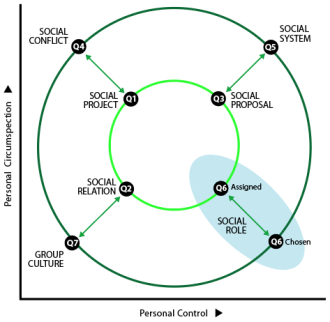
It seems arenas in the right half are self-oriented, while those in the left-half are other-oriented;
&
arenas in the upper half are demanding, while arenas in the lower half are about ensuring comfort.
Central & Peripheral Circles
The inner circle contains Arenas which are specific and focused: a is well-defined, a deals with a particular person, an is well-defined, and any seeks a particular change.
The outer circle contains Arenas that are diffuse, ill-defined and often complex: the is never fully captured, a divisive entrenched is never a simple matter due to fence-sitters and shifts in position of members; and a has uncertain boundaries and contents, and a can be re-defined and expanded in idiosyncratic and unpredictable ways.
Quadrant Affinity
As is common in these patterns, the Arena on the outer circle preferentially guides and supports the Arena on the inner circle in its quadrant. In this case:
- group culture guides fitting in to a social relation
- fitting in to the social system guides formulation of social proposals
- chosen social roles guide and support handling of assigned roles
- the potential for divisive conflict guides fitting in to a social project.
-
Interactions and influences between the Arenas.
Originally posted: 26-Jan-2026.