Protectors of Balance: G4-Tetrads
“The association gathers the efforts of divergent minds into a network and vigorously pushes them towards a single, clearly indicated goal.”
Alexis de Tocqueville
Mobilizing Relationships
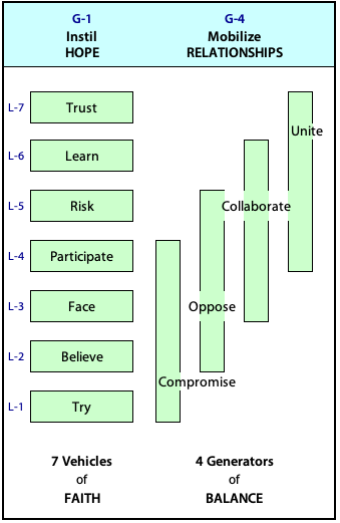
Only after comes to the fore, does the possibility arise of losing balance because of the hectic environment or because nothing seems to be working.
At this point, it seems essential to bring others into the picture. Isolation is self-defeating and active social are critical for maintaining while addressing any impossible challenge.
In practice, available relationships are the first requirement to be scoped before taking on anything.
Relating that protects balance can be enabled by adding an additional adjacent level to groups to form 4 tetrads. Each tetrad has a new qualifier that should fit with . This is provisionally proposed as «reliable» in the sense of ensuring that a presence, effort or phenomenon can be counted on..
This means that each tetrad, if it is to be a reliable , must have components that are constructed out of g1-confident, g2-unequivocal, g3-explicit and g-4 reliable levels. The provisional labeling is as follows:
The function of mobilizing relationships is proposed as: to remain socially connected and stabilized without losing perspective or integrity.
Requirements: Relations are mobilized and preserved by interacting effectively with others, and this calls for qualities like self-restraint, open-mindedness, humility and flexibility.
The tetrads reveal a progression upwards from an activity-focused relationship to more meaningful interactions and ultimately a deep bonding.
Dysfunction is evidenced by rigidity or stubbornness and occurs when the requirements are disrupted by relationship pathology like posturing, defensiveness, pride, fears of a slippery slope, wishes to dominate, self-doubt, or distrust of others.
Destructiveness shows up as a manipulation of relationships.
 Schema for Exposition
Function—which is the basis for taxonomic identification.
Internal structure of the tetrads, including explanations of unnecessary levels.
Inhibition, which is particularly noticeable from the g2-unequivocal and the g4-reliable elements..
Threat to Balance, excluding dysfunction applicable to all tetrads.
Common Criticisms.
Effect of Weakness in the various levels.
Protectors of Balance
Compromise-G41
Function: To reach a mutually acceptable position through relinquishing something of value.
Social life without compromise is impossible. There will always be differences between people and these often show up when attempting to progress a strategy. Compromise is about practicalities and a degree of expedience is necessary to generate a final position that is workable. At the extreme, it may feel like getting anything done involves making the best of a bad situation.
It is impossible to get everything you want in social relationships. As both sides needing to live with the result, willing give and take leading to expedient harmonization is the only practical way forward. Compromises are often temporary or transitory, but if the compromise has been in operation for some time, it becomes the way things are done.
Structure: is constituted by:
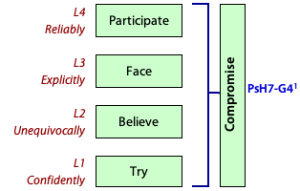
L1: because talks must keep on until there are choices in which all parties have confidence.
L2: , which is about holding to certain principles and fundamentals. There can be no "give" here: an arrangement in which principles are abandoned is a surrender, not a compromise.
L3: the actual reality that is causing a dispute. This means acknowledging the specific concerns (i.e. values) of all parties whose differences threaten to disrupt the social balance.
L4: , which is about the parties being permanently connected and genuinely dependent on each other as they discuss and negotiate.
Unnecessary Levels :
Oppose-G42
Function: To maintain the integrity of a relationship through honest disagreement.
Opposition is about acknowledging differences, typically by revealing what you know or think and getting that view recognized by others who you know may well disagree.
«If everyone is thinking alike, then somebody isn't thinking.» Gen. Patton
If a group values honest expression rather than submission, then bringing differences out into the open is the best policy. Opposition preserves a relationship by allowing a vitalizing tension, and minimizing groupthink, blind conformity or one-sided dominance.
Frank acknowledgement is the social and ethical requirement to equalize relationships. Balance is progressively lost if necessary opposition is avoided for the sake of peace, compliance or approval.
Structure: is constituted by:
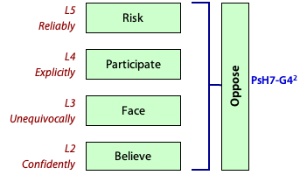
L2: that your position and principles have merit and that revealing them is constructive for the relationship. Opposing will flounder if this confidence is lacking.
L3: a particular reality and refusing to distort, ignore or pretend to be blind to it.
L4: by making it clear that your concern is or should be a concern of the group and so all parties must pay attention to the issue.
L5: your reputation and respect within the group.
Unnecessary Levels :
Collaborate-G43
Function: To work jointly with others through pooling of knowledge and effort.
Collaboration is based on recognizing that no one person or group has all the knowledge, skills and resources that are required to address a particular challenge.
The effect of collaborating is to integrate different perspectives and allow ideas to evolve and improve through shaping by diverse minds. The result is that participants learn from each other, and can test what is learned through application. Productive integration protects balance against competitive or adversarial attitudes.
Structure: is constituted by:
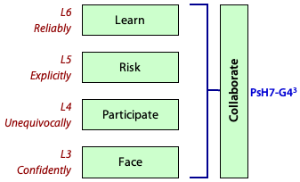
L3: a need for pooling of resources and integration of effort. Without confidence in the project and the presence of complementary capabilities, collaboration will not arise as a possibility.
L4: , which is about being absolutely certain that a joint effort is required for the particular project.
L5: because while the gain from sharing is likely, it is never certain. There is always the possibility that one party may not pull their weight, withhold strengths, or exploit the other.
L6: in order to benefit from the other party's contributions.
Unnecessary Levels :
Unite-G44
Function: To bond with diverse others through offering sincere dependability.
Uniting leads to a degree of merging of identities. The result is that a communal spirit is evoked. This enhances rapport and enables solidarity, but calls for a degree of humility.
THEE investigations have found that a worthwhile communal existence is developed by uniting with others, and implies caring about others.
However, this bonding comes at the cost of full independence. While other ways to mobilize relationships tend to be episodic or time-limited, uniting may be envisaged as enduring, even if that does not turn out to be the case.
Structure: is constituted by:
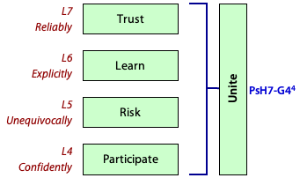
L4: because the existence of an enlarged united group and your membership are taken for granted. Without confidence, uniting will not emerge as a possibility.
L5: personal freedom because the conventions and culture of the other group are only appreciated over time.
L6: about the other party and how the bond will actually function in practice.
L7: , which means there is an assumption that the quality of the relationship will not be undermined by inevitable differences in values, or by emergence of doubts, suspicions and other damaging attitudes.
Unnecessary Levels :
See Table Summary for Easier Comparison
The 4 that are essential for have been provisionally formulated in this topic.
Further insight and validation can be provided by investigating:
 progression of levels in the internal structure,
characteristics of the internal levels,
continuance of oscillation, and
assignment of psychosocial pressures.
The transition to the pentadic grouping must also be clarified.
Originally posted: 12-Jun-2026.