The Taxonomic Investigation
Generating the Tree
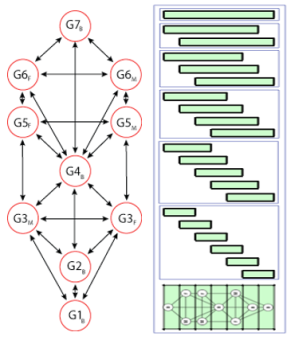
The Tree to be examined in this section is the third element in a structural hierarchy triplet. The top row of Requirements creates the final Tree, which means that, diagrammatically, the structural hierarchy is turned on its side.
In this arena, the Requirements are as follows:

|
|
Because each Level is a Grouping that contains Groups specifying a variety of activities, labelling in the Centres often needs to be slightly adjusted.
Determining the Internal Duality
In the triplet, the originating Tree, , had an internal duality as follows:
Develop a Position within Society
v
Become Secure within Society .
The lower part of the internal duality of the would therefore be expected to be: Become Secure within Society—if it follows the pattern discovered for Domain Fundamentals and subsequently found to be appropriate elsewhere.
In studying the Tree from this perspective, the upper part has been provisionally labelled: , which again accords with the usual pattern.
Structuring the Tree
Dynamic Duality
Trees reflect dynamic functioning in the world-as-it-is, and therefore always incorporate practical pressures and socio-physical constraints. These are modelled by recognizing the influence of a dynamic duality, which states that functioning may be governed by:
- personal or individual forces, essentially self-interested, labelled P;
or
- social or communal forces, essentially impersonal, labelled S;
or
- a balance of forces, due to a synthesis or fusion of poles i.e. any activity is simultaneously responding to both personal and social forces that cannot be disentangled: labelled B.
Application of a dynamic duality to a Level converts it into one or two Tree Centres. When there are two polar opposite Centres, the more dominant one in practice is, by convention, placed on the right side of the Tree.
The conversion of Groupings to Levels will be presented in two parts: initially the lower section that is about becoming secure; and then the upper section that is about energizing yourself.
Psychosocial Pressure
As Levels in this Tree are derived from Groupings in the Structural Hierarchy, they will have the primary psychosocial pressures that were allocated in the previous section.
Trees are also posited to have the pressures in standard order
i.e. CL1 or KL1 = RL1, CL2 or KL2 = RL2 etc as explained here in relation to spiral-derived Trees.
Channels
There is now a well-established pattern for Trees derived from a holistic hierarchy in that:
•all Centres influence Centres at the neighbouring level;
•L's 1 to 6 influence Centres that are 2 levels away;
•L7 influences the Centre that is 3 levels away;
...which makes L4 the most connected Centre—only omitting L1.
Identifying and naming the Channels to reveal the inherent dynamism is an essential, if often rather difficult, part of the inquiry.

The Channels will also be investigated in two parts: initially the lower section that is about interacting responsibly in social settings; and then the upper section that is about ensuring ambitions are socially integrated.
Clarify the Centres as follows:
- : Centres that provide security,
then - : Centres that energize you.
Originally posted: 10-Oct-2025. Last updated: 16-Jul-2026.