Review: The Self-Reliant Persona
Overview
This is the final Tree framework in a structural hierarchy triplet, which emerged from efforts to strengthen financial security, itself derived from the 7 ways to interact for personal benefit.
The triplet is:
→ →
That means is your vehicle for prospering, and your is the field on which it operates. The requisite determinants have been proposed in this section, and the account is recapitulated and summarized below.
The Twin Drivers
In being self-reliant, there are two drives:
► A drive from below——which is about using interactions in the world as it is in order to derive personal benefits and ensure your security. (As you will recall, this Satellite commenced with the discovery of different ways to «interact for benefit».)

► A drive from above——which is about using your inner strivings and potentialities to energize yourself so as to get the benefits that you desire as well as those that you need.
These twin drivers meet in the demand to manage yourself within the arenas of social exchange—: markets, hierarchies, networks and core-groups.
The key demand in managing exchanges comes from your initiatives whose risks must be organized—.
These 4 Centres form the spine of self-reliance: click thumbnail to enlarge.
Essentially it is based on drive that is steady yet adaptable. To outsiders you appear to be motivated, steady and self-correctingin the face of social challenges.
As usual, the pattern of intervening levels is similar in the two internal duality sections:
grounds your interactions, while grounds your ambitions.
controls your interactions, while controls your ambitions
is context orienting interactions, while is the context for ambitions.
As is common to all frameworks of this sort, the lower pole, becoming secure, requires you to be responsible, while the upper pole, energizing yourself, demands that you integrate within your society. This aligns with self-reliance being about effective participation in social life.
Channels & their Manifestations
While anyone can be conscious of the need and desire to be self-reliant, they are not usually conscious of this framework as a whole. However, the centre-states and the various influences in channels do come into consciousness as required.
What is more noticeable are the resultant character traits as proposed in the previous topics. Below is a summary of channel influences and some suggested traits.
|
|
|

|
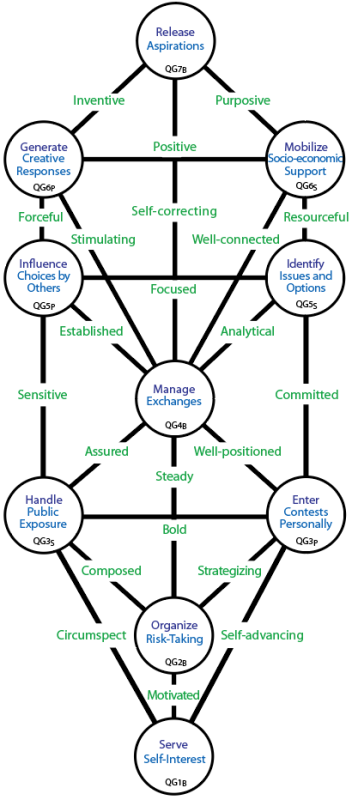
|
The two peripheral paths from Ambition to Interaction are markedly different. On the right are the dominating Centres and the channel-traits are correspondingly assertive and world-engaging: purposive → resourceful → committed → self-advancing. This can be contrasted with channel-traits in the other Centres that start strong but rapidly become more adaptive and self-protective: inventive → forceful → sensitive → circumspect.
The balance is evident at each stage e.g. promotion pushes you forward, while caution holds you back; conviction focuses and firms your attention, while sensitization opens you up to be generally aware; and so on.
The heart of the framework is found in the (): it covers everything from handling your family (the most important core-group for well-being), to organization life, influential networks, and holding your own in a multiplicity of markets.
- Consider the effect of more egotism.
Originally posted: 16-Oct-2026.