Harness Relational Energies
CG5: Check Identification
The critical foundation of a compatible relationship is a sense of belonging. This can be determined by checking whether or not you can identify with the relationship as a unit.
Dynamic Duality: All bases of belonging are joint: the conclusions, the terms, the exchanges. On the one hand, you can check your identification and reach your own conclusion regardless of the state of the relationship or views of the other party. On the other hand, you cannot belong unless you are accepted by the other party as "my partner" or if it is a group as "one of us". The other party will have a view on whether and how you belong and this must be tolerated if the relationship unit is to be substantiated.
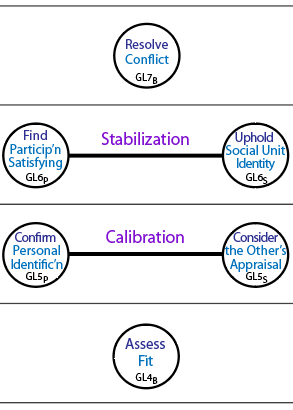
This means that this level in the Tree will generate two polarized but connected Centres: and .
We label :
and label : .
The other's appraisal of the relationship as a unit will dominate because you cannot properly belong where you are not wanted, no matter how much you identify and assert that you truly belong.
So the social Centre is dominant and placed on the right side of the Tree.
 GL5 Linking Channel
CG6: Sustain Participation
Sustaining participation as a member of a relationship involves regarding the relationship as a unit with a social identity. This unit has a life of its own and it demands to be valued and given commitment if it is to survive and thrive in the world-as-it-is.
Dynamic Duality: On the one hand, you can fully control your participation and do so because it is satisfying and you find the relationship rewarding. On the other hand, the social identity created makes demands on you in social settings and these cannot be ignored or flouted without damaging the unit. Such demands are wholly outside your control.
As a result, this level in the Tree will generate two polarized but connected Centres: and .
We label :
and label :
All relationships go through ups and downs as stresses are navigated. Getting satisfaction is less important than commitment to the social identity if these difficult periods are to be managed effectively.
So the social Centre is dominant and placed on the right side of the Tree.
CG7: Resolve Conflict
Conflict occurs in all relationships simply because people are different, development occurs, and the context changes. As a result, arrangements that work at one time cease to be satisfactory at a later time. The relationship can continue if the conflict is resolved through good faith negotiations to reach a mutually beneficial agreement.
Dynamic Duality: You can notice the conflict, raise it and seek a resolution, but you cannot resolve it on your own. The other party must recognize the issue and participate in the negotiation. That means personal and social factors must be fused or synthesized.
So, in the Tree, this level becomes a single balanced Centre: ,
and we label :
If you can confirm belonging, enjoy participation and resolve conflict, then a social relationship will provide you with the energy to maintain its stability and sustain its continuance.
On this basis, consider flows of influence between Centres...
- ... starting from your views and interests in seeking a suitable relationship.
Originally posted: 31-Oct-2026.
