From Interests to a Relationship
Influence From L1: Putting Your Interests First
To L2
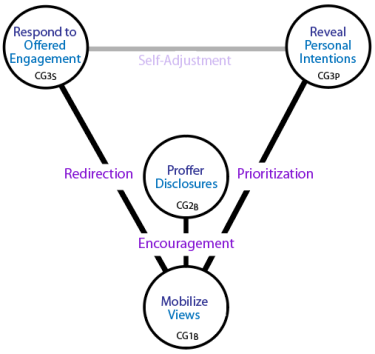
Relationships must in some way engage your interests. So interests encourage you to approach people and offer more than polite small talk. Proffering disclosures that directly or indirectly indicate your interests leads to others responding and potentially giving you opportunities that you seek. In these interactions, your disclosures and responses to them encourage you to review your own interests and views.
So is provisionally labelled Encouragement.
If either centre discourages the other, that puts a brake on moving forward.
To L3
Not all your interests nor all your purposes will be relevant to any particular relationship. Your interests can focus the values, goals and aspirations that you reveal to a particular party by bringing the most important to the fore. At the same time, intentions that are revealed will focus your attention on particular interests, again highlighting those that are most significant in the situation.
So is provisionally labelled Prioritization.
If either centre does not emphasize the importance of the other, that puts a brake on moving forward.
The interests that you mobilize are powerful inner forces and they may direct or, more likely, redirect any response that you make to offers of engagement. Any offers that you receive can also shift your attention amongst your varied interests. Otherwise neglected options may come to the fore and others may be suppressed as inappropriate.
So is provisionally labelled Redirection.
If either centre offers no sense of direction to the other, that puts a brake on moving forward.
To L4
Your personal views and interests cannot contribute directly to assessing the fit in a relationship until filtered by your intentions and/or dialogue with the other party. and were identified as being exercised privately and fantasies will run rampant without public exposure and testing at and .
Influence from L2: Getting Out More
To L3
The challenge here is to close the distance between the two parties and deepen the relationship so as to make engagement possible and likely.
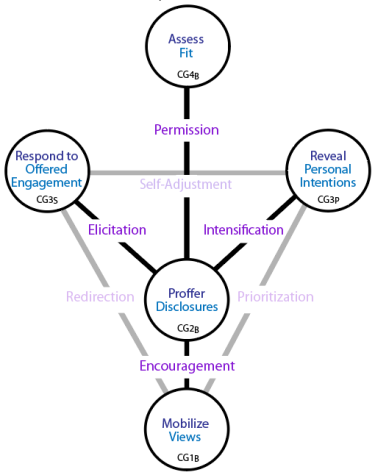
As you disclose more, you start revealing your values and goals. Conversely, revealing your intentions and aspirations will lead you to disclose more in general and specifically about yourself. The mutual influence of these two states enlivens the relationship and deepens the engagement from your side.
So is provisionally labelled Intensification.
If either centre puts a dampener on the other, that puts a brake on moving forward.
Your disclosures are provided to elicit a possible engagement because the other party uses your disclosures to determine whether and how to offer an engagement. At the same time the other party's offers to engage will elicit relevant disclosures.
So is provisionally labelled Elicitation.
If either centre disconnects from the other, that puts a brake on moving forward.
To L4
Disclosures influenced by your interests open the door to assessing whether there is a fit. Any assessment of fit allows for additional disclosures to check its validity. A positive judgement permits continuous disclosure, while a negative one withdraws permission and leads to a retreat from the relationship.
So is provisionally labelled Permission.
If either centre prohibits the other, that puts a brake on moving forward.
To L5 (and above)
Disclosures without any engagement or assessment of fit can tell you nothing about whether or not you belong and they do not help you decide whether you identify with a future relationship. So there is no direct channel of influence. Nor can there be direct links to even higher levels.
Influence from L3: Putting Your Self in Play
Within L3
As proposed earlier, the two Centres are linked because each leads a person to adjust to the other and both allow the relationship to be shaped by and .
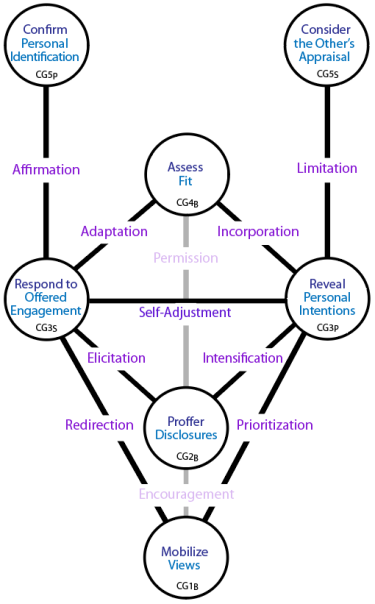
So is provisionally labelled Self-adjustment.
If either centre refuses to adjust to the other, that puts a brake on moving forward.
To L4
Purposes and values are the rationale of social relationships and the fit must be sought and found there. The fit must incorporate the intentions or it is not a fit at all, and the fit has to become part of what you are aiming for.
So is provisionally labelled Incorporation.
If either centre repudiates the other, that puts a brake on moving forward.
Any assessment of fit must take into account the engagement that is offered and adapt to that. Offers of engagement and responses to them must adapt to the emerging fit if the relationship is to develop.
So is provisionally labelled Adaptation.
If either centre opposes the other, that puts a brake on moving forward.
To L5
There are 4 possible Channels of influence: but two are not requisite.  Details
Appraisal by the other party is based in part on your intentions, so that limits what you reveal. Revealing intention limits and may shape or even inhibit appraisal by the other.
So is provisionally labelled Limitation.
If either centre dominates the other, that distorts the possible relationship.
When the other party offers an engagement, that affirms your identification with them and the engagement. When you confirm an identification with the relationship-unit, then that affirms the engagement that is offered.
So is provisionally labelled Affirmation.
If either centre disconfirms the other, that interferes with a possible relationship.
To L6 & L7
Engagement cannot directly influence participation or conflict without mediation by or .
is the watershed level in which there is a relationship where a degree of fit exists and can be assessed.
Continue identifying flows of influence between Centres...
Originally posted: 31-Oct-2026.
