From a Good Fit to its Continuity
... continuing
The previous topic investigated influences between Centres starting with the mobilization of interests () and showed how this can lead to a potentially satisfactory social relationship. The question now is how that can be bedded in so as to potentially endure.
Influence from L4: Confirming the Relationship
To L5
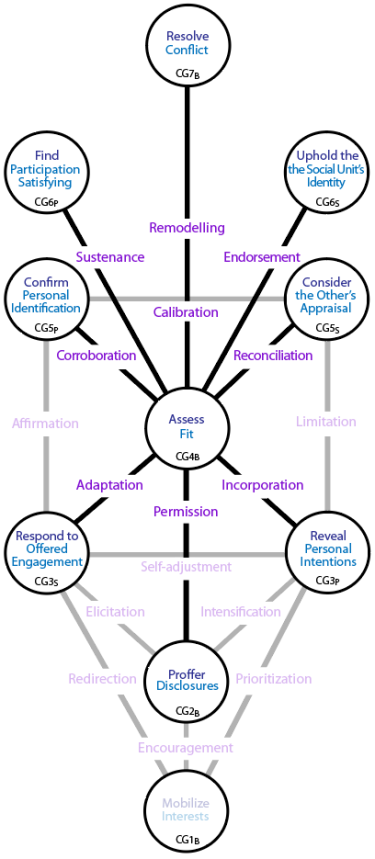
The other party's appraisal of the relationship must be reconciled with your sense of the fit. Conversely, your position on the fit must be reconciled with the appraisal that you are facing.
So is provisionally labelled Reconciliation.
If either centre does not reconcile the other, that suggests a problem with the relationship.
The fit as assessed and your identification with the relationship are both yours and these should support each other. The fit gives grounds to identification and identifying provides a basis for confirming the assessed fit.
So is provisionally labelled Corroboration.
If either centre does not corroborate the other, that suggests a problem with the relationship.
To L6
If the fit enables upholding the identity of the social unit, the relationship is on a strong footing. If upholding the social identity strengthens the fit, that also confirms the relationship. In other words, the fit endorses the commitment to the social unit and existence of the social unit endorses the assessed fit.
So is provisionally labelled Endorsement.
If either centre does not endorse the other, the relationship is in trouble.
The fit, which is focused on fulfilment of relationship needs like meaning and safety, sustains satisfying participation. Satisfying participation, in turn, sustains and nourishes the fit.
So is provisionally labelled Sustenance.
If either centre does not sustain the other, the relationship is in trouble.
To L7
The presence of a conflict means that a previous fit is no longer working and it must be redesigned in some fashion. The fit, if present and previously strong, views a conflict in a positive light, and re-frames it as a need and opportunity for a change in the relationship that will suit both parties.
So is provisionally labelled Remodelling.
If either centre does not allow for remodelling, then the relationship is broken.
Influence from L5: Owning the Relationship
Within L5
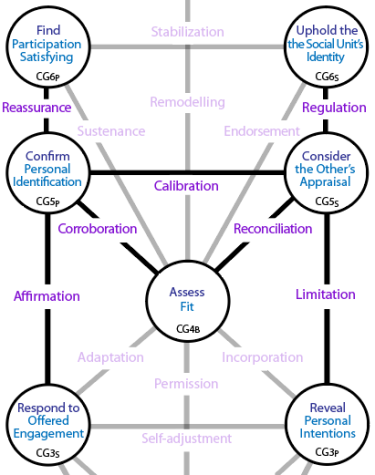
As proposed earlier, the two Centres are linked because each checks the correctness and degree of the other. Both ensure that the makes sense.
So is provisionally labelled Calibration.
If either centre spoils or deranges the other, then the relationship is broken.
To L6
There are 4 possible Channels of influence: but two are not requisite.  Details
The identity of the social unit, and fidelity to it, is a standard used to appraise the relationship. Conversely, the appraisal provides rules and guidance as to the social unit and how it should be upheld.
So is provisionally labelled Regulation.
If either centre fails to regulate the other, then the relationship is in trouble.
When you identify with a relationship, the ups and downs of taking part do not unsettle you and so you feel reassured in your participation. Conversely a satisfying participation reassures you that your claim to belong was sound.
So is provisionally labelled Reassurance.
If either centre unsettles you, then the relationship is in trouble.
To L7
There is no sense in a link between personal identification with or belonging to the relationship () and the presence of conflict calling for resolution (). Conflict must be mediated via the realities of participation (GL6) or via issues with fit (GL4).
Influence from L6: Stabilizing the Relationship
Within L6
As proposed earlier, the two Centres are linked because each stabilizes the other. Both ensure that the fit remains solid.
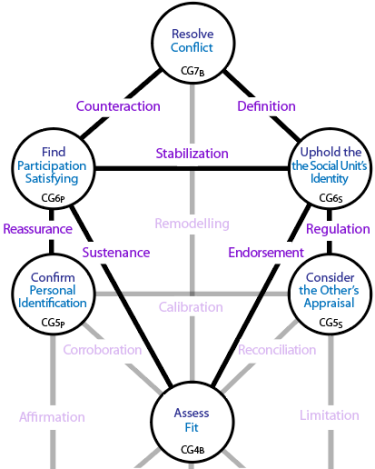
So is provisionally labelled Stabilization.
If either centre destabilizes the other, then the relationship is in trouble.
To L7
The nature of the social unit is the foundation on which conflict develops and therefore shapes it. Resolution of conflict alters the social identity in some specific way based on the negotiated agreement.
So is provisionally labelled Definition.
If either centre cannot re-define the other, the relationship is in trouble.
Finding participation satisfying counterbalances frustrations and fosters the identification and resolution of conflict, so counteracting potential corrosive effects. Conflict gnaws away at comfort and cooperation and so counteracts the usual satisfaction that comes from participating. Even following resolution, satisfaction is affected and needs re-building.
So is provisionally labelled Counteraction.
If either centre does not counteract the other, the relationship is in trouble.
All possible channels of influence have been examined and either ruled out or identified and provisionally named.
- Consider channel patterns within the Tree.
Originally posted: 31-Oct-2026
