3 Bases of Belonging
Orientation
Compatibility is not about identity between two parties, which is impossible, but about entering a relationship that permits comfortably living and working together while valuing and upholding individual differences.
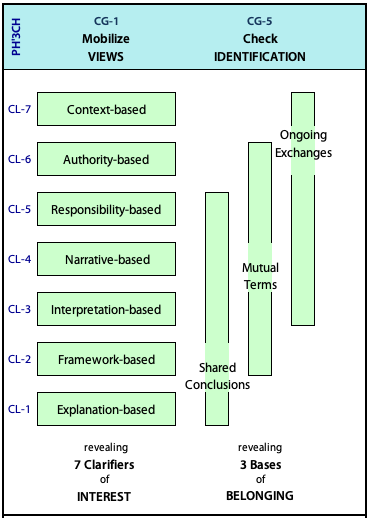
The tetrads clarified whether the fit is sufficient to render a relationship viable by employing tests to determine the presence of •meaning, •worth, •safety and •continuity. The next step is to determine whether or not you belong in that particular relationship.
Remember: The function of is to regard the relationship in all its ramifications as yours.
So, you must ask yourself questions like: is this where I should be working? are these neighbours my natural circle? could this person be my partner for life? As with assessing fit, the possibility of mishandling and misjudging exists. Each constituent level within a pentadic group can be overdone, undervalued, or distorted leading to turmoil sooner or later.
CG51: Shared Conclusions
Function: To be in accord with the other on important factors and choices affecting the relationship.
Being in accord does not mean complete agreement but it does require tolerance of some views or decisions where there is disagreement.
Example:  Teams
Teams
Temporality:
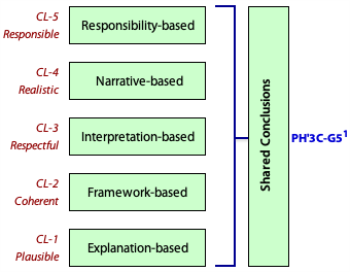
Conclusions are typically episodic, being formed and shared when it matters. For many issues, it is perfectly satisfactory for each party to have their own views and positions. But there are many issues that feel important and where a common view is required despite differences within the parties. A consensus is then required and that view must be willingly adopted and shared by each and all—even if one previously argued strongly against it.
If the issue goes to the heart of the relationship, it will need to be recognized as part of the and handled differently.
Structure:
You must responsibly regard the conclusion as one you are on the basis of a realistic . Any conclusion assumes speculative which must be held respectfully, especially if there are differences of view.
The accord will be revealed in the of some event, situation or phenomenon that both parties agree is plausible, in part because it rests on a coherent that is held in common.
Example Forms of Mishandling:
- At : just going along with the conclusion.
- At : ignoring implications of the conclusion.
- At : imposing a superficial perspective.
- At : ignoring the agreed frame of reference.
- At : supporting a view the other deems groundless.
CG52: Obligatory Terms
Function: To ensure both parties are comfortable with the rules and conditions of the relationship.
There is no room for disagreement here because these terms make or break the relationship.
Temporality:
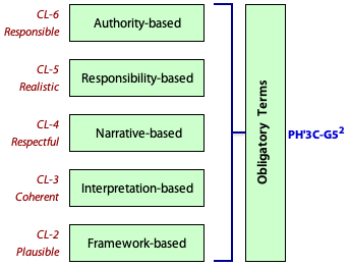
Terms are usually semi-permanent. In a marriage, major life decisions on matters like children, location, debts create conditions that last many years. In social circles, the terms are largely implicit, but must often be made explicit when a big adjustment is called for. In formalized relationships like clubs or employment, there may be explicit initial conditions or a contract with a few items modified or dropped and others added carefully over longish periods of time, and always with consultation.
Structure:
You must responsibly regard relationship terms as legitimate based on a like convention or religion that you both acknowledge, and can realistically each be . Any set of terms needs to evolve over time to accommodate changing circumstances, and there must be respect for the that shapes how they are formed and applied.
The terms become an agreed and agreeable plausible that is subject in practice to coherent .
Example Forms of Mishandling:
- At : accepting an obsolete authority.
- At : accepting or imposing one-sided terms.
- At : altering a condition arbitrarily.
- At : applying a condition inappropriately.
- At : demanding an unreasonable rule.
CG53: Ongoing Exchanges
Function: To constructively explore together emerging opinions and disagreements.
Conversations that explore issues permit the widest diversity of views to be brought out into the open.
Example: Nietzsche
Temporality:
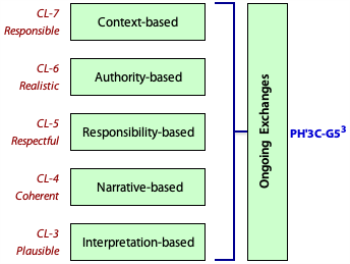
As the name indicates, exchanges need to be continuous. If discussed, differences and disagreements may endure on an "agree to disagree" basis without imperilling the bond. Ongoing exchanges are almost synonymous with the existence of a relationship, which is why they are particularly important in the early stages. Whether it is a marriage, a social circle or a work environment, if such exchanges stop for any length of time, the relationship starts deteriorating and may even cease to be.
Structure:
You must communicate regularly and responsibly about emerging issues and demands in relation to the , while being realistic about the supporting your views. Ongoing exchanges must be respectful about the that each carries for upholding their own values and obligations.
All opinions that are offered must be plausible of the reality under discussion and exist within a coherent .
Example Forms of Mishandling:
- At : insensitivity to what the moment demands.
- At : ignoring the need to be authoritative.
- At : denigrating the values of the other party.
- At: discontinuity in exchanges.
- At : being opinionated.
Summary Table
| CG5 | Belonging | Function | Effect | Temporal Character |
|---|---|---|---|---|
| 3 | Ongoing Exchanges | To constructively explore together emerging opinions and disagreements. | Maximizes openness. |
Continuous: constitutive of the relationship. |
| 2 | Obligatory Terms | To ensure both parties are comfortable with the rules and conditions of the relationship. | Generates make-or-break commitments. | Semi-permanent: background reference for the relationship. |
| 1 | Shared Conclusions | To be in accord with the other on important factors and choices affecting the relationship. | Enables consensus despite disagreement. | Episodic: when it matters for the relationship. |
Transition
Clarification of social compatibility is now well-advanced. A relationship has developed (), the fit has been assessed as viable () and it is now determined to be one to which you can belong ().
The whole purpose of belonging is to participate in the various activities that characterize the particular relationship. Only through such participation is it possible to know what the relationship is really like. You will be able to discover at last whether there is effective, substantial and ongoing compatibility.
Participation is not an episodic or temporary activity. You are now seeking to be part of a relationship-unit with its own social identity, which must be sustained.
can be enabled by adding a sixth level to form G6-hexads, which stabilize the relationship and confirm the fit.
- Continue to Sustain Participation (CG6-Hexads).
Originally posted: 6-Oct-2026.