Mobilize Views: CG1
The Foundation is You
As explained in the orientation, apart from pursuit of specific purposes, there is a concern to enter selected relationships to experience togetherness and to benefit from genuine compatibility. This is partly to mitigate the unavoidable necessity to fit in to a society and its culture, like it or not.
It follows that determination of compatibility must be your responsibility. So needs to start from your experience and your interests.
It is up to you to become as clear as possible in your own mind about how your interests fit with another because without common interests there is no point to compatibility. With that base, you must become clear about the nature of the person, persons or social body, the wider context, the evolving situation and other issues—any of which may be relevant to whether or not there is likely to be compatibility.
The requisite psychosocial process in the CG1-monads is to . This is the only way to answer: "where do I stand" in relation to any particular person, group or social body.
Monad Function: To access and establish a personal stance for social encounters.
The relevant views will be shaped by your personal experiences, past and current, as much as or sometimes more than the reality you are facing. However, those views have to be yours—there is no right view unless you hold it.
Remember: Only you can determine whether or not another person or group suits you—no-one else; and that determination rests on the views that you hold and develop through experience.
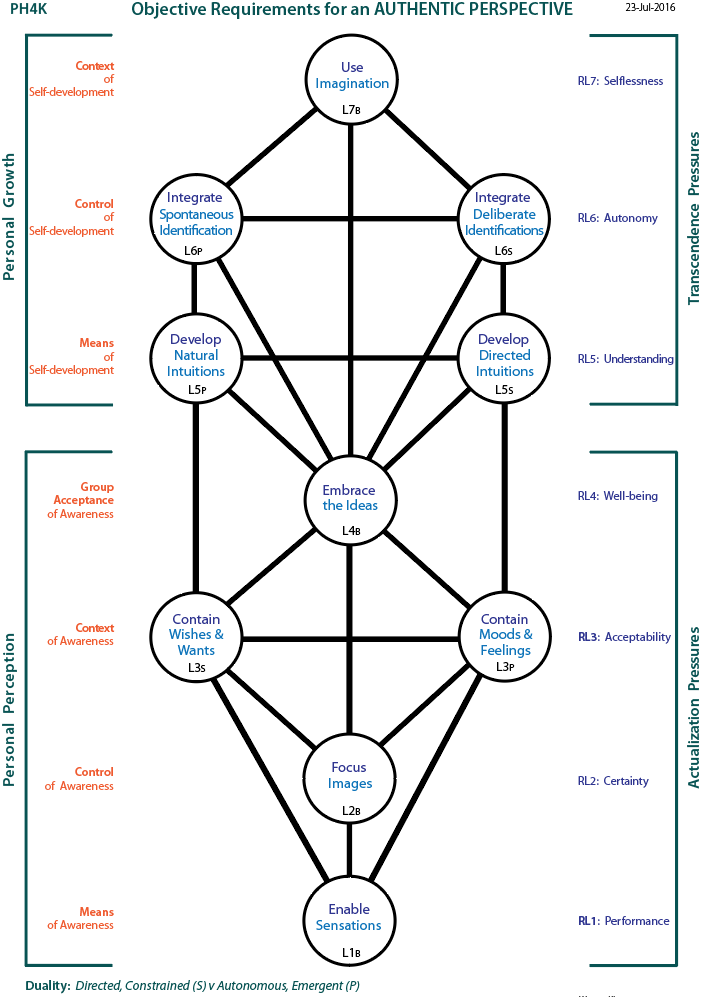
Preliminary studies in the Experience Domain suggest that the primary hierarchy tree () provides an integrated structure dedicated to —which is synonymous with a personal view. Click thumbnail to view this instrument: you can see that are the centre-piece for any view, but other centres play a part as well, although not all need be activated.
The only requirement in this monadic grouping is to mobilize views: there is no requirement to express those views. The issue in regard to views and all later groupings is acceptability, not correctness.
Remember: This framework is not about seeking acceptance and approval from certain others but rather to discover whether or not you, with all your quirks and faults, are compatible with them and they, with all their quirks and faults, are compatible with you.
Mechanism: Views are mobilized through reflection on previous experiences and relationships, and on intuitions generated by the emerging potential relation.
Personal Strength: Reflection and intuition call for self-knowledge. You must know what you actually and honestly want, need, believe in and can handle in practice, otherwise your interests will be unreal and unrealizable.
Qualifier
Given "" as the natural grounding for clarifying compatibility, it is necessary to determine a qualifier for these : see an explanation here. This g1-qualifier is a vital validity check because it needs to characterise the lowest level of every group in subsequent groupings.
Qualifiers get their character from the correspondingly numbered monad, which for g1 is . It is provisionally proposed as «plausible». Anything plausible is suggested as reasonable, possible and acceptable for consideration without necessarily being true.
Psychosocial Pressures
The expected 1° pressure is autonomy. This fits here given the emphasis above that your views and the judgement of compatibility are ultimately matters for you and you alone. While social fitness in terms of society and culture is not optional, choosing social relations within that environment is an exercise in freedom.
The expected 2° pressure is understanding. This also fits because specific views defined by the monadic groups cannot be strongly held without grasping their meaning and implications. You must also understand yourself and your situation to mobilize and develop views that are genuine and relevant to the encounter.
How It Goes Wrong
Everyone forms views. But that does not mean they will always help you determine compatibility. Reflection and intuition can go wrong in many ways:
If you do not know yourself, because:
- your head is full of the current fashions and fads of how to be;
- you habitually dissociate and disconnect from your experiences;
- you use a protective cocoon (false self) to interact with others;
- you have a paranoid or schizoid tendency.
If you do not believe in yourself, because
- you seek approval;
- you fear rejection;
- you doubt or distrust yourself;
- you do not respect yourself.
If you regard authenticity as a matter of ethics, so that:
- you habitually suppress your own autonomy in favour of others;
- you equate a wrong view with failing or being a bad person;
- you seek others to be a mirror of yourself to remove pain and conflict.
In all these cases, authenticity is lost and any fitting in subverts compatibility concerns. The door is then wide open to either isolation and alienation or a pseudo-compatibility leading to future dissatisfaction, unhappiness and relationship breakdown.
Re Inquiry: If you are obsessed with being correct even in private, then you may put extra effort into inquiry before developing a view. There is no harm as long as this does not mean avoiding having views where they are required. All results of inquiry must be fed into experiences that you can call your own, and you need to recognize that the potential for being wrong remains.
Clarifiers of Interest
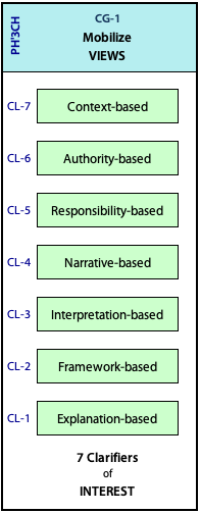
In order to clarify the interest that invites a social relationship, a person must be able to form views in all ways possible. These possible ways have been identified by the , which emerged from the ) and then became levels in the .
In accord with those studies, the ways to are named as follows:
 Cumulation
Levels in THEE hierarchies often cumulate properties or functions and this phenomenon is evident here. While each of the 7 views is distinct, a cumulation is evident when ascending the monads.
So:
The stands alone.
The may provide an explanation, but an explanation does not provide a framework.
The may work as a framework or provide an explanation—but the reverse does not apply.
The may provide an interpretation, work as a framework or provide an explanation—but the reverse does not apply.
The may form the narrative, offer an interpretation, serve as a framework, or provide an explanation—but the reverse does not apply.
The may generate responsibility, specify a narrative, offer an interpretation, serve as a framework, or provide an explanation—but the reverse does not apply.
The may serve as an authority, indicate responsibility, determine the narrative, provide an interpretation, work as a framework or offer an explanation—but the reverse does not apply.
- Differentiate the CG1-clarifiers of interest via functions, structures and concerns.
Originally posted: 6-Oct-2026.