7 Clarifiers of Interest
Orientation
Your interests are the starting point for selecting and developing relationships where compatibility is assured.
In this framework, you commence as a unique individual with your own set of diverse interests and you seek to be in a relationship with others. You never know in advance whether there will be compatibility but you do know that the greater the compatibility, the easier for you because there will be less demand on you to adapt or even suppress your individuality.
Remember: The function of is to access and establish a personal stance for social encounters.
So each monad draws on a particular way to clarify your interest in regard to establishing a relationship where compatibility will become an issue. Any view you form may get adjusted as you become more aware, or it may be wrong and resistant to correction.
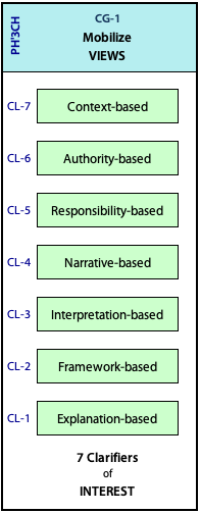
CG11: Explanation-based Views
Views are explicit or implicit plausible statements of causation: the resulting view is that something exists or occurs because of something else.
The supposed causation, even if widely believed, is often just a correlation, and the cause that you personally recognize may be mostly wishful, fearful, speculative or expedient.

Errors:
Potential for Adjustment—if you become aware of an inappropriate bias, flaw, distortion or self-serving quality.
What You May be Missing: Contrary facts previously unknown, denied or ignored.
CG12: Framework-based Views
Views are constructed around plausible categorization: the resulting view is that something is an example of a particular enduring type, method, process or system.
The framework may be formal, well-structured and widely shared, or it may be informal, poorly articulated but intuitively understood by all parties.
Errors:
Potential for Adjustment—if the framework is not properly understood or does not apply to the particular situation.
What You May be Missing: An alternative framework that is more suitable for the situation.
CG13: Interpretation-based Views
Views are developed based on plausibly making the implicit explicit: the resulting view is that something exists or is happening beneath the visible surface.
Interpretations may be persuasive and widely shared or idiosyncratic and regarded with doubt or even suspicion by others.
Errors:
Potential for Adjustment—if you are over-thinking or being slightly paranoid.
What You May be Missing: A simple, superficial and obvious account of the situation.
CG14: Narrative-based Views
Views identify a plausible trajectory: the resulting view is that something is part of an unfolding course of events.
Narratives may be provided and socially shared, or they can be created specifically to justify a particular stance or interest.
Errors:
Potential for Adjustment—if you are generating a self-fulfilling or retrofitted story.
What You May be Missing: A discontinuity that cannot be accommodated by your narrative.
CG15: Responsibility-based Views
Views are driven by plausible values and obligations: the resulting view is that something expresses personal goals, values and/or beliefs.
Your values will usually be shared by others but your priorities can differ; and your obligations, while understood by others, may be idiosyncratic.
Errors:
Potential for Adjustment—if conflicts of interest bias your judgements.
What You May be Missing: Your inappropriate self-righteousness or rigidity that blocks flexible perception and adaptation.
CG16: Authority-based Views
Views plausibly draw on or appeal to an available authority: the resulting view is that something exists or is proposed as an authoritative source says it should be.
The source can be extremely varied: it may be, for example, a social body, a person, a rule or code, a common standard, established facts, past experience.
Errors:
Potential for Adjustment—if deference is misplaced due to the source being irrelevant, discredited, false or inaccurately identified.
What You May be Missing: Relevant authoritative sources that speak directly to the issue of concern.
CG17: Context-based Views
Views flow from a plausible take on the situation as a whole: the resulting view is that something applies because it fits the particular case.
The relevant context may be shared, or it may be something that you alone notice and highlight.
Errors:
Potential for Adjustment—if too many situations are treated as special with too many exceptions to rules, beliefs, frameworks.
What You May be Missing: An element or pattern in the situation that is not known, not noticed or misjudged.
Summary Table
| CG1 | Name | Function | Form of the View | Adjustment Potential |
What You May be Missing |
|---|---|---|---|---|---|
| 7 | Context-based view |
To take the situation as a whole into account. | Something applies because it fits the particular case. | Too many situations deemed special | Unknown, unnoticed or misjudged factors. |
| 6 | Authority-based view |
To draw on or appeal to an available authority | Something exists or is proposed as an authoritative source says it should be. | Misplaced deference | Other relevant sources of authority |
| 5 | Responsibility-based view | To express personal values and obligations. | Something accords with personal goals, values and/or beliefs. | Conflicts of interest | Your inner rigidity. |
| 4 | Narrative-based view |
To identify a temporal trajectory of events. | Something is part of an unfolding course of events. | Retro-fitting events |
A discontinuity or vital element. |
| 3 | Interpretation-based view | To make the implicit explicit. | Something exists or is happening beneath the visible surface. | Over-thinking | The direct superficial meaning. |
| 2 | Framework-based view | To construct a view around a categorization. | Something is an example of a particular enduring type, method, process or system. | Poor understanding of the framework | A more suitable alternative framework. |
| 1 | Explanation-based view | To offer explicit or implicit statements of causation. | Something exists or occurs because of something else. | Biases or flawed thinking. | Contrary facts |
Transition
In the Experience Domain, the explains how views that you can call your own are formed. In the Change Domain, the tells you where to focus and apply that faculty so as to position yourself for clarifying compatibility in social relationships.
Construing the situation and mobilizing relevant views that tap into your personal interests is a start. It is a private start and it only goes wrong if you are unable to draw on your own experience as previously explained.
In a later grouping component, you may find one or more of your views leads to an absolute rejection of that component. But even if it produces a wholly positive attitude, a personal view can never be more than a starting point for exploring potential compatibility. Furthermore, whoever you are dealing with cannot see into your head. They do not know what your views are and so they can neither welcome nor reject them.
You cannot simply assert because they are created without taking account of the other party. The view must be modified and strengthened so that it can be disclosed in a way that is relevant in a social situation and is capable of being understood by another. That way your view can be sensibly welcomed, argued or rejected.
Only if you put yourself forward in an intelligible and personally meaningful way can the other party determine how to regard you. This becomes possible by adding a second level to form G2-dyads, each of which leads to disclosures that commence a connection to another with a possibility of compatibility.
- Continue to Proffer Disclosures (CG2-Dyads).
Originally posted: 6-Oct-2026.