Check Identification: CG5
 The Story So Far
By plausibly you energize 7 …
…which establish the foundation of future compatibility within a created relationship.
In coherently, you energize 6 …
…which apply in social settings so as to provide a basis for connecting.
In respectfully, you energize 5 …
…which establish a working relationship with the potential for compatibility.
In realistically, you energize 4 …
…which apply a variety of criteria to determine the relation's sustainability.
…now read on:
Own the Relation
Having privately made your own that there is sufficient fit for the relationship to be viable, the question arises as to whether you want to make it yours. This choice is again a private matter.
In practice, a relationship is a daily flow of separate and joint activities, enjoyable and frustrating events, and exchanges that demonstrate togetherness. You must determine whether you belong in this sea with its ebb and flow.
The present framework suggests three key phenomena will guide your thinking and provide evidence about the degree of your identification with the relationship:
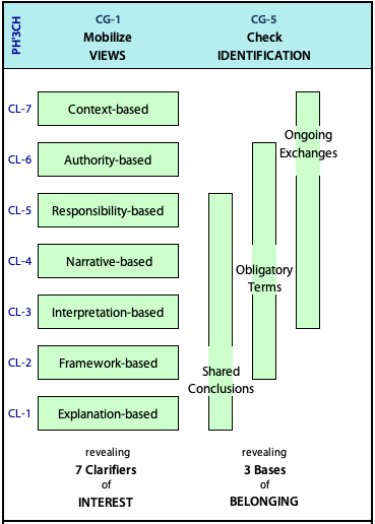
- are you finding that in most key matters you both reach the same conclusion?
- do you both feel comfortable with emerging rules and arrangements for operating your lives within the relationship?
- is it natural to have ongoing exchanges of opinions on a wide variety of matters without avoiding issues where you disagree?
Pentad Function: To regard the relationship in all its ramifications as yours.
Mechanism: Owning a relationship requires its appropriation. You need to be clear to yourself about claiming your place in the relationship and see it as something for yourself. This implies responsibly desiring it to continue and to develop. This appropriation is the private precursor to any explicit public commitment.
Personal Strength: Appropriation once again calls for self-knowledge. Belonging is your feeling and no-one else can assess its quality or intensity. You must draw on your knowledge of yourself to determine whether you can truly identify with the relationship.
Qualifier
Because is a requirement for clarifying compatibility, it is necessary to determine a qualifier: see an explanation here. This g5-qualifier will need to characterise the fifth level in every group in this and all subsequent groupings.
Qualifiers get their character from the correspondingly numbered monad, which for g5 is a . So the qualifier is provisionally proposed as «responsible». Anything checked responsibly is determined on the basis of personal values, obligations and in the light of likely consequences.
Psychosocial Pressures
The expected 1° pressure is acceptability. This fits here because entering a relationship changes your life to a significant degree. Your identity is not easily altered and in seeking compatibility you want others to accept you more or less as you are, just as you must accept them as they are. Change occurs during a relationship, but the idea that you can deliberately change yourself or your partner to force compatibility is a wishful fantasy.
The expected 2° pressure is well-being. This also fits because the desired side-effect of relating, regardless of the primary goal, is to be content and even happy with the fit. If you do not feel good about belonging in the relationship, then you may tolerate it for a while, but you will be unlikely to seek to claim it as yours.
Bases of Belonging
If your confirms a viable relationship, then adding an adjacent level of to form pentads enables . The pentads are 3 which are named as follows:
Note that the 3 pentads possess 3 levels in common: an view, a view, and a view. That means they buttress one another and each depends to a considerable degree on the others. So need to be worked out via and must validate and express as well as being part of .
In each pentad, you must check:
- the g5-level view is responsible, which is critical for any personal claim.
- the g4-level view is realistic, which is critical for relational longevity.
- the g3-level view is respectful, which ensures belonging is protected.
- the g2-level view is coherent, which ensures belonging makes sense.
- the g1-level view is plausible, which provides commonality.
How It Goes Wrong
Everyone fairly soon at least implicitly and develops a sense of whether or not they belong in a relationship.
Things go wrong if the desire or fear about being in any relationship or with this particular person, club or firm over-rides good sense.
At one extreme the other party becomes bemused and confused about expectations generated without any seeming basis.
At the other extreme, a relationship may be spoiled because of a denial that leads to a refusal to claim what is there for the taking.
- Differentiate the CG5-bases of belonging via functions, structures and concerns.
Originally posted: 6-Oct-2026.