Sustain Participation: CG6
 The Story So Far
By plausibly you energize 7 …
…which establish the foundation of future compatibility within a created relationship.
In coherently, you energize 6 …
…which apply in social settings so as to provide a basis for connecting.
In respectfully, you energize 5 …
…which establish a working relationship with the potential for compatibility.
In realistically, you energize 4 …
…which apply a variety of criteria to determine the relation's sustainability.
In responsibly, you energize 3 …
…which establish the possibility of genuine compatibility which might endure...
…now read on:
Uphold a Social Identity
via the pentads provides definitive confirmation of compatibility in a relationship. It is hoped and expected that to that relationship will be personally enjoyable and serve the interests of all parties.
Implication: If there is a breakdown in shared conclusions, the terms of the relation or in ongoing exchanges, then the relationship will be in trouble and might even cease to exist.
Once the fit in a relationship is definite, the relationship assumes a life of its own and develops a social identity. The relationship becomes perceived by others as a unit, with each party perceived as a representative of that unit. Those within the relationship feel that unity and identity are valuable, even as they pursue their own idiosyncratic paths.
Identity. Entering a new one-to-one relationship or forming a new clique brings a new social identity into existence. Pre-existing informal circles, clubs and firms will have an established social identity that must be accepted on joining and sustained in social settings.
Willingly is therefore about subordinating oneself to the nature and deepest needs of a relationship while finding submergence of self in that social identity to be satisfactory, even pleasant.
Hexad Function: To protect the relationship and gain its benefits through willing subordination.
If subordination to the social identity feels completely natural and even pleasant, then the relationship will be stable, others will recognize and support the unit, and its underlying rationale will thrive.
If subordination often feels wrong, the social identity will get disrupted. It then becomes apparent that the assumed compatibility does not run as deep as imagined. Such a relationship becomes stressful and may ultimately fall apart.
Mechanism: Participation that is wholehearted and based on identifying with the relationship calls for commitment. is a form of willingness that promises continuity and carries risk. Commitment is identity-defining, demands integrity and generates destiny. It establishes an obligation to uphold the identity of the relationship-unit.
Personal Strength: Commitment once again calls for self-confidence, without which it will become half-hearted and seem doubtful. The "for better or worse, in sickness and in health" part of marriage vows depends on self-confidence. In less formal situations, self-confidence will also be evident.
Qualifier
Because is a requirement for clarifying compatibility, it is necessary to determine a qualifier: see an explanation here. This g6-qualifier will need to characterise the sixth level in both hexadic groups and in the final heptadic group.
Qualifiers get their character from the correspondingly numbered monad, which for g6 is a . So the qualifier is provisionally proposed as «proper». Anything deemed proper is handled in accord with accepted rules, standards and understandings that apply.
Psychosocial Pressures
The expected 1° pressure is well-being. This fits here because feeling good in the relationship as it is lived on a daily basis is what is needed. Either ongoing participation feels sufficiently satisfying and enjoyable, in which case the relationship is likely to thrive, or it is unsatisfying, unpleasant and draining, in which case the relationship is under strain and opportunities to leave will be sought.
The expected 2° pressure is selflessness. This also fits here because preserving a relationship and especially its social identity depends on subordinating oneself to it. Effective participation calls for absolute suppression of ego-driven wishes and impulses in regard to some critical communications and interactions.
Markers of Stability
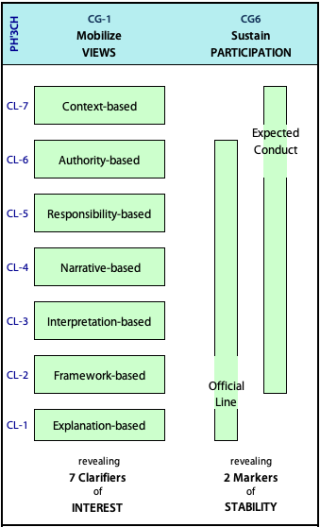
If confirms that you belong in the relationship, then adding an adjacent level of to form hexads enables .
The hexads are 2 named as follows:
How It Goes Wrong
This is where compatibility should be initially confirmed in practice. Everything may look good, but the reality of being in the relationship over time either seems to work or it just does not work.
Commitment may be given but only operate half-heartedly because of perceived inherent risks: loss of freedom, loss of opportunity, loss of options.
Commitment may be given wholeheartedly, but then betrayed because of the apparent attractiveness of an alternative relationship.
- Differentiate the CG6-markers of stability via functions, structures and concerns.
Originally posted: 6-Oct-2026.