2 Markers of Stability
Orientation
Compatibility in the relationship was established through . Because such a relationship functions as a social unit, it possesses a social identity. This identity is to be found in its system of beliefs and interactions that necessarily impact on activities and communications with others. Such a system is and should be resistant to modification because you chose to belong and you have made a commitment to it.
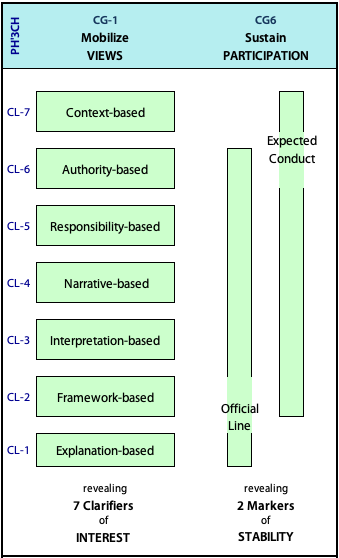
Remember: The function of is to protect the relationship and gain its benefits through willing subordination.
Individuals are different in many ways, but as a party to a relationship, it is often necessary for all to handle others in an agreed way. The goal is to preserve the relationship and prevent distortion or damage to its social identity.

Flexibility is required to handle situational exigencies, but responses and adaptations must always accord with the essential nature of the relationship or it gets destabilized and trouble soon erupts. Stability and protection of the relationship are handled in two ways:
■ adherence to the on specific matters
&
■ adherence to the in social life generally.
CG61: Official Line
The relationship may have to deal with a talking point, a core idea, a view of a happening, or an intention—where being focused and consistent is essential for all members.
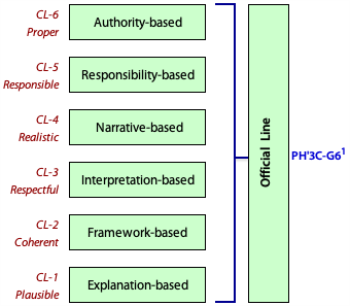
The taxonomic label is . This common function has also been called "toeing the line", "being on message", "staying on script", "sticking to the story", or "singing from the same hymn sheet".
The is always definite, explicit and settled.
Function: To enable alignment with a position that is determined within the relationship to reflect its social identity.
The parties must find a way to create a which is plausible (or it will be rejected), coherent (or it will be misunderstood), respectful (or it will offend), realistic (or it will not work as expected), responsibly owned (or it is not genuine) and proper (or it will not be deemed acceptable).
Failure:
Dissociating from the official line is called variously: "going rogue", "being off-script", "breaking ranks", "muddying the waters".
Occasional distancing or denial of the is a lapse which may be noted but forgiven. Repeated disavowal reveals a fundamental incompatibility that proves to others that you are a maverick and do not really belong.
CG62: Expected Conduct
You are a representative of the relationship and so your conduct (and that of other parties in the relationship) must in general, everywhere and always, present the relationship in accord with expectations embedded, often implicitly, in its social identity.
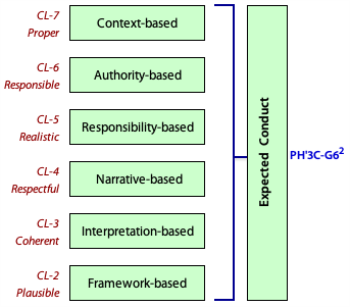
The taxonomic label for this identity-preserving function is . It has also been called "good form", "the done thing", "proper behaviour", "playing the game".
Because the context is infinitely variable, is always emergent, indefinite, and tacit. However, once there is a breach, then what was expected is commonly articulated in the process of upbraiding the offending party.
Function: To enable personal adaptation to the vicissitudes of social life in a way that maintains the social identity of the relationship.
The conduct must be plausible (or it will be rejected), coherent (or it will be misunderstood), respectful (or it will offend), realistic (or it will not work as expected), responsibly owned (or it is not genuine) and proper (or it will not be deemed acceptable).
Changes within each party and in the circumstances continually impact a relationship and the social identity will naturally evolve over time. The identity is stable but evolves slowly, in part through the accumulated conduct of the parties.
Failure:
Departing from is called variously: "letting the side down", "not playing the game", "being a loose cannon", "embarrassing everyone", "showing yourself up".
An occasional misjudgement rarely causes much damage. It will be noted and forgiven. But repeated failure to conduct yourself as the social identity requires is destabilizing. You are then proving to others that you cannot be relied upon and this suggests a fundamental incompatibility.
Summary Table
| CG6 | Stability | Function | Definiteness | Incompatibility |
|---|---|---|---|---|
| 2 | Expected Conduct | To enable personal adaptation to the vicissitudes of social life in a way that maintains the social identity of the relationship. | Emergent, indefinite, tacit (until the breach). | Due to not fitting: being unreliable. |
| 1 | Official Line |
To enable alignment with a position determined within the relationship to reflect its social identity. | Definite, explicit, settled. | Due to defiance: being a maverick. |
Transition
A compatible relationship has now been established () and applied to everyday living and working ().
Any established relationship-unit is a system whose parties desire stability and resist modification. This stability is manifested as a social identity.
However, the world changes and the parties change, so it is inevitable that the relationship itself must change. The need for change will be reflected in disagreements that can emerge anywhere, but especially in relation to , , and .
At some point, everyday disagreement will swell and metamorphose into a defining conflict. Such conflict is a sign that discussion needs to take place to adjust the relationship and restore harmony. This can only occur through good faith negotiations that lead to a new meaningful agreement.
through negotiation can be enabled by adding a seventh level to form the G7-heptad.
- Continue to Resolve Conflict (CG7-Heptad).
Originally posted: 6-Oct-2026.